
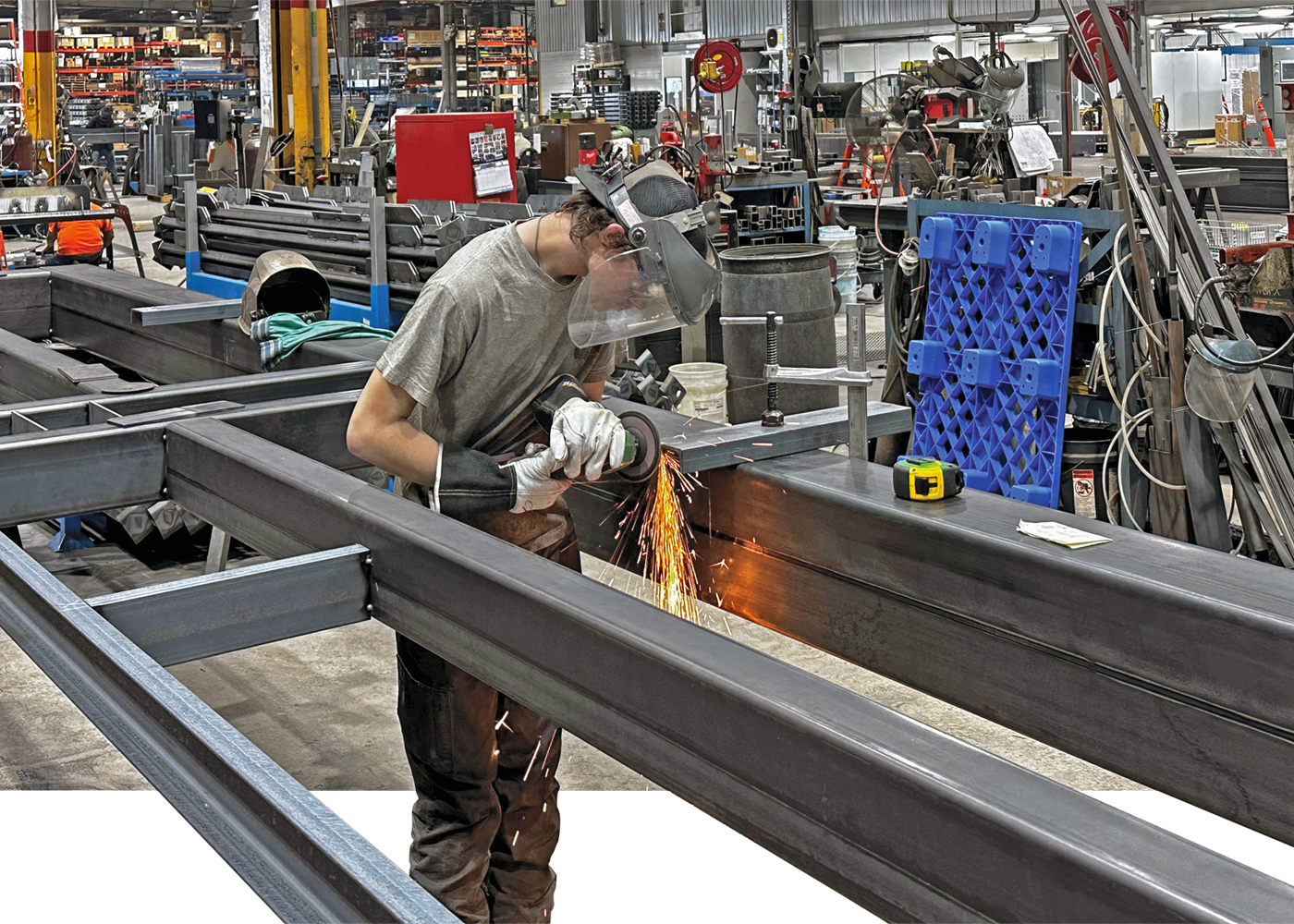

For the fourth year in a row, state enrollment in youth apprenticeship programs has seen a record high, with 11,344 students participating during the 2024-25 school year — a 14% increase from the previous school year, according to Gov. Tony Evers’ office and the Department of Workforce Development.
Nearly all (99%) of Wisconsin’s 421 public school districts with at least one high school had students enrolled in YA programs this past school year.

“I think at this point most of the schools, especially in Northeast Wisconsin, are well aware of the benefits,” says David Gordon, youth apprenticeship coordinator and career and technical education (CTE) coordinator for CESA-7, which is part of the Northeast Wisconsin Youth Apprenticeship Consortium (NEWYA).
Youth apprenticeship gives juniors and seniors the opportunity to earn school credits, wages and the chance to try out a chosen field of interest with a local company. It offers area companies the chance to train and recruit the next generation of skilled labor.
The state says 7,447 employers — also a record — participated this past school year. But some manufacturers have yet to tap into the power of youth apprenticeship programs as a talent-building pipeline.
Getting companies on board
Companies that previously had not hired under-18 workers have sometimes had to rethink those policies, and others have simply underestimated what 16- or 17-year-old workers can do, Gordon says. “That’s really a missed opportunity, because if employers are waiting for students to walk across the graduation stage before they try to recruit them, they’ve already lost the game,” he says.
Companies that are willing to adjust those hiring practices “are not going to have the same problems with talent recruitment as other organizations that aren’t willing to come to the table and find places for students,” Gordon says. “It can be a little daunting at first, but the benefit is that our services are available, and it’s at no cost.”
NEWYA exists to help companies navigate the process of onboarding YA students, and its network of school-based coaches can find students that are right for particular roles or companies. NEWYA’s business development team meets with companies, walks through facilities, talks about barriers and helps them navigate the process of finding the right candidates.
“We have a very knowledgeable team that can help companies establish protocol,” Gordon says. “We can conduct mentor training to help equip them with the tools they’re going to need to communicate with 16- and 17-year-old students.”
Once employers implement a YA program, “they quickly identify the amazing results that they’re going to get,” he says. “We see very high retention rates from our employers.”
Companies making the leap
Lindquist Machine in Ashwaubenon was one of those companies that needed to think through the process of how apprentices might be incorporated into their daily operations.

“It sounds really great — get a great young man or woman engaged in the industry, foster their education and provide an environment for them to grow,” says Josh Rolfing, vice president of manufacturing at Lindquist. But the challenge was that Lindquist is a very high-mix, low-volume shop, “so the technical skillset required is very high,” Rolfing says. “How do you get someone into this environment so that they feel successful and that we feel like we’re getting a return on our investment?”
For Lindquist, it came down to finding the right people, placing apprentices in the right spots and partnering them with the right people.
“We took a risk on a couple of young men here recently in the last couple of years, and they’ve done a great job … They both have a ‘give-me-more’ mentality, which is that once they learn and grow in one area, they want to take the next step and improve their skillset and value,” Rolfing says.
Lindquist placed its apprentices where they could perform front-end operations, such as receiving and cutting material at saw or waterjet stations and delivering it to other work centers.
The company is working with a student who recently graduated from Preble High School, as well as a student at NWTC. Wisconsin’s Registered Apprenticeship Program, which serves adults and can follow participation in YA, saw a record 17,089 enrolled apprentices last year.
Lindquist anticipates growing its YA presence, potentially with a welding student, Rolfing says.
The company understood “there’s a significant cost to the schooling and the training side,” Rolfing says. “So it’s a very long-term play, but it’s very necessary and keeping young, energized and capable talent in our work pool. So frankly, it just came down to understanding there’s a high cost, but really there’s an even higher return.”
The benefit to Lindquist is being able to get in front of the need for talent. Also, “growing our own talent gives us the opportunity to be close to how that talent is being grown,” Rolfing says. “That’s another huge component. We get to educate them culturally on what we believe is important and what drives excellence in our organization.”
Accommodating rapid growth
Therma-Tron-X, or TTX, which designs, fabricates and installs custom industrial finishing equipment and wastewater treatment systems in Sturgeon Bay, has grown significantly over the past year, starting 2025 with about 300 employees and growing to about 340, says Jake Schulz, vice president of production.

TTX started its youth apprenticeship program in 2022 with two YA students, reaching 12 in 2024. Several of those YA students have transitioned into full-time employment, filling needed roles in areas such as fabrication, plumbing, pipe fitting, electricity, supply chain, inventory or engineering.
Once a student joins the YA program at TTX, they can try roles to see what works best for them.
“I think that’s what makes TTX a little unique. We try to play to people’s strengths,” Schulz says.
TTX receives referrals for students from Lauren Baumann, a school-based youth apprenticeship coach for Door County schools. “She knows the type of talent that we’re looking for, and so we have a high rate of hiring those that she refers to us,” Schulz says.
TTX has had 28 youth apprentices, with nine transitioning to full-time employment so far, Schulz says.
“Others have gone on to school and have not come back fully yet,” he says. “We’ve seen some of them return from college and then work here in the engineering spaces over the summer.”
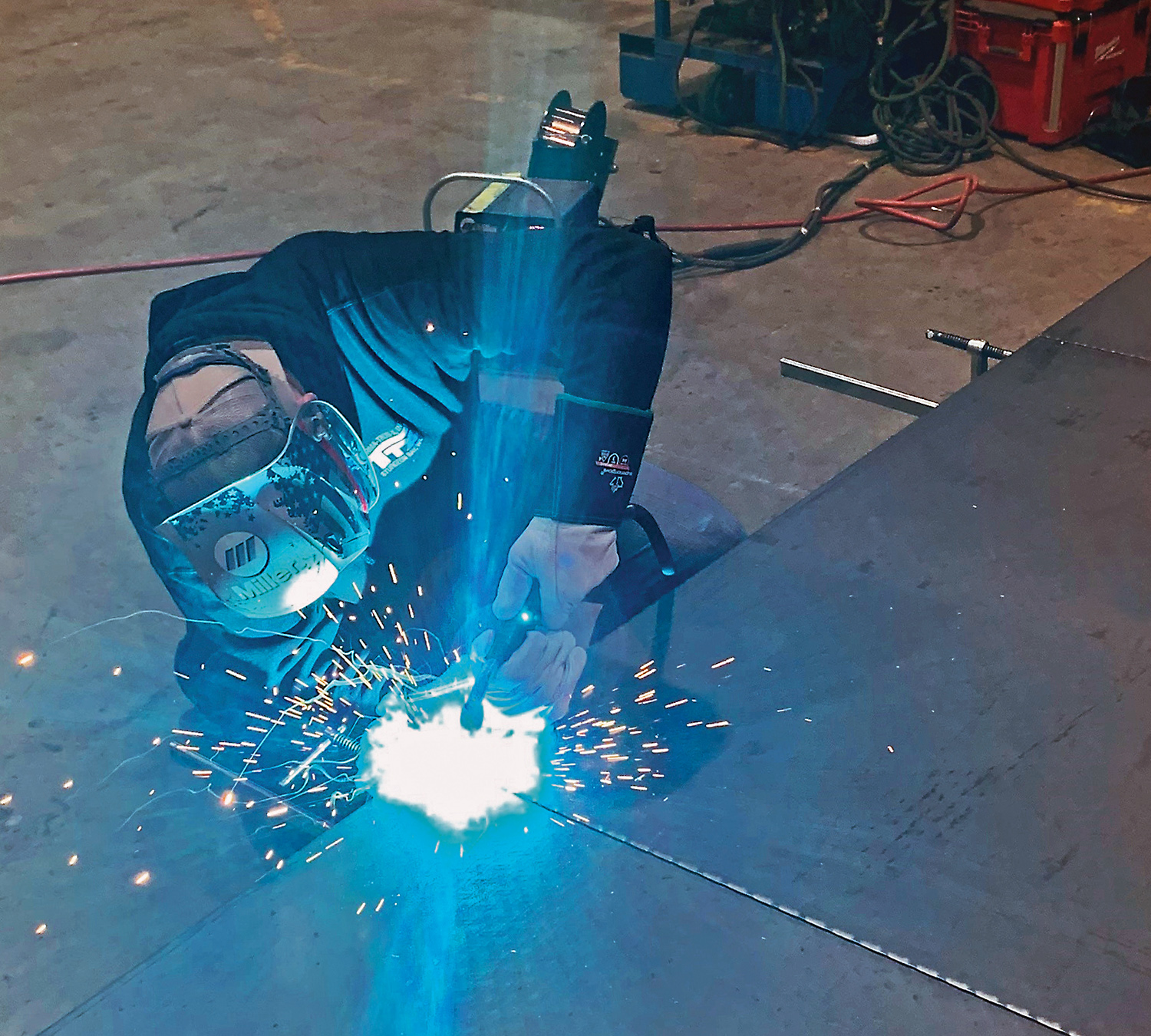
That was an effort TTX developed for a youth apprentice, Jack Konop, who started in the pipe shop and expressed an interest in welding, so he entered a training program led by TTX’s weld quality manager, Matt Goll — a former NWTC instructor.
“With that experience, it validated him wanting to go to school for mechanical engineering and design,” Schulz says. During the New Manufacturing Alliance Quarterly Meeting in June, Konop was awarded a $1,000 scholarship for a four‑year mechanical engineering program.
Another apprentice, Colton Blackley, recently passed “an extremely hard weld qualification in the 6G pipe. Adults and experienced welders will struggle with this. And he is just embarking on his senior year,” Schulz says.
Youth apprentices at TTX are matched with talented mentors who can train them quickly and effectively. “We challenge them to do real work, and it’s not helper-level work. You’ll be hard pressed to differentiate between (our youth apprentices) and a full-time employee, other than the fact that they leave to go back to school early in the day.”
Launching the program at TTX made sense as “we also had labor challenges that we were facing with increased demand,” says Schulz, who also serves on the school board in Sturgeon Bay. Helping students find their way in life is a passion of Schulz’s, whose older children grappled with what to do after high school.
Schulz’s oldest son, Isaac, is interning with TTX, pursuing a business management degree; his second-oldest son, Carter, 19, is now serving in the U.S. Air Force, but spent three semesters in youth apprenticeship with TTX. Schulz’s 16-year-old daughter, Madelyn, also is planning on going into a youth apprenticeship, though in another career pathway.
In Wisconsin, most YA participation is in health sciences careers, followed by manufacturing; marketing; architecture/construction; and agriculture, food and natural resources.
“I would encourage any organization that is not currently doing youth apprenticeship should find a way to start doing it,” Schulz says. “It’s both rewarding and worth it personally and professionally to see the next generation start to take the reins on their life.”
Why YA is growing overall
One of the reasons YA is seeing a boost in participation is that students themselves are becoming ambassadors, Gordon says. “It grows through word of mouth on the value that the experience brings to students, both in helping them explore different career opportunities, but also to solidify their objectives for after they graduate from high school,” he says.
One of the benefits students are sharing is that companies are supporting many of them with some post-secondary expenses after they graduate, Gordon says.
More companies are seeing YA as a viable option for building their talent as baby boomers leave the workforce. School districts are incentivized to build opportunities, receiving grants for each YA student that help them to further sustain and build CTE programming, Gordon says.
The rapid expansion of youth apprenticeship, however, “has really exhausted the Wisconsin state budget for youth apprenticeship,” Gordon says. Currently there’s $10 million allocated by the state to support YA statewide, he says. “Our grant is funded on a per-pupil basis, and consortia across the state expect $1,100 per student to create a program that has outreach and support.”
But this year, the Wisconsin Department of Workforce Development was not able to fund consortia at the full rate.
“As impactful as this is, consortia and school districts are going to have to make some really tough decisions because there’s just not funding available,” Gordon says.
Gordon says increasing state funding for YA programs will ensure that this is still a viable option for students. Youth apprenticeship students from NEWYA alone will earn more than $10 million in wages, he says.
“That doesn’t take into account the post-secondary training costs that are covered, wages that will continue after they graduate, so the return on investment is strong,” Gordon says. “The experiences are strong, the schools are excited, the employer partners are excited. So an increase in that state funding is really critical in us being able to continue this work.”