

By Kate Bruns
For each of the last 12 years, the NEW Manufacturing Alliance’s Manufacturing Vitality Index has provided key insights that have guided the organization’s work and directed resources toward needs in the 18-county New North region. Working in partnership with the University of Wisconsin-Oshkosh Strategic Research Center, NEWMA’s 2022 study paints a picture of strong financial optimism tempered by significant workforce and supply chain challenges.
Both primary challenges are universal, particularly the supply chain issues spurred by the ongoing global pandemic. But NEWMA Executive Director Ann Franz says Northeast Wisconsin is as well-positioned as any region to tackle them.
“With our long, strong history of manufacturing, we have more people engaged than in most areas of the country — our focus, our heritage, our colleges investing in manufacturing degrees, engagement from K-12 tech ed programs and the overall importance of manufacturing to our economy,” Franz says.
And while workforce and supply chain are the headlines to this story, there’s certainly more for manufacturers to consider as we look to 2022. Here are 22 insights and issues to watch:
1. 96% of New North manufacturers reported supply chain disruptions in 2021.
When it comes to supply chain issues, everyone’s in the same boat — stuck sideways in the Suez Canal. The voyage ends with increased costs and lead times for companies that are just trying to fill orders and meet demand.
Tim Wiora, CEO and executive director of Madison-based WMEP Manufacturing Solutions, says 2022 is a year to focus on “controlling what you can control,” and supply chain is a problem beyond most organizations’ control. He says some larger organizations with engineering departments are working to reengineer products around the availability of materials, but that isn’t realistic for most small-and medium-sized manufacturers.
2. It’s time to rethink “just in time” inventory strategy.
Franz says companies are not getting what they need “just in time,” so many are buying excess inventory. And some are outsourcing work. “I know some companies are definitely reanalyzing ‘just in time,’” she says.
“They’re doing the ‘just in’ and waiting for the ‘time’ part of it,” Wiora adds, laughing. “It has definitely taken on a new meaning.”
3. Supply chain bottlenecks: “It’s as simple as a nail.” In 1990, the United States manufactured 37%
of the world’s semiconductor chips. Today that number is just 12%, making computer chips the rightful main character in the nation’s supply chain saga. In December, news organization Axios hosted a panel discussion about manufacturing issues, and U.S. Sen. Debbie Stabenow of Michigan called the semiconductor chip shortage a “wakeup call that we need to be making things in America.”
But Franz says it isn’t just semiconductor chip shortages affecting companies in the New North, noting that she recently spoke with a pallet company that was struggling to procure something distinctly lower tech. “It’s as simple as a nail,” she says.
4. Manufacturers feel financially healthy in the new year.
Despite supply chain slowdowns, it’s overall a great time to be in manufacturing. And in Northeast Wisconsin, 98% of respondents to the NEWMA Vitality Index said they expect a financially healthy 2022. Eric DeKorne, who manages business retention and expansion efforts for the Greater Green Bay Chamber, says demand is not the issue for most manufacturers he visits.
“It’s not like a recession where everything pulls back,” DeKorne says. “The demand has stayed high.”
5. 2021 was a year of strong sales, with great expectations for 2022.
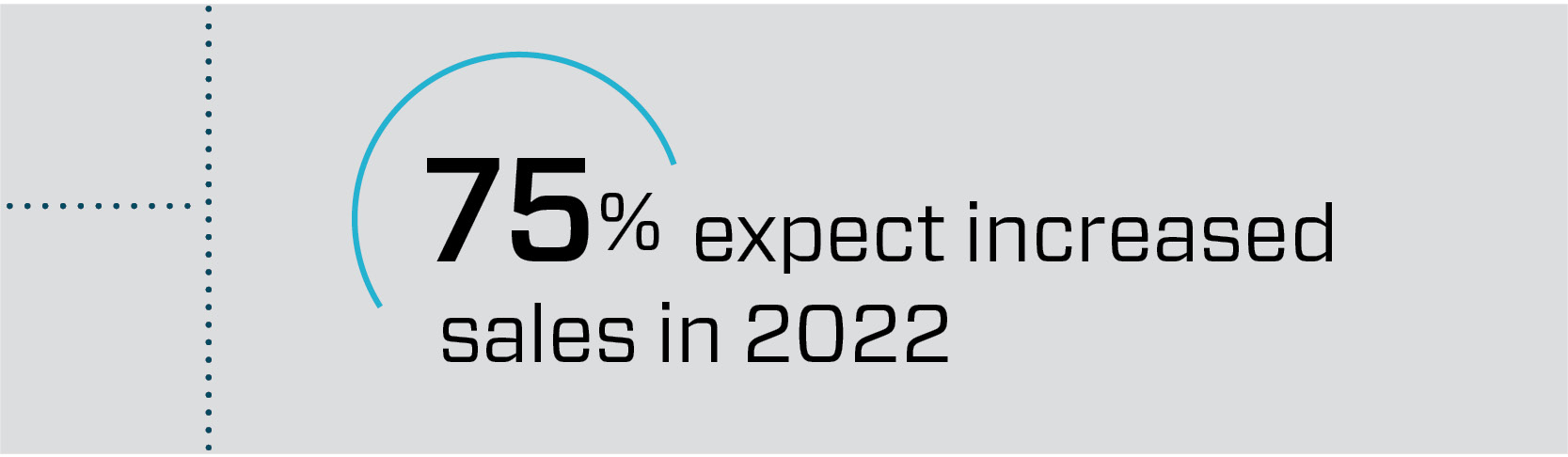
After only 40% of New North manufacturers reported increased sales from 2019 to 2020, the most recent reporting year shows things are looking up, with 77.2% of NEWMA Vitality Index respondents reporting increased market share and 70% reporting increased sales in 2021. In addition, 75% of survey respondents expect increased sales in 2022.
“ … but now that skills gap has morphed into a population gap. It’s just a numbers game.”
Nick Novak, Wisconsin Manufacturers and Commerce
6. The newest question mark for manufacturers: inflation.
U.S. economic recovery has led to surging inflation in the new year, with prices on everyday goods reaching a 39-year high. It’s a new concern that has found its way to the top of many Wisconsin manufacturing leaders’ minds in the last two months, Wiora says. No two economists agree on the severity or potential duration of the phenomenon, but in the meantime, manufacturers have added inflation concerns into their already-complicated pricing mix.
7. COVID-19 isn’t going away.
Seventy-two percent of Wisconsin manufacturers surveyed by WMEP Manufacturing Solutions for its 2021 Wisconsin Manufacturing Report
said COVID-19 has had either a major or modest impact on their business since 2020. While some impacts were positive, the majority fell into the negative category. Newer and smaller manufacturers were hit hardest.

8. Most manufacturers are bearish on vaccine mandates.
With the federal government’s on-again, off-again large employer vaccine mandate looming, manufacturers nationwide are grappling with an unvaccinated workforce. The Sikich Industry Pulse survey of manufacturers published in November indicated that only 16% of manufacturing workforces nationwide have vaccination rates greater than 80%, and multiple state and national surveys have found that most employers are not inclined to implement companywide vaccine mandates, regardless of federal action.
Wiora says some Wisconsin companies that are close to 100 employees are cutting back on workforce to stay under the large employer mandate threshold, some are stockpiling tests and adding HR staff to administer testing of unvaccinated workers, and many are still taking a “wait and see” approach.
9. Modernization is on the move.
With COVID-19 exacerbating labor shortages in plants across Wisconsin, manufacturers are picking up their pace of technology adoption and modernization. The 70% of NEWMA Vitality Index respondents reporting plans to invest in modernization this year is the most in the study’s 12-year history. Workforce is the biggest driver of the uptick.
“COVID forced a lot of remote work and is bringing on the digital age faster,” DeKorne says. “Companies are speeding up their transitions to Industry 4.0 practices.”
10. No, the robots are not taking over the world.
But, Franz says, they will increasingly be the solution for manufacturers struggling to hire. In turn, this will create demand for individuals with electromechanical skills.
11. Manufacturers need room to grow.
According to the NEWMA Vitality Index, 35% of Northeast Wisconsin manufacturers plan to expand in the next 12 to 24 months. Increased demand and the growth of e-commerce are major drivers. In fact, the commercial real estate company JLL estimates that the U.S. will need a whopping 10 billion square feet of additional warehouse space in the next five years to keep up. It’s an issue in Northeast Wisconsin.
“We don’t have a lot of empty industrial manufacturing warehouse space available in our region, so businesses may not be able to quickly expand like they might need to due to this increased demand,” DeKorne says.
12. Growth means hiring.
The NEWMA Vitality Index shows that 56.8% of respondents need to hire workers in the first quarter of 2022. That number increases to 58% in Q2 and 65.5% for the remainder of the year.
13. Good help is hard to find.
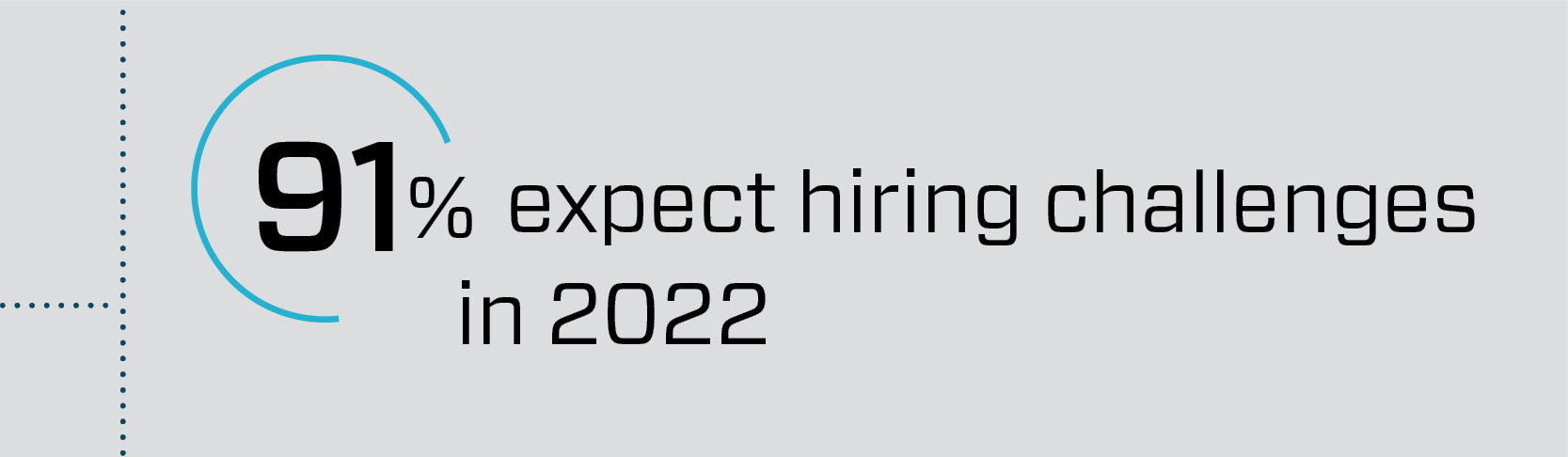
In the NEWMA Vitality Index, 91% of respondents said they anticipated difficulty finding talent in 2022. Franz says this is the most in the history of the study, which is especially alarming given that workforce shortages are a statewide problem that predates the pandemic.
“We simply need more people in Wisconsin,” says Nick Novak, vice president of communications and marketing for Wisconsin Manufacturers and Commerce. “Coming out of the Great Recession in 2008 and 2009, the economy was rebounding, and Wisconsin manufacturers reported they were struggling to hire people with the proper skills, but now that skills gap has morphed into a population gap. It’s just a numbers game.”
14. Employee referrals and external job sites are top sources of new workers.
With talent attraction as a major emphasis, respondents to the 2022 NEWMA Vitality Index said employee referrals and websites like Indeed were still their top resources for job candidates. Competition for workers is increasing rapidly. Novak says the state has 50,000 candidates for 100,000 job openings.
15. Continuing to connect with schools, colleges and universities is key.
“Manufacturers simply need to get more involved in our local schools, our technical college system and our universities to make sure (students and educators) know what the business community needs,” says Novak, who points to AriensCo in Brillion as a “shining example” of a manufacturer in the New North that has partnered successfully with K-12 education.
16. Machinist roles remain the toughest to fill.
Throughout the years, NEWMA Vitality Index respondents have consistently listed machinists/CNC machinists as the most difficult-to-fill occupations.
“Companies are speeding up their transitions to Industry 4.0.”
Eric DeKorne, Greater Green Bay Chamber
17. It takes more than technical skills.
More than half of the respondents to the 2022 NEWMA Vitality Index said communication skills and attendance were the soft skills in which employees were most deficient.
18. Culture is now nearly as important to prospective workers as salary.
While salary and benefits are always important in attracting employees, experts say the COVID-19 pandemic has led to changed attitudes about the importance of workplace satisfaction.
“You can probably drive down I-41 and see multiple billboards advertising $15 an hour,” Wiora says. “Well, money is a part of it — but culture is a bigger part of it. The way to be competitive in the market right now is to really have your culture well-defined and well-displayed.”
19. Collaboration is key in solving Wisconsin’s workforce challenge.
“Instead of stealing from each other, (WMC thinks) it’s important for the state to do a coordinated effort,” Novak says. “We have a very intensive manufacturing economy with supply chains throughout the state, so bringing people to Waupaca Foundry, for example, benefits not just Waupaca but other counties in the state. A big piece of this puzzle is making sure our efforts are statewide.”
20. The hackers had a head start on working in their pajamas.
COVID-19 has affected industries where people go to work, but Wiora says one group of “remote workers” that didn’t miss a beat during the pandemic was hackers. In the WMEP 2021 Wisconsin Manufacturing Report, one in six Wisconsin manufacturers said they had been hacked or experienced a cybersecurity breach of some kind.
21. Hope is not a cybersecurity strategy.
Wiora says WMEP conducted focus groups in creating its 2021 Wisconsin Manufacturing Report and heard the word “hope” more than once as executives discussed the cybersecurity controls they have in place, leading the WMEP report to describe Wisconsin manufacturers as “overconfident aboutcybersecurity.”
“If you look at the commentary, most people are saying, ‘Yes, we have a strategy and we hope it works.’ It’s not a focal area for them, and hope is not usually a strategy,” Wiora says.
22. Challenges have forced leaders to work in, not on, their businesses.
Wiora says a side effect of the pandemic and its related challenges has been, especially for smaller manufacturers, working “in” a business instead of “on” a business. According to the WMEP 2021 Wisconsin Manufacturing Report, half of the state’s companies have a formal strategic plan for growth and most small manufacturers (66%) do not.
“Are you planning for the future or are you just getting by? You need to blend the two right now, because in my opinion, we’re still looking at a future with not enough workers,” Wiora says. “So how are you going to do things differently to meet your customer demands, stay profitable and potentially grow?”
In Demand
Machinist ($23.30/hr)
Assembly ($20.60/hr)
General Labor ($16.80/hr)
Industrial Maintenance ($28.52/hr)
Machine Operator ($20.04/hr)
Engineer ($39.21/hr)
Welder ($22.95/hr)
Skilled Tradesperson ($29.87/hr)