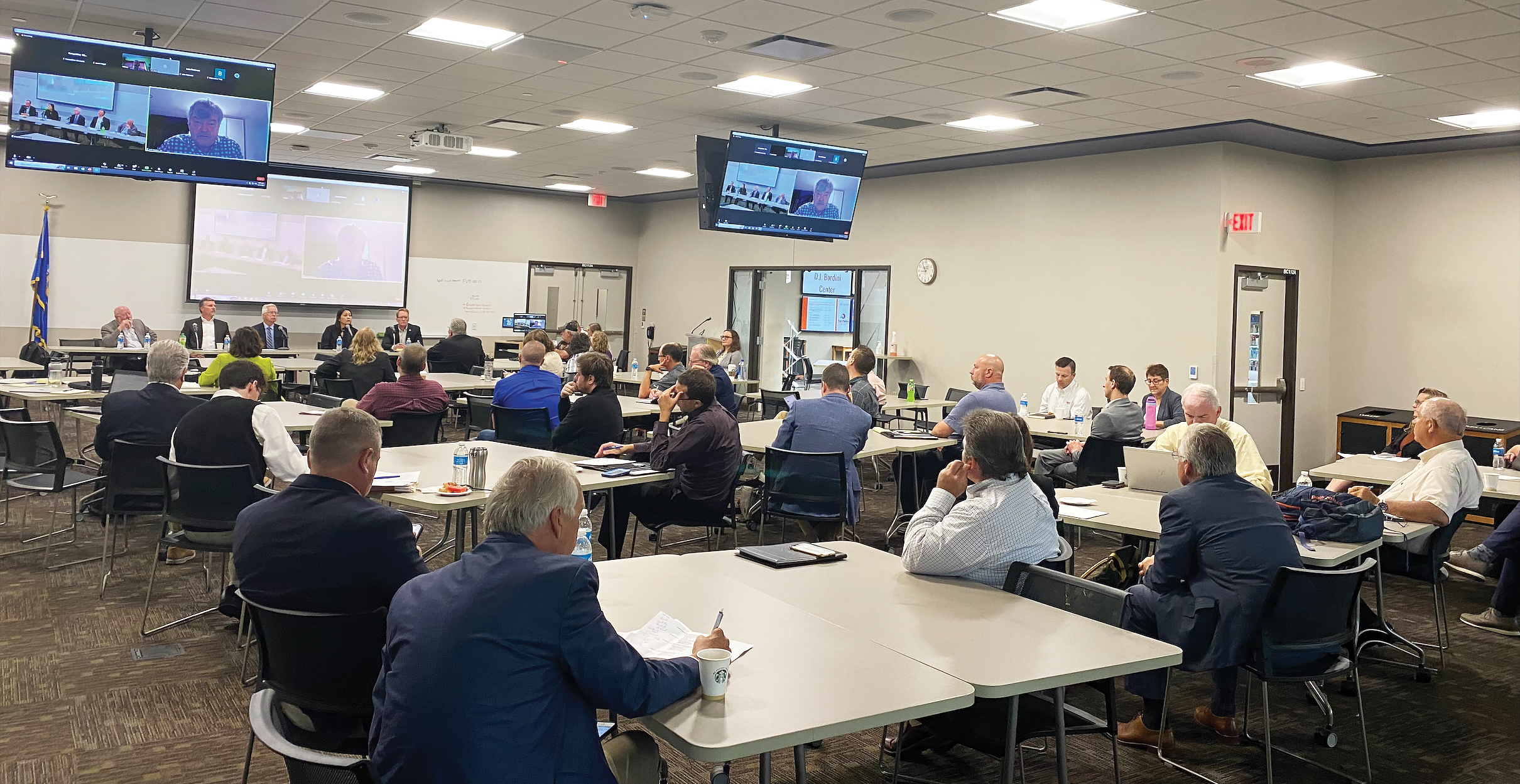

On Aug. 23 community leaders convened at Fox Valley Technical College in Appleton for the Wisconsin Tomorrow Broadband Action Accelerator, a morning-long conference hosted by New North, Inc. and the Madison-based business coalition Competitive Wisconsin, Inc.
Barbara Koldos, vice president for business development at New North, Inc., joked that she earned the nickname “Broadband Barbara” after leading her organization’s 18-county broadband study alongside Jack Maytum of the Virginia-based consultancy Design Nine. Koldos says the project involved 72 meetings with stakeholders over the course of just three months; a final report was issued in May.
The study took a two-pronged approach, Koldos said, including a physical survey that was delivered to households across the region as well as a speed test and asset mapping effort that moves beyond what she described as historically unreliable census tract data.
Maytum and fellow panelist Rory Tikalsky, broadband expansion manager for the Wisconsin Public Service Commission, praised the New North’s collaborative, regional approach to the issue, noting that it will accelerate timelines and leverage county resources more effectively. And while it’s a massive undertaking, it’s one that simply can’t be ignored.
“Society is essentially saying this isn’t a luxury anymore,” panelist Mark O’Connell, president and CEO of the Wisconsin Counties Association, said. “It’s a necessity.”
Federal solutions, regional efforts
Tikalsky said Wisconsin can expect to receive about $65 billion of the funds designated in the federal infrastructure law for broadband allocation; current plans are to use funds for increasing digital equity and for developing a “middle mile” program.
In order to receive those funds, Tikalsky explained, the state must present a plan for getting everyone in Wisconsin to a speed of 25 megabits per second download and three megabits per second upload in the next five years.
“That’s the structure the federal government has given us,” he said. “We’re doing everything in our capacity … to develop a plan to meet that goal. But the funding only comes if we have good maps.”
Documenting a problem is the first step toward a solution, agreed Brown County Broadband Director August Neverman.
“If you have a map, you can solve a specific problem,” Neverman said, adding that it goes beyond just individual location connectivity. “You’re also solving 911 problems, zoning, business parks, school districts, fill in the blank.”
Furthermore, understanding coverage needs — including types of coverage needed — is critical in rural locations like Door County, where Community Broadband Coordinator Jessica Hatch says fiber is the only viable solution because the preponderance of trees prevents wireless access from being effective.
Meeting in the middle
After we know where gaps are, next comes the challenge of how to fill them.
Conference panelists offered opposing viewpoints on how the state can create a reliable “middle mile” — the physical, central pipeline for distributing internet service that was an emphasis of the New North study.
Bill Esbeck, executive director of the Wisconsin State Telecommunications Association, said much of Northeast Wisconsin is already served because of companies such as Bug Tussel, Charter Communications and Nsight Telservices. He called additional middle-mile investments a “colossal waste of money.”
Bob Webb, vice president of IT services and innovative technical operations at Nsight, says public/private partnerships are key in the effort of connecting all of Northeast Wisconsin, but he agrees with Esbeck that the New North report didn’t fully capture all existing capabilities — though the omission was understandable, given the project’s complexity.
“Focusing solely on middle mile is like building a highway without off-ramps and roads to the houses and businesses located off the highway,” Webb told Insight. “Counties and town governments should seek partnerships with their local providers to incorporate existing networks, utilize available funding and foster quality partnerships to bring broadband to their communities.”
Keeping on the event theme of “knowledge is power,” Tikalsky closed out the conference by encouraging counties to stay energized and stay in communication with the PSC’s Wisconsin Broadband Office.
“We want to hear from you,” he said. “Give us your data.”