
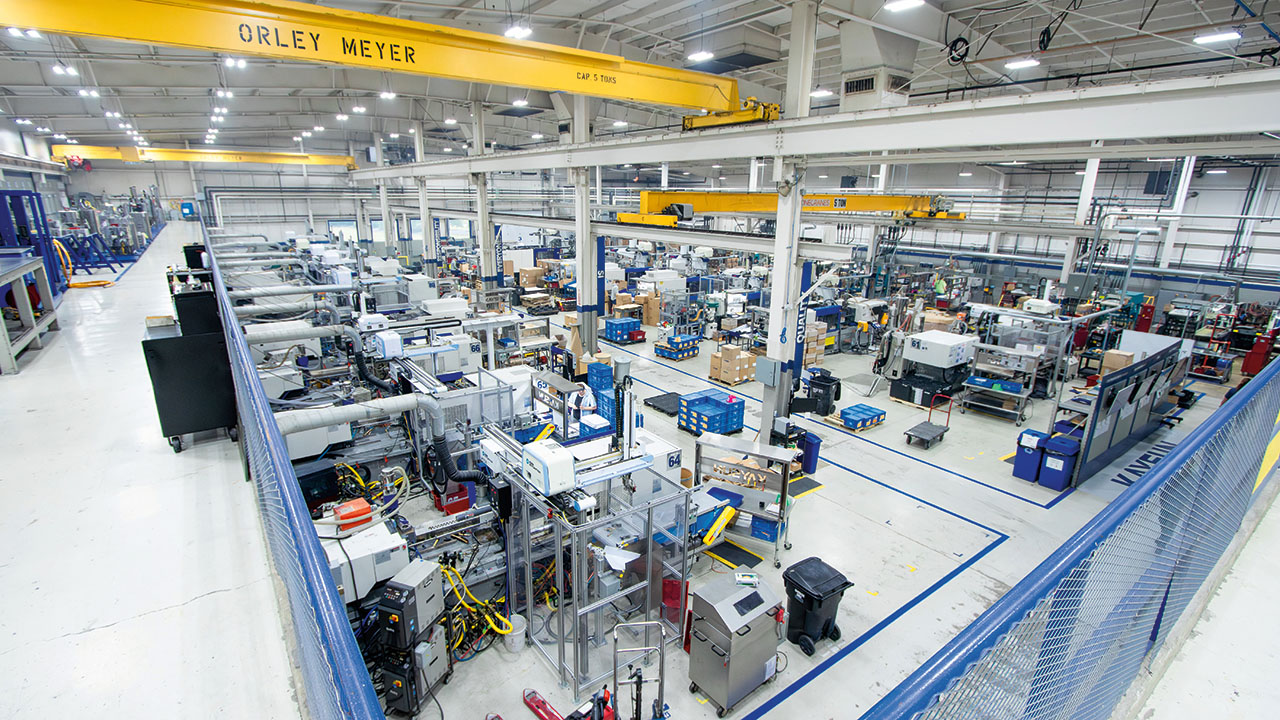

As the political tensions escalated around the Strait of Hormuz, Heather Kinzel kept an uneasy watch like a military planner.
The Middle Eastern waterway is a major supply route for plastic resins and the feedstocks used in the production of injection molded plastics, including at Manitowoc‑based Kaysun Corporation, which produces an array of precision injection molded components for multiple industries. Losing that volume could be catastrophic.
Kinzel anticipated panic and volatility in the market as manufacturers looked for alternative suppliers, a task that took weeks in the past. Kaysun has integrated AI tools into its procurement processes, a move that allows Kinzel and her team to work proactively and present a plan that would minimize supply disruption and mitigate any downtime that could affect delivery.
What in the past might have taken two weeks was done in six hours.
“I was able to collect that critical data and build a detailed risk assessment tool that identified potential suppliers,” says Kinzel, Kaysun’s director of purchasing. “I was able to find and include information on some of the price volatility not related to the crisis and push back on suppliers and actually get some price reductions.”
AI’s impact on procurement
As manufacturers roll out AI into their supply chain and procurement operations, the trickle has become a torrent that can flip their world view — if they have the tools and personnel in place to take advantage of the enhanced vision.
Traditionally, manufacturers have placed more strategic emphasis on delivery over input, focusing on the last‑mile challenge of obstacles and inefficiencies for delivering a finished product to the customer. That process can consume as much as 53% of logistics costs, even though it is the shortest distance in the journey.
As a result, back‑office activities such as procurement received less strategic emphasis and were often positioned as cost‑cutting operations. Procurement teams often face additional hurdles that mute their strategic inputs, including a lack of supplier visibility, disparate data systems, delayed data reporting and coordination bottlenecks.
AI tools are quickly flipping that script. With the power to analyze vast amounts of data across various systems, AI tools can detect critical inefficiencies, supplier risks and anomalies in the supply chain in real time. Add in the ability to augment those findings with historical sales data, real‑time logistics information and external environmental factors, and procurement teams in the first mile now find themselves in a position to play a much greater strategic role.
“Many manufacturers are in a time of transition,” says Jen Fietz, owner and chief executive officer of Stoke RGA. “If you can manage the data that will be produced, it will take you to a new level. Those things you used to have a gut feeling about but had to wait for confirmation on — now you are going to have the confirmation you need to take action immediately.”
Preparing people and data
One of the keys, Fietz says, will be having people in place with the skills to manage the data and draw the appropriate conclusions.
It’s not replacing people, she says. It’s redefining what they do and unleashing them to be much more involved in their company’s strategic operation.
“It’s more than just developing an option B. AI gives supply chain managers opportunities to develop options B, C and D,” Fietz says. “Now it can be about scenario planning, understanding the bigger picture of the organization and what’s ahead, as well as developing strategies to help get there.”
AI tools allow Kinzel’s team to connect data faster and validate information, so recommendations can be made earlier.
“But it’s still only a tool,” she says. “You still have to know what you are looking for and check your facts.”
An AI rollout with poor data sources or ill‑trained employees can produce worse than bad results for a company — it can be downright risky, says Ovetta Sampson, founder and owner of Right AI, an enterprise AI consultant who has advised some of the world’s largest companies on how to maximize their deployment of AI technologies.
“You can have the most sophisticated tech stack in the world, but without good data and established accurate data pipelines set up to feed your models, your AI‑enabled systems will be useless,” Sampson says. “Data is the love language of AI. One of the biggest challenges to engineering supply chain management is accessible and accurate data.”
AI opportunities
Companies are rapidly accelerating their financial commitments to artificial intelligence, with global corporate AI spending expected to reach a staggering $2.59 trillion globally, according to a 2026 AI statistical report by planning firm Upmetrics.
While user‑facing tools get public attention, MIT research highlights that back‑office operations deliver the highest returns relative to investment. An estimated 88% of organizations now use AI in at least one business function, up from 78% in 2025.
About 29% of manufacturing firms reported using AI or machine learning at scale, including procurement operations to plan supply chains, according to Deloitte’s 2025 Smart Manufacturing and Operations Survey of 600 executives.
Worldwide companies such as Nike, Grupo Bimbo and Starbucks have spent tremendously on AI systems to help manage final delivery to the customer. They have struggled on the procurement side, Sampson says, often because they are trying to stitch together a wide array of suppliers with varying levels of data sophistication, including some who still provide manual data entry.
Sampson says many of these companies are known for having some of the most sophisticated data systems at the retail end of their operations, yet they still struggle with suppliers that consist of small manufacturers based in multiple countries around the globe. Real‑time collection that produces consistent, repeatable and actionable data is difficult, but it is necessary to create an accurate system that can give companies reliable data for that decision making.
While complicated, Sampson does see procurement as an ideal integration use case for AI, as long as companies can get the data right. Though it is not without risks.
“The increased data collection needed to power AI enabled experiences can also lead to IP and potential moat erosion,” she says. “The models are hungry for data and they have no moral code. If you’re using AI systems that you didn’t build, you’re trading your business data for efficiency. Your moat is your data, not your products.”
The power of AI will also create another new opportunity for procurement and supply chain managers — time.
“What that time does is amplify the shift to strategy,” Fietz says. “You get a chance earlier in the process to evaluate and make decisions on that critical information.”

