
By Nikki Kallio
Manufacturers already know they need to make an extra effort if they’re to find employees to fill open positions — it’s no longer simply about offering great pay or benefits, but about catching an applicant’s eye.
But figuring out what that means can sometimes be tricky.
NEW Manufacturing Alliance Executive Director Ann Franz says employers are looking for new ideas, which is why NEWMA hosted a special Manufacturing Month kickoff event on Oct. 1 focused on talent. Representatives from Sargento, Elevate97, AriensCo and CMD Corp. shared the innovative ways their companies are finding (and keeping) the people they need.
“I’ve been hearing from so many companies about their concerns around hiring and retention,” Franz says. “We have at our fingertips 200 companies, some of which are doing some really cool things to attract talent. What’s really exciting is the companies are willing to share their best practices.”
Each of the featured companies has different strategies to offer participants. For example, AriensCo has created features to meet employee needs such as adding a day care. CMD Corp. will share how its focus on employee well-being has allowed the company to achieve a Best Places to Work rating within the plastics industry, Franz says.
It’s one of the worst times ever to find talent, and manufacturers are recognizing that offering work-life balance is key, Franz says. “We are finding that there is a workforce that many companies are not considering — that’s part-time employment,” she says.
Programs such as Earn & Learn, launched by NEWMA’s K-12 education task force, connects graduating high school seniors who want to work part time with area manufacturers that offer tuition reimbursement while they attend college.
Investing in education
Sargento Cheese is one company embracing part-time work through developing a progressive talent initiative focused on students. It offers flexible general production positions for students who want to work part time while attending school full time, says Anne Troka, community engagement manager for Sargento.
Sargento has more than 50 paid student positions, including college students in internships and co-ops, and high school students in youth co-ops and youth apprenticeships, she says. Sargento partners with Lakeshore Technical College and CESA 6 on its youth apprenticeship program and with Inspire Wisconsin on the high school youth co-op program. The company is looking to fill positions company-wide, with the priority on production roles.
“So much of what my work focuses on is future talent,” Troka says. “I look at our teams and what the needs are going to be that our company has in each of our different departments or teams over the next one to three years. And we focus on both entry-level and experienced positions.”
Students receive guidance from mentors, who are coached by company leaders to work with the students. At the end of their experience, which is usually between nine and 12 weeks, students complete interviews about their experience and the skills they gained.
“Based on that feedback, we’ve had great success,” Troka says. “Because we really look for the win-win, something that benefits Sargento and at the same time equally benefits the student.”
In addition to a wide variety of benefits (including free cheese in the lunchroom, naturally), Sargento continues to support employees in their personal and professional growth.
“We have a great tuition reimbursement program, which is especially attractive to anyone who wants to continue to grow and kind of be that lifelong learner at our company — that’s really valued,” Troka says.
The benefit, which can be used for any area of interest — not only those directly applicable to the employee’s role — is available to all employees, including those general production student employees, after 90 days of employment.
Bobbi Miller, business services manager at the Fox Valley Workforce Development Board, says exposing students to manufacturing careers in this way can help develop relationships that culminate in long-term employment.
“A lot of students have no concept of what manufacturing really is,” Miller says. “So having companies getting engaged with those career days at school, providing subject matter experts, speakers that will go in the classroom and maybe do a project with students, I think that’s a really good first step just around exposure.”
Once they’re in a manufacturing career, young workers also want a pathway to growth, upskilling and contribution to the company.
“This generation really wants to be seen and heard — they want to have a contribution that is really important, so taking their ideas and really moving forward with some of those, I think, is an excellent way to make somebody feel like they’re valued,” Miller says.
Some company leaders also recognize the benefit of removing barriers to employment — such as age or education requirements. In an employee’s market, companies need to reevaluate those standard “musts” for the role — such as a bachelor’s degree and five to 10 years experience.
“These are all things that instead of inviting people to apply into your workspace, they’re deterring them, they’re weeding them out,” says Karen Sinette, director of people experience at Elevate97. “It’s no longer, ‘Post it and they will come.’ I think you have to make your job ad a differentiator.”
For example, Elevate97 embeds videos so potential workers can see both the job and the workspace, which the company has made a point of making attractive. “You can see the look on people’s faces in a video and you can see the work that they’re doing,” Sinette says. “I also think it’s important to make your job ad really tell your story.”
It’s no longer enough to simply post a list of benefits. “People assume you have the standard package,” Sinette says. “They want to know, ‘what else?’”
Miller points out the new generation of workers expects a different experience at work than their parents or grandparents — they believe it should be enjoyable and even fun. “So what are the things that you’re building in that make it appeal to them in that way too?”
Additionally, some companies have transitioned to more flexible hours or eliminated swing shifts in favor of a straight eight-hour day — even in traditional manufacturing environments. That’s reflective of the market and what kind of conditions workers are seeking, Miller says.
Sinette says Elevate97 has compressed workweeks, will consider job sharing and offers a “hot desk” program for those who work from home but want to come in for collaboration.
“Honestly, it’s not a big deal how it gets done as long as it gets done. We have had flex work in place well before COVID,” Sinette says. “I really believe that employers need to take a step back and just figure out if the work’s getting done or not and loosen the grips on some of these policies.”
That might mean allowing workers to have their phone and earbuds with them on the floor.
“Think about the things you have in place at work that could be a barrier and get rid of the barrier if you can,” Sinette says.
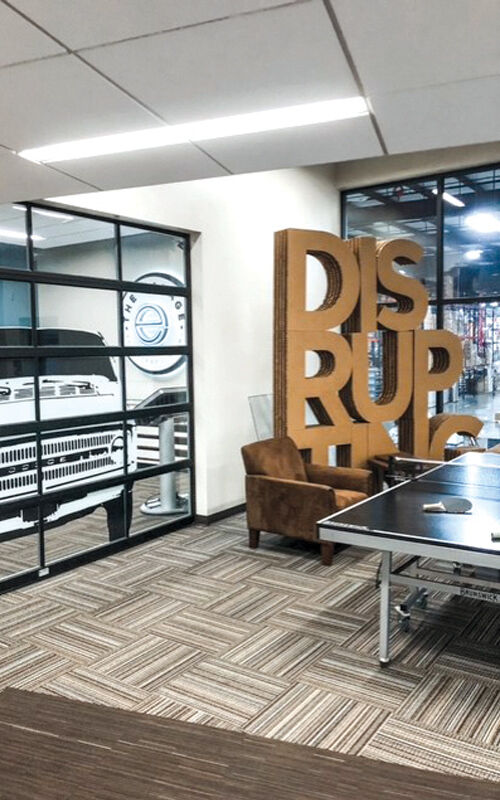
Elevate97 also creates an environment that’s appealing, including a guitar and ping-pong in the break area, wellness and game competitions, a book club, chili cookoffs and a garden. It’s part of what the company does — creating environmental or experiential graphic design for corporate environments, in addition to producing exterior signage and continuing its legacy business as a fulfillment company of marketing materials.
As such, it has a range of workers, including welders, fabricators and painters, and is actively seeking material handlers and installation team members.
“The key to retention is time and attention on your employee,” Sinette says. “They want to be cared for; they want to know you’re listening; they want to get the feedback. They want to be part of something … If you don’t have relationships at work, there’s nothing keeping you there. You’re going to look somewhere else.”