

Jay Stulo has been with Fox Valley Technical College for 18 years, and this summer he took on a new challenge: serving as the institution’s first-ever director of AI strategy.
It’s a job title that’s becoming more common in organizations, he says, as the need to gain AI literacy, track AI trends, vet opportunities to adopt AI tools and plan for the future becomes more pressing. Manufacturers avoid it, he says, at their own peril.

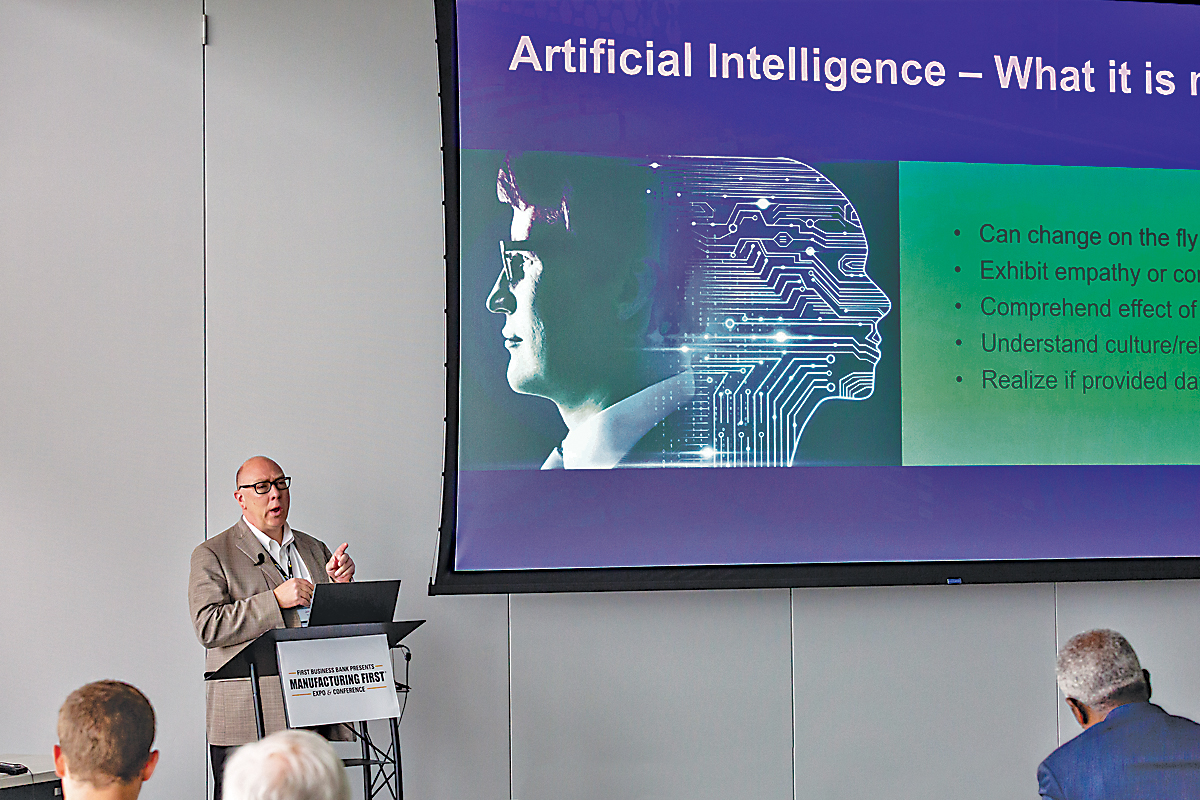
It is with this in mind that Stulo and his colleague, Mike Race of Northeast Wisconsin Technical College, will present a breakout session Oct. 30 at the 2024 Manufacturing First Expo & Conference entitled “Harnessing AI in Manufacturing for Enhanced Data Analysis and Process Efficiency.” Stulo says his goals for the session include encouraging manufacturers to get started with AI, even if it’s something small.
The power of AI for data analysis is a key feature Stulo plans to highlight in the session. The manufacturing floor is swimming with large data sets that AI has the ability to analyze, even responding to natural language questions.
“You could have temperature levels, humidity levels, quality control … AI can start to identify trends and patterns a person may not be able to spot,” says Stulo, who adds that FVTC is piloting a data analytics project of its own, which he says will eliminate the need of faculty and staff to jump into long queues to request reports.
Mo Abuali, a 2023 Manufacturing First speaker and senior digital director at Wipfli, says he is watching five AI trends in the manufacturing industry. He outlined those five trends on a recent episode of Insight’s and the NEW Manufacturing Alliance’s NEW Manufacturing Insights podcast. Many are tied directly to data analysis, including industrial machine learning, scheduling and forecasting, and sustainability and ESG (environmental, social and governance) reporting.

“Industrial machine learning is a good entry-level use case to transition into Industry 4.0,” Abuali said on the podcast. “Industrial machine learning has the ability and the tools and the data to capture real-time data from the factory floor and transform that data into metrics and KPIs to run the business in a more real-time fashion.”
Among the benefits are predictive maintenance, improved scheduling and process optimization, all of which could ultimately translate to the holy grail of “zero down time and zero defects,” Abuali shared. He said companies can also add “zero waste” to the equation by leveraging AI analytics. He said there are a number of use cases for reducing energy consumption and carbon footprint as well as improving ESG ratings.
“In some states there are mandatory [ESG] compliance rules, so capturing that data from the machines and facilities allows you to automate the way you’re doing the reporting, allows you to be more compliant,” Abuali said.
Generative AI rising
Generative AI is perhaps the sexiest of the five trends Abuali highlighted on NEW Manufacturing Insights, where he explained that it has become one of the fastest areas of growth because sensors and graphics processing units are getting cheaper as computing speeds get faster, making them more accessible technologies for manufacturers to adopt.
Examples of generative AI include OpenAI’s ChatGPT and Microsoft Copilot, as well as chatbots that are being widely leveraged for customer service — including at FVTC, where one of Stulo’s first duties as director of AI strategy has been piloting both an HR chatbot and a student chatbot to help answer common questions and help FVTC constituents navigate the college’s robust website.
Lauren Welter, AI consultant with the Oshkosh-based technology firm StellarBlue.ai, says her company has launched an AI website search assistant product — a chatbot on steroids, if you will — that is tackling challenges like those deep, hard-to-navigate websites often hosted by entities such as colleges and municipalities. The company’s first client was the Fox Cities Chamber of Commerce, which implemented the AI Assistant “Francis” this fall with the help of StellarBlue.ai.
“This is something where we really want to bring that information to the forefront and give people a space to be able to get those quick answers instead of just generic search results,” Welter says.

Organizing website data and resources for customer service is just one way generative AI can streamline information to benefit industry, however. John Kehoe, chief operating officer for ark data centers, says using a “ChatGPT‑type” tool is a great way to organize technical publications and manuals and is a good entry point for safely adopting generative AI in the workplace.
Abuali said one of his clients utilized generative AI to improve maintenance procedures on the factory floor. The company had a variety of maintenance records in PDF format, and maintenance personnel would have to search through files, read through appendices and spend significant time searching. Now the records can be searched by entering a simple one-line prompt.
Kehoe cautions that international companies especially must be careful with how generative AI is learning and processing inputs. He says something as simple as words having different meanings in different languages (his favorite example to use in Packers country is “football,” he says) can lead to catastrophe.
“Any time you put bad data in, you get bad data out, but it creates a human reaction,” Kehoe says. “When you’re building it in the first few phases, you really want to probably validate what you’re putting on the street, whatever it might be, is actually ready for prime time.”
“We have to be aware that, with any AI model, it’s garbage in, garbage out,” Abuali told NEW Manufacturing Insights listeners. “You have to train the models to get good results. And you also have to make sure you train the models in a very secure fashion. You don’t want to give your confidential data and train the whole internet on your data, so you have to have a secure approach to do generative AI.”
Making secure connections
Kehoe will also lead a breakout session at this year’s Manufacturing First Expo & Conference, his focusing on issues of cybersecurity in the implementation of AI and Industry 4.0. The NEW Manufacturing Alliance’s 2024 Industry 4.0 Talent & Technology Survey, which was released this summer, found that 51% of manufacturers in Northeast Wisconsin are not yet using artificial intelligence. Lack of expertise, complexity with integration and security concerns were the top three reasons given for hesitating.
Kehoe says cybersecurity concerns shouldn’t stop manufacturers from digitally maturing, but addressing them is paramount. “Now that we have all this information moving, how are you securing it?” he says.
The two most common security pitfalls, he says, are putting proprietary information into the public domain using generative AI tools and machinery suddenly becoming vulnerable to hackers as it connects to the Internet for the first time.
For Kehoe, who has more than a decade of experience in chief information officer roles, a relationship between a company’s operational technology and information technology teams is critical — but often historically absent in manufacturing firms.
“I would always lobby to have those groups talk,” Kehoe says. “You don’t necessarily have to have them always organizationally go up one tree, but you have to have accountability.”
This includes in the procurement process; manufacturers today must understand that buying a new machine comes with significant IT implications, both positive and negative. If the equipment has the opportunity to connect, leaving it disconnected is a major missed opportunity. But connecting it without understanding the implications can lead to a hack that could stymie operations.
“They hook up, they’re connected, and then they find a problem,” Kehoe says. “It can take the whole line down.”
Hackers are savvier than ever, Kehoe adds, even “hanging out” in manufacturers’ operational technology infrastructure and pouncing during peak season or when the company is most vulnerable. But it also remains true that most cyberattacks still happen because of basic human manipulation and vulnerability.
“It’s the phishing, right?” Kehoe says. “Somebody clicks on an email that looks legitimate, and then your password is out in the open. That’s usually how they do it.”
AI: A trusted coworker
Abuali describes a worker’s relationship with AI as “trust but verify.” AI is only as good as the information humans give it, doesn’t understand nuance, is prone to hallucinations and lacks empathy.
For all of these reasons, Stulo says the fear of AI “coming for our jobs” is not based in reality. He advises thinking of jobs as “bundles of tasks,” and the company must sort through those tasks to find low-hanging fruit for AI assistance.
“There is going to be a lot of change in the workforce, the roles, how we work — specifically knowledge workers,” Stulo says. “I think once you spend some time working with AI you come to realize that the human is really important in that partnership.”
“Connected worker applications” is one of Abuali’s five trends. Front line workers, he said, should be empowered to work with AI to improve efficiency and accuracy and to reduce error. He also touts the value of augmented reality and virtual reality in training, onboarding and even attracting new workers to the industry.
“When you’re coming into the operation you can gamify your assembly line before you go out there to work on it,” Abuali said. “It attracts more people to manufacturing, and we have digital natives coming in who love tools and are very tech savvy. It also helps them reduce the training time. I’ve seen those connected worker tools decrease onboarding and training time by up to 50%.”
AI can also be leveraged as companies deal with retirements and job turnover, Stulo says.
“One of the things companies are challenged with is when institutional knowledge walks out the door,” he says. “There are ways to capture that knowledge [so when] all that knowledge walks out the door, you will have an AI assistant that knows everything that the people did that had been there forever.”
Stulo says he hopes his Manufacturing First breakout session will help workers in the manufacturing industry become more productive and not fear the unknown.
“I hope to explain how AI can augment and enhance all of our jobs and not replace us,” he says, “but instead help us keep our jobs so we don’t lose our jobs to somebody else who knows how to use AI. That’s where the real fear should be.”
Read the 2024 NEWMA Industry 4.0 Talent & Technology Survey
newmfgalliance.org/industry-4-0-talent-technology-survey-2024
Manufacturing First Expo & Conference | Wednesday, Oct. 30 | Resch Expo, Green Bay