
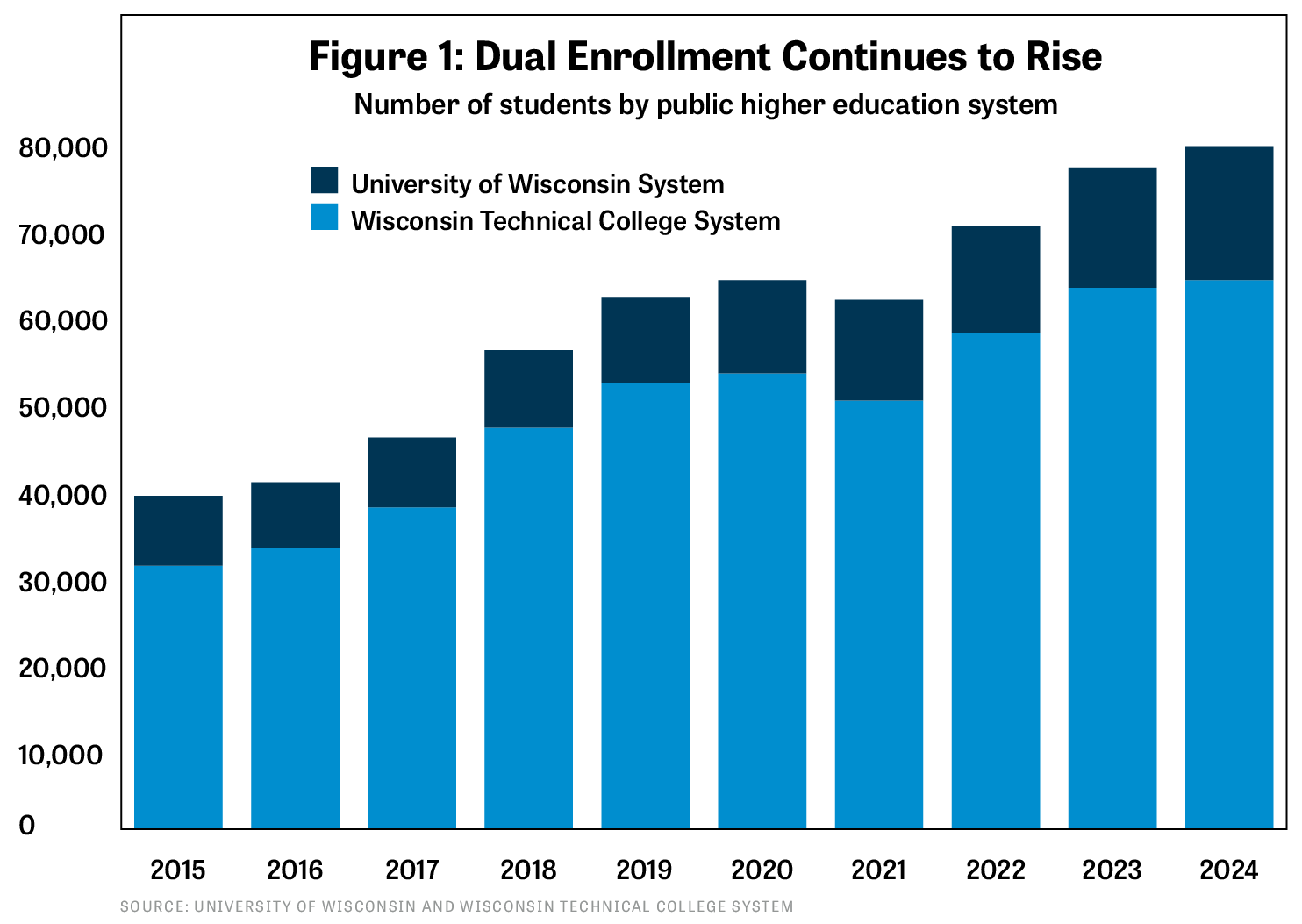

The number of high schoolers earning college credit in Wisconsin has more than doubled in recent years. Most earn credit from their local technical colleges without leaving their high school campuses. In the 2023-24 school year, 1 in 3 community college students in the state was a high schooler.
Education and state leaders have welcomed the trend, pointing to the potential benefits: Students who take dual enrollment classes are more likely to enroll in college and can save thousands on tuition.
Wisconsin lawmakers and education officials want more high schoolers to have this opportunity, but a recent rule change means these classes need teachers with the qualifications of college instructors, and those teachers are in short supply.
For many teachers, teaching dual enrollment would require enrolling in graduate school, even if the teacher already has a master’s degree.
“You’re asking people who are well educated to begin with to go back to school, which takes time and effort, and their reward for that is they get to teach a dual credit class,” says Mark McQuade, Appleton Area School District’s assistant superintendent of assessment, curriculum and instruction.
Leaders in five Wisconsin school districts all said the shortage of qualified teachers was one of the biggest barriers to growing their dual enrollment programs.
Since 2016, the Higher Learning Commission — which oversees and evaluates the state’s technical colleges — has required most of Wisconsin’s dual enrollment teachers to have at least 18 graduate credits in the subject they teach, just like college instructors.
The commission granted Wisconsin extra time to comply, but the rules come as Wisconsin struggles with a teacher shortage: 4 in 10 new teachers stop teaching or leave the state within six years, a 2024 Department of Public Instruction analysis shows.
The subject-specific prerequisite is much different from the graduate education K-12 teachers have sought to become principals or administrators, says Eric Conn, Green Bay Area Public Schools’ director of curricular pathways and post-secondary partnerships.
“To advance in education, it wasn’t about getting a master’s in a subject area. It was getting a master’s in education to develop into educational administration or educational technology,” Conn says.
In 2017, Wisconsin lawmakers created a grant program to reimburse school districts for teachers’ graduate tuition. But of the $500,000 available every year, hundreds of thousands go unused.
Tuition and fees for a single graduate credit at a Universities of Wisconsin school can cost more than $800, putting the total cost of 18 graduate credits around $15,000. For teachers who don’t already have master’s degrees, the cost is even steeper. The state grant requires teachers or districts to front the costs and apply for reimbursement yearly, with no guarantee they’ll get it.
A handful of Green Bay teachers have used the grant, Conn says, but many just aren’t interested in returning to school, even if it’s free.
Some teachers get salary bumps for obtaining master’s degrees, and some earn modest bonuses for teaching dual enrollment.
Schools receive no extra state funding to offer college-level courses.
In October, a group of Republican Wisconsin lawmakers introduced a bill aimed at making it easier for students to find dual enrollment opportunities.
It doesn’t address the shortage of qualified teachers, which would likely require separate legislation.