
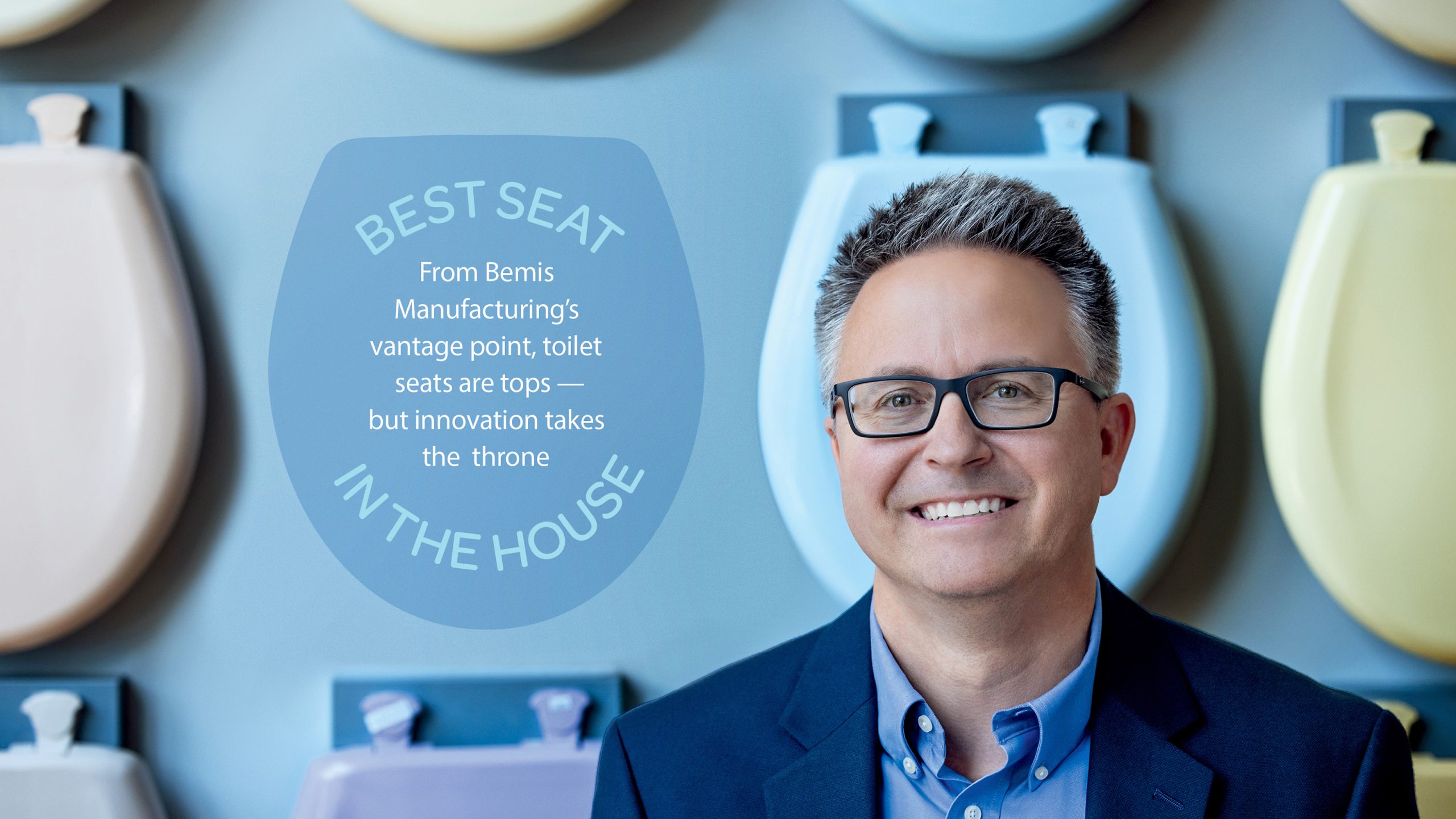

The typical person spends between 92 and 240 days of their life sitting on the toilet. Even still, it’s an often-overlooked bathroom fixture. It’s easy to take toilets — and especially toilet seats — for granted.
That is, unless you are Jon Bemis, vice president of contract sales at Bemis Manufacturing Company in Sheboygan Falls, one of the world’s largest toilet seat manufacturers.
“There’s nobody in the world, no company in the United States, that spends more time thinking about toilet seats than we do, guaranteed,” says Jon, who represents the fourth generation of Bemis family ownership at the 123-year-old company.
And if you’re thinking, “What’s left to think about when it comes to toilet seats?” Jon has an answer for you: a lot.
“It’s a ring and a cover, right? But we’ve innovated the hinges, the materials, the finishes, everything,” he says. “We do toilet seats better than anybody because we care about them more than anybody.”
From wagons to washrooms
Vesla Hoeschen remembers being a child in her father Richard Bemis’ manufacturing plant, watching toilet seats suspended by hooks on a conveyor as they moved through automated paint tunnels where they were finished with enamel coating. The seats would then travel high into the rafters, where they hung to dry.

It is a process Bemis engineers developed in the 1950s and is still used today.
“You could just look up and see thousands of toilet seats above you,” she says. “As a kid, there was this fascination with the whole manufacturing process. It all kind of looked like a big, ornate Rube Goldberg machine.”
Hoeschen is another fourth-generation member of the Bemis family. Officially, she joined Bemis’ board of directors in 2017 and has been chairperson since 2021. Unofficially, she was creating profit and loss spreadsheets for her father at age 12. Richard served as CEO for 31 years and is currently a member of the board.
Being raised with other family-owned businesses like Johnsonville and Kohler in her backyard normalized Hoeschen’s experience as a youth.
“Family business is an ethos in the Sheboygan County community, so it all felt very normal as a kid growing up,” she says. “You don’t recognize that this is a special anomaly.”
But a fifth-generation family business like Bemis is exactly that. According to The Smith Family Business Initiative at Cornell, only about 3% of family businesses survive to see a fourth generation or beyond.
Hoeschen attributes Bemis’ longevity in part to the attitudes of both her father and her uncle Peter Bemis. They were the third generation carrying on the family’s legacy, growing Bemis from a $3 million company to $300 million under their leadership.
“Both my father and my uncle had a ‘roll up your sleeves, head down, get the work done’ kind of mentality,” Hoeschen says. “They were never looking to sell the company or have a huge financial gain. They just really, really loved the idea of making things, which has been passed down to my generation.”
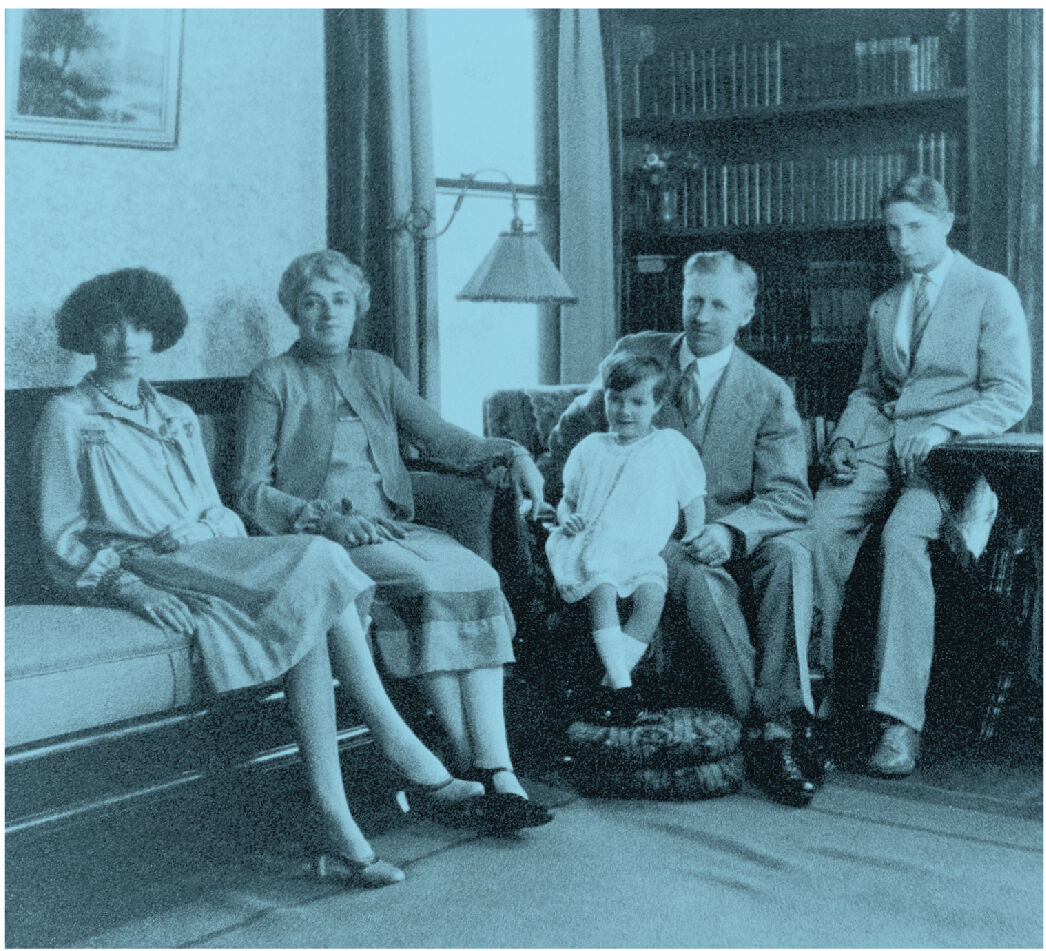
That love of making things can be seen all the way back to the company’s founding in 1901, when it was incorporated as White Wagon Works — the precursor to Bemis. Albert Bemis, who is considered Bemis’ founder, acquired the children’s wagonmaker in 1924, adding to his existing furniture business. The following year Albert founded Bemis Manufacturing Company to act as a sales organization for the company.
During the Great Depression, consumer demand for luxuries such as furniture and toys was down. Albert needed a Depression-proof product that capitalized on the woodworking skills of his workforce, so he made a bet on an unlikely savior that would become Bemis’ core product — toilet seats.
Jeff Lonigro, the company’s current president and CEO, says this ability to adapt and evolve has been baked into Bemis’ foundation.
“The company has always found a way to innovate,” he says, “and that’s kept us in business for a long time.”
Going under the lid
Bemis started manufacturing toilet seats in 1932 and has since grown into a global leader in the market. Products under the Bemis, Mayfair by Bemis, and Bio Bidet by Bemis brands are distributed worldwide through retail and wholesale channels.
While certain parts of the manufacturing process remain the same or similar to those used decades ago, there have been many changes over the years, including an increased focus on sustainability in the making of both plastic and painted wood seats. For example, in 2023 Bemis launched a new seat called Greenleaf, the first toilet seat made from 100% post-industrial recycled plastic.
But wood seats make up the majority of those on the market.
“People don’t realize that more than half of residential seats are wood,” Lonigro says. “It’s a wood core and a wood cover that’s finished. We are the only company left in North America that makes wood toilet seats.”
Bemis receives wood scrap from door, window and floor manufacturers that is ground into wood flour and used in its painted wood seats, in addition to recycling all the material that is trimmed off in the manufacturing process.
“Think of Play Doh when you would put it in a mold, and then squish it down and some would seep out the side. That’s compression molding,” Hoeschen says. “All that squishes out the side gets recycled, the dust that gets sanded off also gets recycled. It’s a very closed-loop process.”
Each year, Bemis reuses 3 million pounds of wood scraps and collects and reuses 1.5 million pounds of wood dust in its toilet seat manufacturing process.
Another major advancement in the toilet seat division was Bemis’ 2020 acquisition of Bio Bidet, an Illinois-based bidet company that includes bidet and smart toilet seats, as well as bidet attachments. U.S. consumer awareness and interest in bidets spiked during the COVID-19 pandemic. Some reports show bidet sales have grown a minimum of 20% each year since.
“[Bidets] are still a small percentage of the overall market in the U.S., but it’s been growing steadily,” Lonigro says. “Our customers were saying during COVID, ‘There’s a toilet paper shortage, so what do you have for bidets?’ It was important for us to get in there.”
Earlier this year the company launched the new Bemis Living App, which interfaces with its bidet toilet seats, allowing users to control and save customized presets — like water pressure, temperature and dryer duration — from their iOS or Android devices.
Prior to joining Bemis five years ago, Lonigro worked for 20 years in a highly technical Fortune 200 publicly-held company. He didn’t expect a toilet seat manufacturer to match that level of innovation.
“I worked for a company with products with 25 circuit boards that were automating with robots, so when I first came here, I’m like, ‘What can really be innovated?,’” he says, “but I’m just amazed at the amount of innovation that we’ve done and that we have in the pipeline.”
Beyond the bathroom
Bemis may be best known for its toilet seats and bathroom products — its largest division — but that’s not all Bemis does. Not even close.
About half of Bemis’ 2,000 employees are at its Sheboygan Falls headquarters. Another 500 are distributed among the company’s U.S. locations, and 500 can be found at its global locations in Mexico, England, Netherlands, Croatia and France.
With more than 250 active and pending design and utility patents to its name, Bemis is known as a forward-thinking leader in manufacturing — and toilet seats are just the start. The company has three other divisions: contract molding services, health care, and gas caps and gauges.
Its contract molding business has become a major part of Bemis. Today the company is among North America’s top producers of contract plastic components for customers in agriculture, lawn and garden, recreational vehicles and even robotic cat litter boxes and stadium seats.
Much of Bemis’ innovation was driven by former CEO Peter Bemis, who was known for pioneering technologies including the use of multi-layer extrusion and co-injection molding. Another of Peter’s achievements was forming a partnership in the mid-’70s with plastics machinery maker Milacron, Inc. that remains strong today.
Milacron President Mac Jones says you will often hear stories of Bemis and its legendary projects in the halls or on the shop floor of the Cincinnati-based company.
“Richard and Peter Bemis balanced each other — Peter was on the innovative side, Richard was on the business side — and those two kept Milacron hungry to keep up,” Jones says. “We thrive most when we’re able to convert innovative ideas that come from our customers, and Bemis came to us early and often with several ideas that we were able to turn into an enabler to produce a part or product for their customer base.”
Together Milacron and Bemis built many record-breaking machines, including the world’s largest co-injection molding machine. Known as the “Bemis Behemoth,” the 6,600-ton press is used to mold large plastic components for agricultural applications.
“The reason why this is really, really unique is because co-injection today is a very sustainable molding technology, but it was three decades ago that Bemis came to us with that innovation,” Jones says. “It was way ahead of its time not only in terms of understanding where their markets were headed, but also in the technology needed to differentiate from their competition.”
Jon Bemis, Peter Bemis’s son, says the company’s reputation as a technically advanced molder is well deserved and, as an example, points to some of the non-pneumatic tires it makes for agricultural vehicles.
“The material for these is extremely unique, because it has to hold up to years and years of service. It can never puncture, but it also has to be flexible,” he says. “There’s a combination of material science, tooling design and processing expertise that all go into something that just looks simple, but it’s extremely complex. There’s more to it than meets the eye.”
Bemis’ divisions don’t exist in a vacuum. In fact, Jon says the interaction between Bemis’ proprietary and contract divisions is a key element in each’s success.
“The real secret to Bemis is that both feed each other. The contract group is learning more about marketing and presenting and B2B from the toilet seats group, and the seats group has the advantage of all the technical wonders that contract brings into the company,” he says. “The whole is definitely worth more than the sum of its parts.”
Simply focused
As only the second non-Bemis family member CEO in the company’s 123-year history, Lonigro says transparency was his priority as he led the identification of four main focus areas for Bemis: market-driven plans, market-backed innovation, talent development and simplification.
“Many of these four pillars have been going on at Bemis. We just really wanted to create more focus and thoughtfulness around them,” Lonigro says. “Now as we do business plans, you always see these four areas flowing through as non-negotiables.”
One of the areas that Hoeschen says has been most impactful has been the strategic decision to simplify. Hoeschen explains that Bemis had a history of “not taking no for an answer.”
“That was fabulous, as it drove a lot of the innovation for the company for many decades,” she says. “The flipside of that is sometimes you tend to overcomplicate things as opposed to going with the most simple solution. Our business had become complex, and the simplification truly, truly helped us. Jeff was the one that really was able to bring that throughout the company.”
Simplification meant refocusing and prioritizing the business’ most profitable activities, as well as streamlining its brands, product portfolio and processes. For example, Bemis had a plastic shopping cart business that was sold due to its operational complexity and high labor requirements.
“Complexity adds cost, and it can add slowness to processes, the product development cycles and operational solutions,” Lonigro says. “We’re always trying to create simplification, which ultimately allows us to focus on the products, the customers and the opportunities that are the most profitable.”
Hoeschen says the philosophy required a mindset shift for not only leadership, but everyone throughout the company. The process has taken time, but it’s been worth it, she says. “Jeff was able to bring about a very great culture change and be much more strategically focused,” she says. “I think that was transformational for our company.”
Increased simplification often leads to increased growth, as Bemis is seeing in its health care division, which manufactures products for the collection and disposal of medical waste.
Lonigro says Bemis’ pipeline is fuller than ever because of this increased simplification that has paved the way for many new products set to launch in the toilet seat, health care, caps and gauges and contract divisions.
“When you mix the business being simplified with some market understanding and some new products, coupled with a workforce and a family that really cares,” Lonigro says, “that makes me super excited for the future.”

