

Across Brown County, economic development is taking shape through a mix of housing initiatives, infrastructure investment, business expansion and quality‑of‑life improvements. While each municipality approaches growth differently, county and local leaders emphasize alignment and collaboration are what make sustained progress possible.
Green Bay: Housing as an economic imperative
Workforce housing has become a defining focus of the city of Green Bay’s economic development strategy. Matt Buchanan, deputy development director, says the message from employers and developers has been consistent.
“You can’t have a strong workforce or economy without housing,” Buchanan says.
In response, Green Bay has expanded its housing tools, including creating seven new tax increment financing (TIF) districts over the past two years. Most are aimed at mixed-use developments with housing as a central feature. The city has also extended TIF districts by one year, a state-allowed mechanism that captures additional revenue for affordable housing, and introduced the Green Bay Housing Partnership’s Community Land Trust (CLT) initiative.
“We’ve made great progress,” Buchanan says.
That progress is becoming visible through projects including the redevelopment of
425 Pine St. into 66 units of market-rate housing and Nova at 221 Cherry St., a 268‑unit market-rate project.
Beyond housing, Green Bay continues to invest in industrial growth and redevelopment. On the far east side, the Grand View Industrial Park is expanding, with W.E. Hoban Co. constructing a new facility and the city acquiring 35 acres for future development.
In addition, riverfront redevelopment continues to reshape the city.
“By investing in those older parts of town, embracing the river, cleaning up brownfield sites, we have been able to enjoy private investment in response to that,” Buchanan says.
The Shipyard District represents the next major chapter. Phase 2, planned for construction beginning this year, will add public amenities including green spaces, a dog park and urban beach.
Bellevue: Corridor growth and housing diversity
In the village of Bellevue, development momentum has concentrated along the GV/Highway 172 corridor near Costco. Andrew J. Vissers, director of community development, says the area has been in motion for more than a decade.
Recent additions include Aldi, with Fox Communities Credit Union building a branch and Chase Bank beginning construction this year. New strip center developments will bring a mix of uses, including a 24/7 animal ER hospital, restaurants and retail.
Manufacturing investment continues as well. KI, Bellevue’s largest employer, is investing $12 million in an expansion totaling nearly 140,000 square feet, and Cherry Optical has made significant facility and property investments.
Residential growth remains central to Bellevue’s identity.
“Residential is the main staple of our community, but with that residential growth [comes] a lot of commercial growth,” Vissers says.
The village has approximately 450 single‑family lots in development or under review and recently amended zoning districts to allow smaller lots and more flexibility to address affordability concerns.
“We’re really focused on diversification of our housing stock to appeal to all sorts of buyers and ages and income levels,” Vissers says.
De Pere: Business parks and downtown revitalization
The city of De Pere has experienced rapid growth in recent years, particularly in its business parks. Daniel J. Lindstrom, director of development service, says in 2025 alone, the city saw 850,000 square feet of manufacturing logistics and general warehousing open in two business parks. De Pere is targeting an additional 300,000 to 500,000 square feet in projects in 2026, building on expansions by long-established employers such as Belmark.
Downtown De Pere is also seeing significant reinvestment. Lindstrom highlighted the first phase of the former Shopko site redevelopment, which includes a 60-plus-unit apartment and retail project, a 90-room Marriott TownePlace Suites hotel and a new city parking ramp.
“That’s two private projects plus a city project — $35 million plus of investment right there,” Lindstrom says.
The city’s Experience De Pere Business Recruitment Grant Program has helped to fuel that momentum.
“We’ve seen our vacancy rate in the downtown plummet to zero and very few vacancies — 1% to 2%,” says Lindstrom, adding that some landlords now report waiting lists.
Countywide infrastructure, workforce and quality of life
Brown County Executive Troy Streckenbach frames economic development through multiple lenses, beginning with the cost of doing business.
“For a business to be successful in a community, directly looking at what it costs to do business here includes property taxes,” he says.
Brown County has reduced its overall debt by more than $100 million and lowered its tax rate to approximately $2 per thousand, while also cutting property taxes by $7 million.
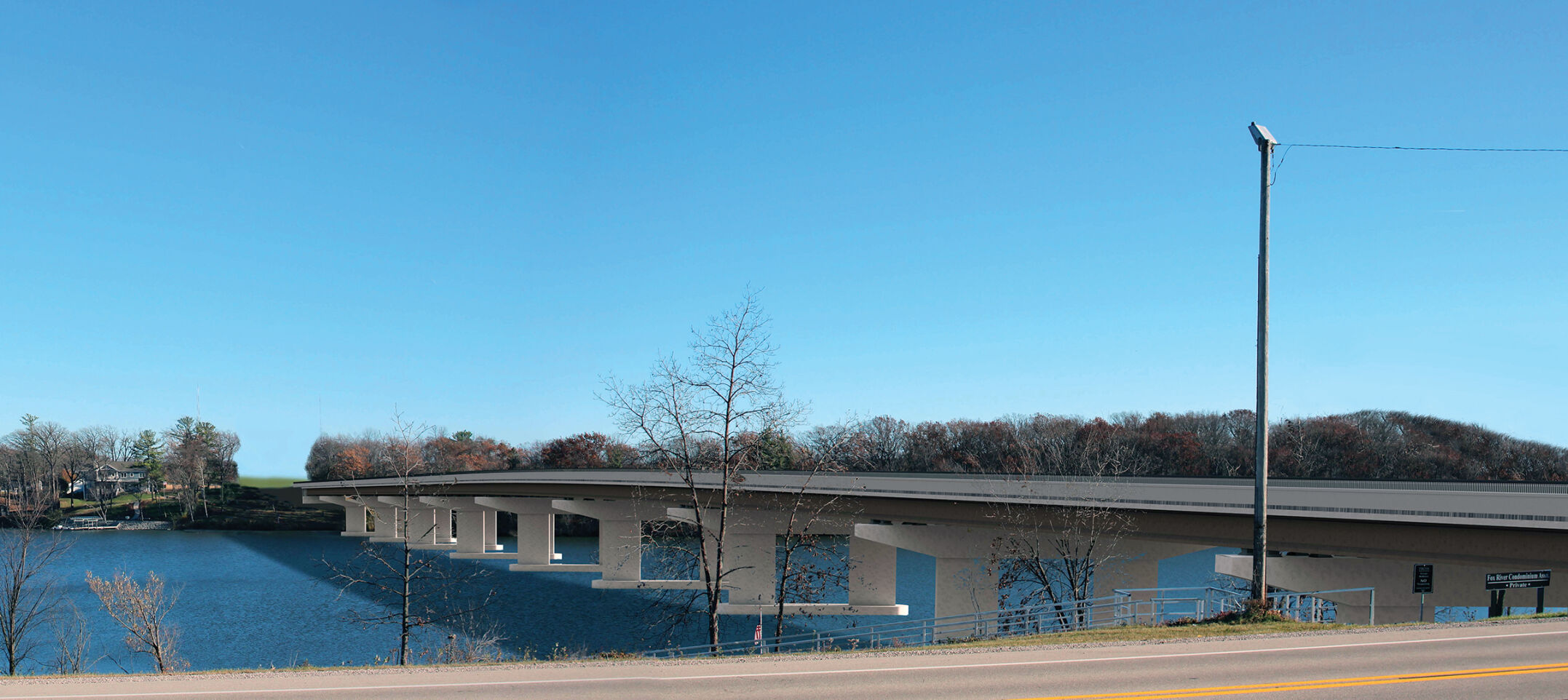
Infrastructure investment is another cornerstone. Streckenbach points to the $180 million South Bridge Connector project as transformational.
“It’s a pretty significant investment in our infrastructure that then leads to development,” he says.
Broadband expansion is equally critical. Streckenbach says the county’s partnership with a telecom provider will result in 270 miles of fiber and allow 14,000 households to gain access to high-speed internet by 2026.
Lisa Jossart, vice president of economic development for the Greater Green Bay Chamber, says growth looks different across municipalities, but collaboration is essential to the successes being achieved.
Case in point: Futura, an Italian-based company, that established its first location in the area this summer.
“The chamber, New North, Inc. and our economic development partners are always looking for ways to collaborate and tell the story of our whole region,” Jossart says. “When we do site selection as a team, that’s huge for attraction.”