
Like many industries, construction is dealing with a shortage of skilled workers both as the current skilled workers age and retire and as the industry competes for new, younger workers.
“A good share of our skilled craftspeople, overall, are at the ages of 55 or over,” says Todd Higgins, director of masonry for Neenah-based Miron Construction. “For the industry to keep pace with the demand, it’s estimated we need roughly 740,000 new construction workers nationwide for the next three years.”
While new technologies alone don’t necessarily solve the problem, they can streamline the process to help contractors get the job done with fewer skilled workers. And some technologies, like robotics, both reduce injuries and downtime and make the job less physically demanding.
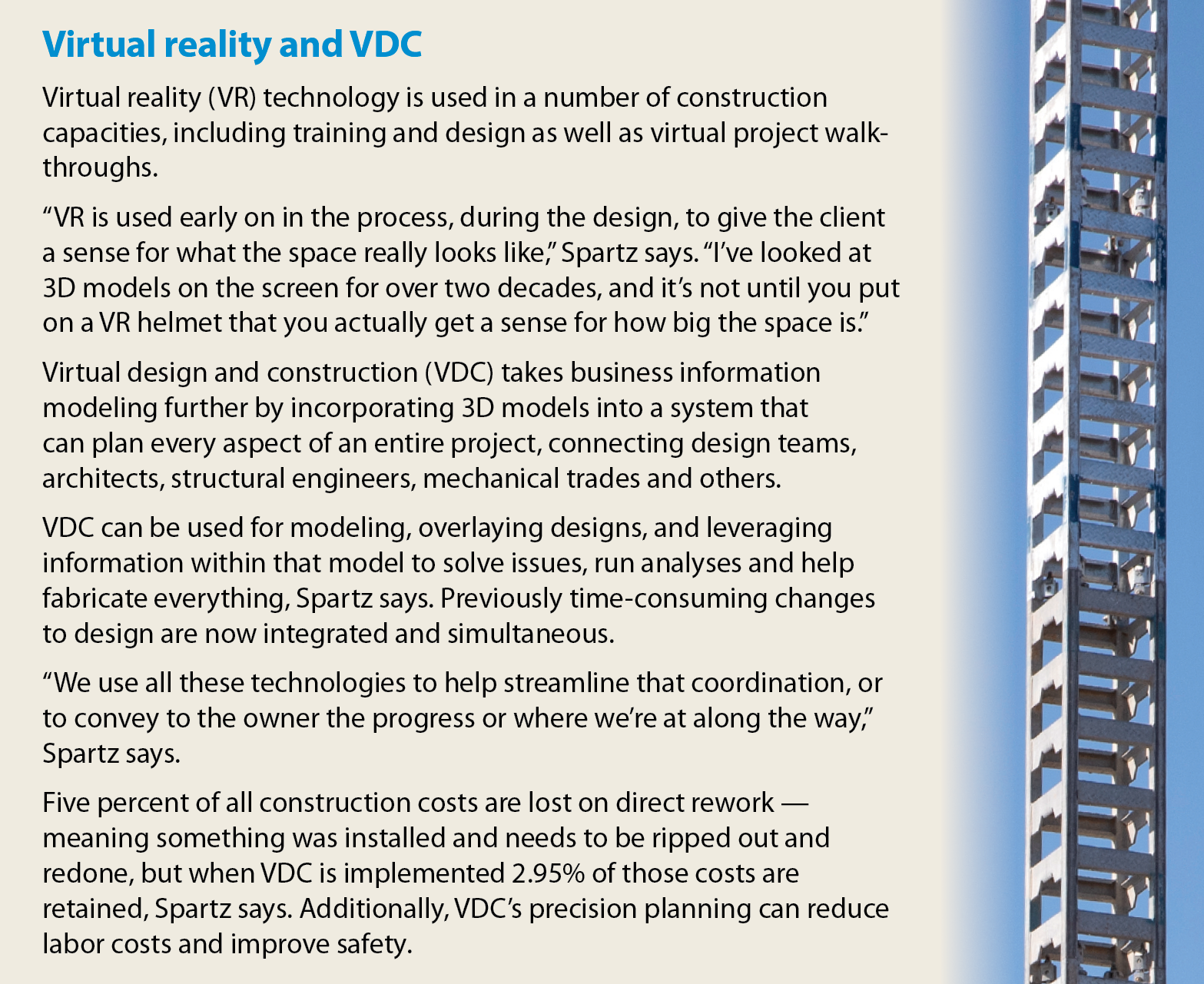
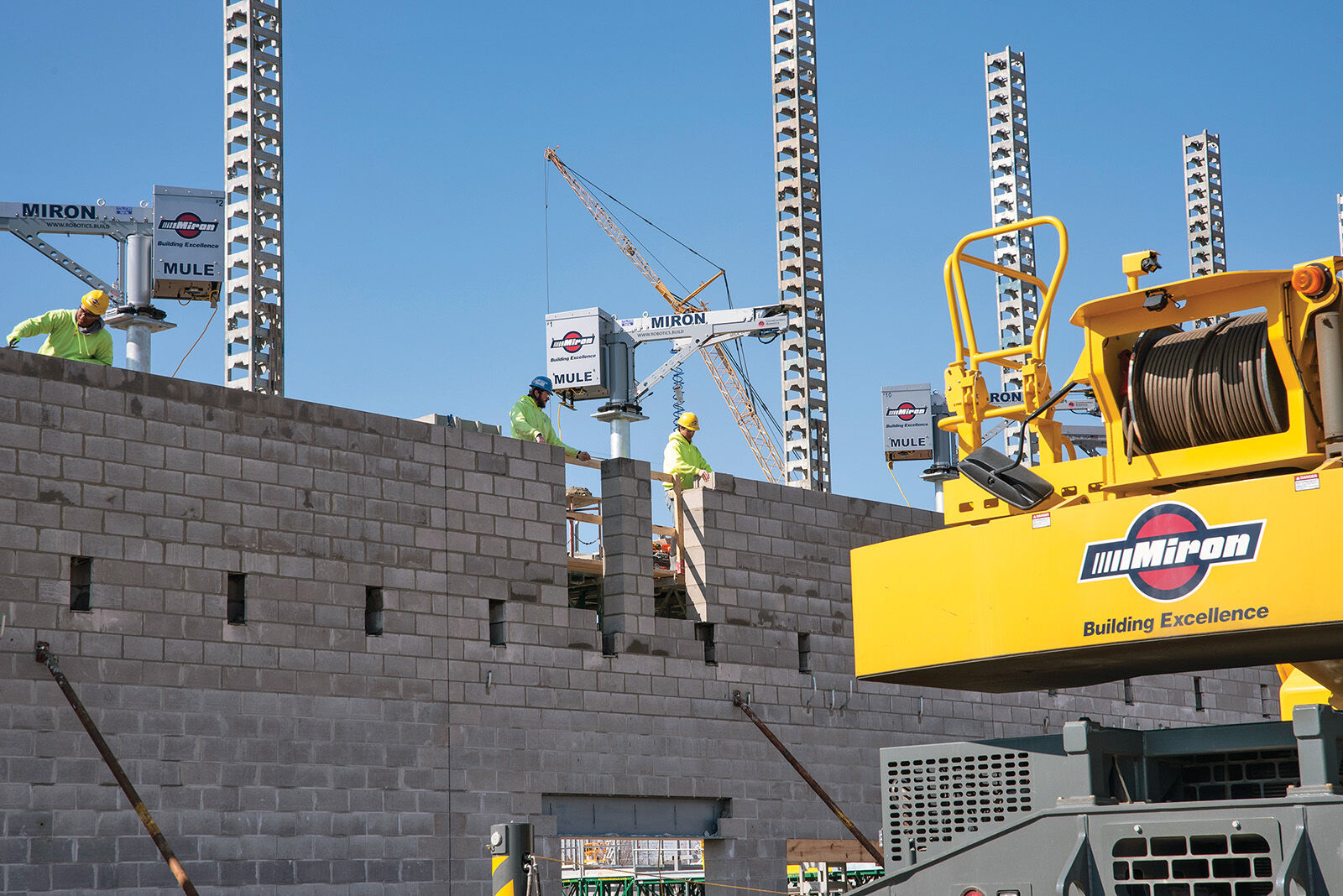
One example used in masonry is Miron’s MULEs — Material Unit Lift Enhancers, which the company began implementing for its current Neenah High School project.
“It’s a great product and is definitely helping us out in many, many ways,” Higgins says.
With a combination of factors affecting the construction industry’s labor force — including the pandemic, a post-pandemic rebound, an aging workforce, and a shortage of skilled workers — implementation of the MULEs was a good opportunity for Miron.
“We knew something had to be done,” says Higgins, who took the idea to Miron owners Dave Voss and Tim Kippenhan. He says the executives bought into the concept right away because of its appeal in reducing injuries, fatigue and physical wear on craftspeople.
The company initially purchased 10 units and generators to operate them, investing about $75,000 in each for use in building the new high school — the company’s largest masonry project to date, which is expected to be completed in July 2023.
The concrete blocks used on the project weigh between 77 and 95 pounds, with each worker normally lifting 3,000 pounds throughout a shift. The MULE has a lifting capacity of 150 pounds and is calibrated to carry most of the weight — so a mason might only be lifting 10 pounds for each block.
“We’ve seen the efficiency pickup, the safety pickup, and just talking with the craftspeople that were using them, how they felt at the end of every day,” Higgins says.
So Miron decided to invest in 10 more, also used on smaller projects.
While the MULEs have been in use less than a year, Higgins says the company already is recognizing the value. “Most importantly, with the lack of workforce it’s definitely allowing us to maximize on our construction schedules,” Higgins says. “That’s where that’s really helping. But definitely they are paying for themselves in the long run.”
As with any changes in the workplace, the MULEs were initially a hard sell with workers who have been used to doing things a certain way.
“It’s the old saying: You cannot teach an old dog new tricks,” Higgins says. “But a lot of them were very open-minded. And once they used them, and how they felt at the end of every day — that’s really what sold it.”
Tech tools
While the fundamentals of building a structure remain much the same as they have for hundreds of years, the tools are evolving.
New technologies are helping contractors, designers and builders get the job done more efficiently, which helps not only with costs, but also with managing projects amid an ongoing talent shortage.
Dean Hunt, vice president of business development for Green Bay-based Bayland Buildings, says companies are incorporating new technologies and expanding upon how existing technology is being used, both in-house and through subcontractors.
For example, Bayland has been using Procore construction management software for about six years. It’s a type of comprehensive customer relationship management (CRM) tool that essentially acts as a hub of information — it can be used to schedule appointments and to share notes, photos, plans, drawings, contracts and more. It can incorporate new plugins to help it grow and develop for the specific needs of a company, and it’s real-time and cloud-based, giving stakeholders access to information whenever and wherever needed.
“If you’re on vacation and you want to know how your building’s going, you can bring it up and take a look and see, ‘OK, they’ve got that wall put up,’” Hunt says. “It is a really great tool.”
In 2019, Bayland CEO Chad Calmes requested the company upgrade and outfit its conference rooms with the latest smart board and camera technology — which, as it turns out, was just a few months before the onset of the COVID-19 pandemic.
“Being a commercial general contractor, we were essential. So we were working, and that technology has been just phenomenal for us,” Hunt says.
Technology is also being used to help contractors and their clients get real-world views of their projects. LiDAR (Light Detecting and Ranging) technology, also simply called laser scanning, can map existing buildings and terrain, allowing the contractor to gain a precise picture of where everything is located.
Fond du Lac-based C.D. Smith Construction uses a laser scanner that gathers 2 million measurement points per second and reconstructs the real world in a 3D virtual environment called a reality-captured point cloud, says Jamie Spartz, the company’s director of virtual design and construction.
The scanner also takes 360-degree photos and maps the 3D measurements to the photos, which allows for highly accurate measurements to be taken directly from the photography. That point cloud can be incorporated into engineering software to design new elements without the need for field measurements, Spartz says.
Designers use software like Lumion 3D Rendering Software or Autodesk computer aided design (CAD) and business information modeling to better help clients envision their completed projects, including integrating people, cars and pets within a building. Facades can change with a click, helping clients envision end projects.
“It helps us to design a better quality building,” Hunt says. “All that technology that we’re using to design the building is making it a better product during construction, and we can eliminate potential problems that would cause a lot of cost during the build.”
Hunt and Spartz agree: Technology is key to the future of construction. Going forward, Spartz says C.D. Smith is continually looking at new technologies. Exoskeleton suits, concrete printing, and drone-in-a-box technology — which could fly autonomously to survey a site each day and then recharge itself at night — are all possibilities.