
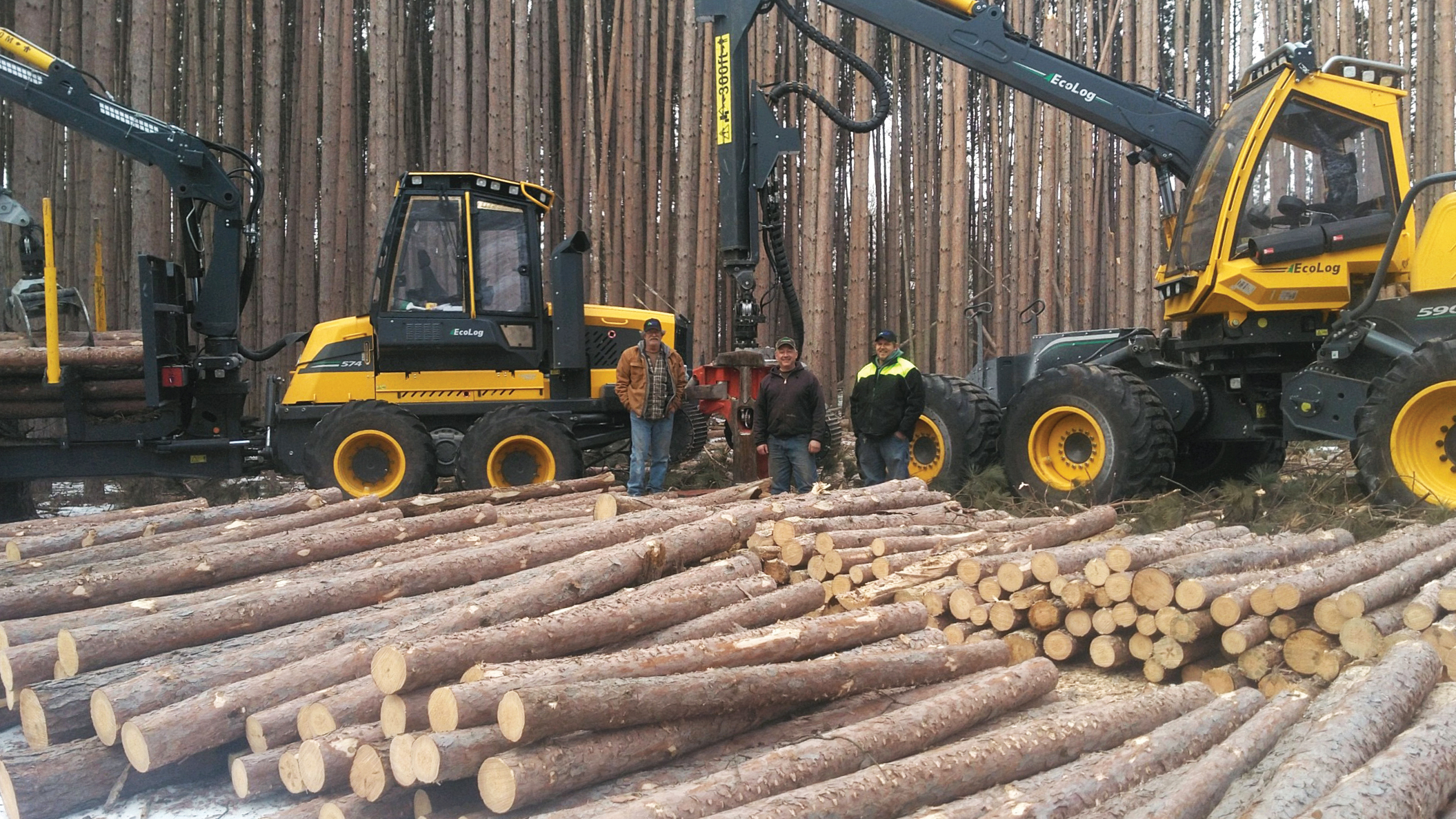

While the forest products industry has been around for multiple generations, the challenges the industry faces today warrant fresh perspectives, new collaborations and innovative tactics.
The latest outgrowth that checks all those boxes is the establishment in spring 2023 of the Timber Professionals Cooperative Enterprise (TPCE), an important complement to the Timber Professionals Cooperative (TPC) formed a few years ago. The TPC is driven by a cooperative steering committee consisting of representatives from the seven Wisconsin and Michigan regions served by the Great Lakes Timber Professionals Association (GLTPA). The impetus for its establishment was to address the surge of pulp-consuming mills closing, with others being sold and purchased repeatedly every few years.

The resulting unstable market for raw forest products continues to have a trickle-down effect on loggers, log truckers and the overarching industry today, says Dennis Schoeneck, TPCE president and owner of Enterprise Forest Products and Forest Products Transit. That’s what prompted the creation of the TPCE, he says. TPCE is working to take the cooperative’s work to the next level by pursuing and funding ownership of a mill in effort to curb instability in the region’s market and give loggers another destination to take their product.

“There is a lot of pulpwood; our whole industry is driven by pulpwood and everything that comes along with it,” says Scott Koerner, a board member for both cooperatives and operations manager for Koerner Forest Products. “If your region loses a mill that uses this small stuff, and if you can only sell a portion of the log, what do you do with it?”
This is an important question for an industry that has long prided itself not only for its sustainability expertise, but for capitalizing on every piece of every tree felled.

“Nothing goes to waste,” says Henry Schienebeck, executive director of the GLTPA. “Whether it’s making wood pellets or companies interested in using wood fiber for biofuel, we [want to use it all].”
It’s a high-priority topic for loggers and truckers, but its impact extends far beyond the forest products industry.
“There are so many good things made from wood that we use in our daily lives — not just doors, windows and paper, but dissolving pulp is used in clothing, gum, toothpaste and ice cream,” Schienebeck says. “And, having a healthy forest to recreate, to use trails and go sightseeing, that’s what people care about, and that’s exactly what our industry supplies through sustainability.”
The changing face of the industry
But what happens if a logger doesn’t have a mill to take the logs for processing? A given mill’s intake is only so big; as such, volumes can’t exceed capacity and intake has to be staggered to accommodate the equipment, staff and storage capacities in a given facility. And with fewer mills than ever, this is a very real challenge, Koerner says.
“One mill has me on weekly quotas,” he says. “We’re always juggling these small windows of time. You have to have a contract to take it there, and then the contract is for a specific time frame. The age of the product matters, too. For example, a pine mill needs to rotate inventory every two to three weeks in the summer or it will spoil.”
And yet, the juggling act is an essential one to figure out as the industry is the state’s number two economic driver, says Schienebeck, and there are gaps left behind by a number of mill closures. He says there are only five pulp mills left in the state that process the wood or pulp that impact our daily lives far beyond the paper we use.
TPCE mission: purchase and run a mill
TPCE’s work to research and purchase a paper mill hasn’t been an easy endeavor. Its previous pursuits were in response to the Wisconsin Rapids and Park Falls mill closures. With the Wisconsin Rapids situation, the co-op performed a study to determine the mill closure didn’t simply impact the 1,000 people who worked there; its reach extended to 15,000 to 18,000 people — directly or indirectly. In spite of a lot of legwork, and two attempts by the TPC to purchase the Wisconsin Rapids paper mill as well as an effort to purchase the Park Falls mill, it fell short for a number of reasons.
“We just didn’t get enough logger input on the Park Falls mill to get that going,” Koerner says.
TPCE is currently working on purchasing and running a wood chip mill in East Central Wisconsin that plays an important role in the forest product process.
“Because it takes round wood, puts it through the chipper and hauls it to the mill, it saves the mill a step,” Schoeneck says. “One of our biggest stumbling blocks is that we’re still relatively new and we’re still working on collateral.”
Schoeneck is insistent TPCE isn’t a group that will “simply fade away” because of roadblocks and challenges. He points to the traction made with a $1 million USDA matching grant, some of which has been used to fund environmental engineering assessments and other experts for projects like the East Central Wisconsin mill.
“Our senators and congressmen saw something in us as through the USDA; they gave us the money to help the forest products industry,” Schoeneck says. “TPCE, and the driving TPC behind it, is in it to position the industry for long-term stability and growth.”
The cooperative’s board has seven members, combined with 95 members from the industry focused on exploring opportunities for acquisition or development of forest industry companies that directly affect the livelihoods of loggers and truckers.
“We are pursuing the chip mill, and we are doing our best to keep it going as well as to have an ongoing impact on our industry,” Schoeneck says. “That includes our ultimate goal of ensuring forest health.”
Schienebeck reiterates the effort being all encompassing in that health is defined as not only financial health but forest health as well.
“You can’t have a healthy forest without a healthy forest industry,” says Schienebeck. “We’ve seen a decline in the number of mills over the past 20 to 25 years, and we are still not recovered from the Wisconsin Rapids mill closure.”
Closures are only the beginning
The forest products industry’s closures are compounded by other challenges. These include dramatic cost increases, increased environmental regulations (welcome, but requiring additional funds to ensure compliance), long permitting lead times resulting in lost market opportunities, changing weather — especially in the winter, an aging workforce and a lack of markets compared to a generation ago.
“We are working as a collective group of loggers to control their own destiny a bit and have some buy-in through the co-op,” Koerner says.
The industry is not for the faint of heart. When it rains, and a logger is unable to work, his or her livelihood is at stake, Schoeneck says. There is no government subsidy or backup plan if it’s too wet to cut or the ground isn’t sufficiently frozen to allow for the heavy equipment to drive on it during the winter months. For many in the industry, it’s a multi-generational labor of love that is both their livelihood as well as a calling to perpetuate Wisconsin’s beautiful forests.
“For many of us, it’s a fourth-, fifth- or even sixth-generation logging business,” Schoeneck says. “Is it in our best interest to run out of trees? Absolutely not. We are like farmers, nurturing and caring for what has been given to us. We understand the life cycles of different tree species and know very well what it takes to grow trees in our area. When you see a clear cut, it’s for a reason; in many cases, it’s because a tree comes back best that way.”
Their challenges will not be resolved overnight, but both the TPC and TPCE are determined to find solutions.
“This is why the co-op is so important,” says Schoeneck. “We are trying to collectively help the industry, and in turn, maybe help ourselves in the process.”