

American demographics are shifting, including in the CEO chair. Combine the long-expected stream of retirements by baby boomers with the pandemic’s impact on companies, says Tracy Johnson, CEO of Green Bay-based InitiativeOne Leadership Institute, and there’s a sudden surge of job opportunities at the top.
“I think some of those leaders stayed a little bit longer because of the pandemic,” Johnson says. “They were the steady hand boards [were looking for] for continuity across the pandemic.”
But now, organizations are ready for new, bolder leadership and baby boomers are ready to retire.
The latest CEO turnover report from the Chicago-based global HR firm Challenger, Gray & Christmas, Inc. shows that 2024 is on pace to be a record year for CEO exits at U.S. companies, up 13% from a year ago. The top industries being affected are government/nonprofit, technology, and health care, with the average age of exiting CEOs sitting at 60.
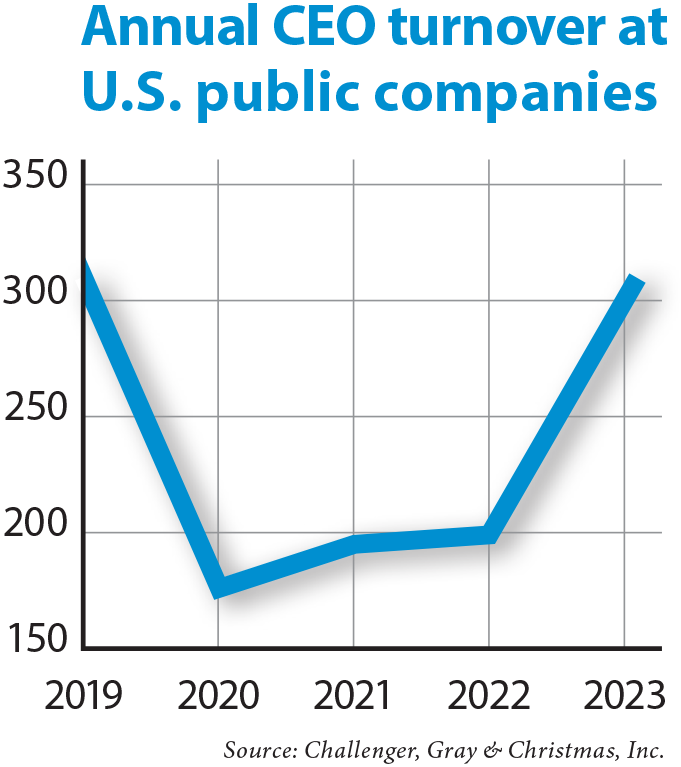
“[July 2024] saw the highest average age for exiting CEOs since the Great Resignation, and nearly a third of them stepped down into an advisory or board role, while a large number retired,” Challenger, Gray & Christmas Senior Vice President Andy Challenger said in his firm’s report. “This suggests normal succession plans were executed. Many companies are recognizing the need to prepare leaders well in advance of an exit to ensure smooth transitions.”
Succession planning is more important than ever, says Diane Roundy, Northeast Wisconsin-based director of executive search at Truity Partners. The pandemic tightened the labor market, she says, and while some of that has settled down, there is still a shortage of qualified individuals.

“Leadership teams need to be talking about succession planning and getting people geared up,” she says. “Do you have your people? Do you have someone that can take over if you need to step down or something changes?”
“What we are seeing is that the most successful companies are elevating leadership from within,” says Johnson, whose firm specializes in helping organizations build their leadership benches. “Knowing what’s in your talent pool internally helps immensely.”
New leaders for a new era
But promoting from within doesn’t mean status quo leadership. Johnson advises that organizations should look at CEO turnover not as an upheaval but as a “renewal.” She says a successful CEO today will need bold ideas, greater openness to lifestyle balance issues and strategies for dealing with challenges like inflation, supply chain shortages, the culture of remote work and artificial intelligence. Fostering inclusive decision-making and paying attention to other workplace culture issues is key, she says.
Roundy agrees. “The biggest emphasis I see right now is [the term] ‘culture fit,’” she says. “Culture is the number one topic when we are talking to decision makers about finding the next key person.”
Those key people aren’t necessarily women, statistics show. In 2022 and 2023, about 30% of new CEO hires were women. In 2024, that number is declining.
“It’s interesting that as the nation considers electing a woman for president, fewer women are ascending to the CEO role. Many women were tapped to lead during the tumultuous pandemic years but burned out due to lack of support in these roles,” Challenger said.
Length of CEO tenure is also on the decline, Johnson says, dropping from an average of six years in 2013 to 4.8 years in 2022, but she stops short of predicting shorter CEO tenures are the new normal.
“I don’t have a prediction,” she says, “but I do think we will move to ‘how successful can we be as a collaborative team?’ and teams being able to run organizations.”
Because of rapidly evolving technology, Johnson says, it will become increasingly difficult for CEOs to operate alone. She cites the wisdom of Microsoft co-founder Bill Gates, who talks frequently about the key to future success being ability to “learn, unlearn and relearn.”
“It’s a learning mindset, and the successful CEOs continue to learn,” she says. “They can’t be afraid, which is why trust is so important. You have to really work to create that collaborative, consensus-building environment in the organization and be able to fend off all the challenges externally that are going on.”