
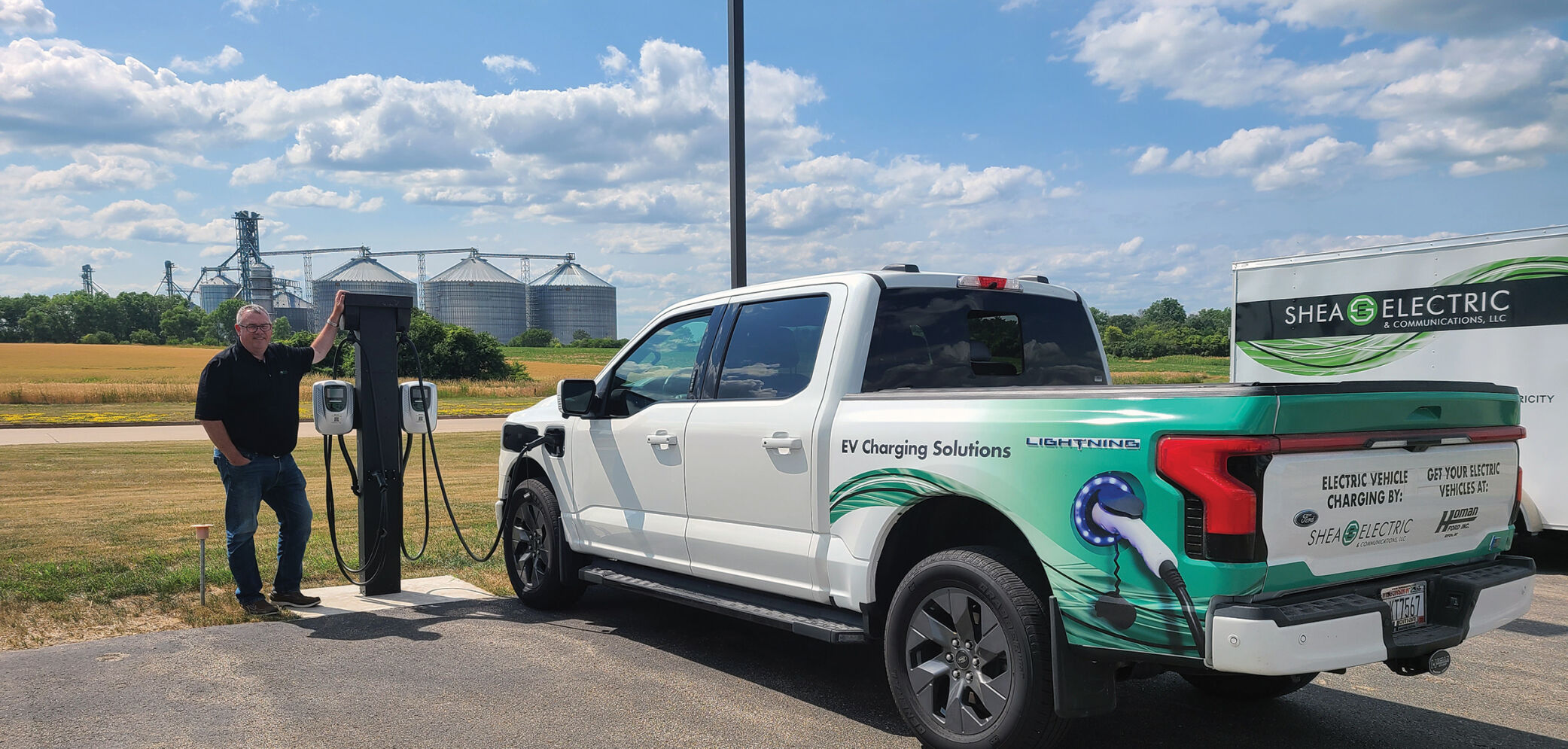

Dan Shea, Shea Electric, charges his Ford Lightning.
On a rainy June afternoon at Shea Electric and Communications in Oshkosh, dozens of people gathered to examine electric vehicles and ask questions of experts on the technology.
One of the concerns heard often — here and in many discussions about electric vehicles — has to do with “range anxiety,” or the confidence that the vehicles will have enough power to get where they’re going.
That’s what the National Electric Vehicle Infrastructure (NEVI) Plan aims to address. The federal NEVI plan, announced in February 2022, helps to support the U.S. Department of Transportation’s Alternative Fuel Corridors (AFC) program, which encourages infrastructure for EV charging, hydrogen, compressed natural gas and propane.
The Wisconsin Electric Vehicle Infrastructure Plan, released in July 2022 by WisDOT, was developed as a prerequisite to accessing NEVI funding. The plan aims to establish a network of EV charging stations accessible to the public within urban, rural and suburban areas as well as historically underserved communities. The NEVI program requires charging stations no more than 50 miles apart throughout the system, and Wisconsin aims to have 85% of the state highway system within 25 miles of NEVI-compliant fast-charging stations.
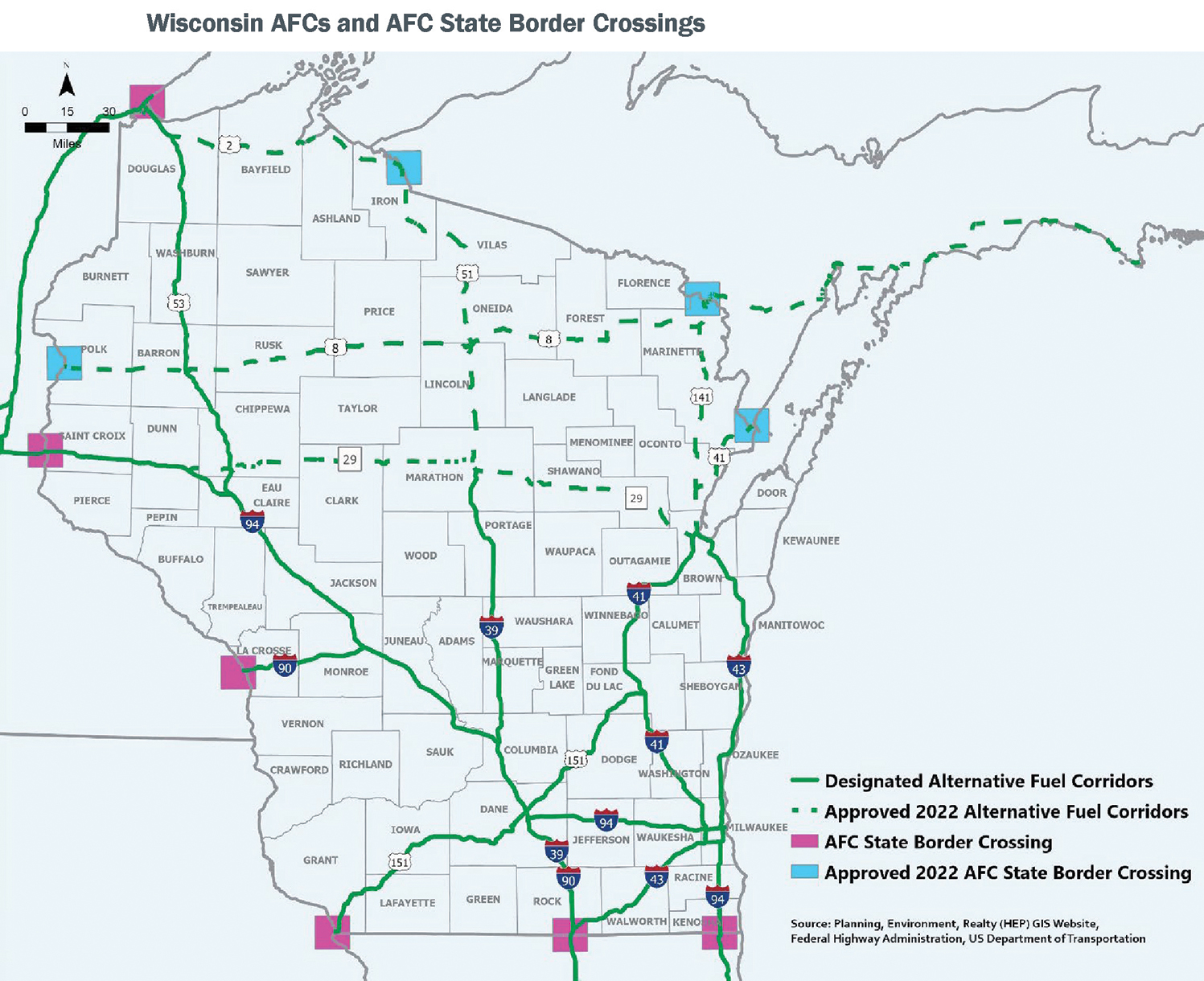
“We looked at the map of Wisconsin and where we had designated alternative fuel corridors, and we really saw a need to be able to support projects in the northern third of the state of Wisconsin,” says Kaleb Vander Wiele, the electric vehicle project manager at WisDOT. The state had previously designated AFCs largely in the southern and western parts of the state, including US-41 and US-43, and with the addition of the NEVI program, the state “requested a fairly aggressive series of U.S. and state highways for last year’s designation window.”
That included state Highway 29 from Green Bay through to Eau Claire, US-41 north of Green Bay, US-141, US-51, US-2, and US-8, he says. “Altogether, it was about 800 additional miles for this system,” giving the state about 2,000 miles of AFC to support projects.
While Wisconsin already has a fairly substantial system of AFCs compared to other states, “the overall goal is not just to support travel between our larger cities and our larger metro areas, but to help support folks who want to leave the interstate and the Alternative Fuel Corridor System and head out into more rural Wisconsin to be able to do so knowing they’re going to have a charger somewhere along the way,” Vander Wiele says.
Vander Wiele says NEVI funds Level 3 fast chargers, with four charging ports at 150 kilowatts per hour in each location.
“Once you leave some of our larger and smaller metro areas, Milwaukee, Madison, up through the Valley, the La Crosse area, the Eau Claire area, you head out into more rural Wisconsin, publicly available charging really any standard, any type of charger is significantly limited,” he says.
The WEVI plan includes about $78.65 million of available funding over five years. Businesses and local governments will be able to apply for up to 80% cost-sharing assistance for installation of EV chargers, which will be hosted at businesses. The owners of the new EV chargers can decide whether to keep the chargers private or make them public.
“We haven’t put any formal framework on who is and is not able to apply for the program,” Vander Wiele says. “So that may be retail, restaurants. It could be big box stores; it could be gas station convenience. It could be mom-and-pop stores as well. We’ve seen a lot of interest from them. We’ve even had a conversation with a snowmobile club that’s interested in hosting a charging station.”
Demystifying electric vehicles
Currently, the market for EVs is rather narrow. EV sales in the U.S. were less than 5% of the market in 2021 but projected to reach 40% or more by 2035 according to S&P Global Mobility and 50% globally by 2035 according to Goldman Sachs. Contingencies include public interest, retooling at the manufacturing level, construction of battery plants and availability of materials.
The public hasn’t quite fully embraced the idea of EVs yet, partially because “the mystique of plug-it-in versus stop at the gas station deters people,” says Rob Dresen, managing partner for Homan Ford & Chrysler in Ripon. “Everybody is interested in learning; not everybody is interested in owning,” he says.
Once people open their mind to EVs, however, they’re usually hooked and often add an EV as their second vehicle for their daily work commute and errands.
“There are so many things that the vehicle does differently that you otherwise wouldn’t experience with a standard internal combustion engine vehicle,” Dresen says. “Once they know that is a thing, they open up their mind to consideration.”
That’s why events like the one hosted June 13 at Shea Electric and Communications are so valuable. Shea partnered with Homan Automotive, Amplify Oshkosh, Bergstrom Automotive and Horicon Bank to offer information on EVs and EV infrastructure, as well as an opportunity to test drive electric cars.
About 85 people signed up for the event, but 135 showed up — despite the downpour, says Dan Shea, chief operating officer of Shea Electric. Eleven electric vehicles were on site, with nine available to test drive, including a Cadillac LYRIQ, a Hummer, Ford Mach-Es, the Chevy Bolt and a 4xE Jeep.
“This is coming like a freight train,” Shea says. “This is just the way it is, but our government is putting more and more emphasis on fuel efficiencies and emissions because they go hand in glove, and it’s just the wave of the future.”
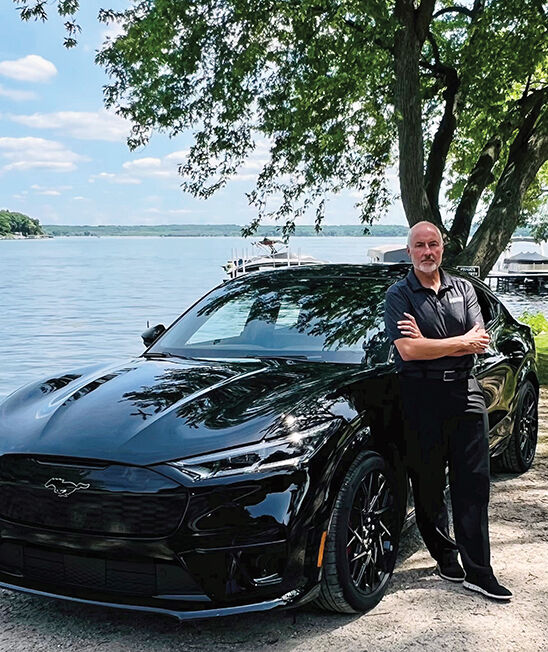
Both Shea and Dresen own electric vehicles — Dresen a Mustang Mach E and Shea a Ford F-150 Lightning, which he brought to the event for people to test drive.
“It’s the quietest vehicle I’ve ever had. It’s the most cost-effective vehicle I’ve ever had. I’ll never need another oil change,” says Shea, who has continuously owned Ford F-150s, most recently a 2020 or 2021 internal combustion model. “That used to cost me anywhere from $95 to $115 to gas up. Now … if I go from 20% to 90 or 100% [charged], depending on where I’m at, it’s costing me $22 to $32.”
“This is coming like a freight train. Our government is putting more and more emphasis on fuel efficiencies and emissions because they go hand in glove, and it’s just the wave of the future.”
— Dan Shea, chief operating officer, Shea Electric
Dresen says his first experience with an EV was a rental car. “When you step away after four or five days of driving that vehicle and you go back into a standard ICE engine vehicle, the throttle response is vastly different, and you realize it,” he says.
Dresen says one of the reasons the cars handle so well — including in the snow — is that the battery pack on most EVs is centered low and between the wheels, creating greater stability. Additionally, that large battery transfers power to a small battery through a high voltage converter that allows everything to stay awake. This includes parking cameras, which can double as security cameras.
When the lease on Dresen’s wife’s car expired, “she drove [the EV] for about two weeks and I said, ‘Do you want to look into getting you a different vehicle?’ She said, ‘No, I’m keeping this.’
“She took it from me.”
The benefit of EV infrastructure
Dresen says there is now enough EV infrastructure to host the number of vehicles on the road, with most dealers having installed at least Level 2 chargers, many with Level 3 available for public access. This includes Homan Group, which is making available four Level 3 chargers by the end of the year, Dresen says. “We’re in a nice little pocket between interstates with primary highway cross traffic, on ramps, off ramps, exits,” he points out.
It makes sense for businesses to make the chargers public. The Wisconsin Electrical Vehicle Infrastructure Plan aims for chargers to be close to retail and restaurants. “If you ever go by a Tesla Center, most of them are sitting there reading a book. And I think that that’s great,” says Shea. “But for the people who have a very busy lifestyle, they want to go shopping at Festival Foods. They want to go have lunch.”
Shea is currently working with The Supple Group on EV charger installation at three of the group’s four restaurants in the region: Fox River Brewing in Oshkosh and the Melting Pot and Fratello’s in Appleton.
“They see that they’re less than a mile off the highway. They know that it’s going to become a destination point, because people are going to get an hour to an hour and a half of charging in while they have lunch.”
Additionally, Shea has talked to HR managers about the value of installing EV chargers at workplaces to attracting young workers.
“This is going to be a game changer for businesses. Young people don’t expect free energy, but they do expect to pull up and be able to charge their vehicle, and it’s important to them,” Shea says.
Adding chargers is attractive to those workers who may live in apartment complexes, very few of which have EV chargers, Shea says.
“If you don’t have [chargers] in your apartment complex, when do you charge them? When you’re working,” Shea says. “So when you’re going to work for eight hours, that’s where you’re going to charge. That’s why there’s a need at these businesses.”