

Northeast Wisconsin companies working on attracting and retaining young workers have been looking beyond their benefits packages and instead making culture shifts that appeal to young workers who are just starting their careers — the generation known as Gen Z, generally defined as people born between 1997 and 2012.

While most Gen Z workers grew up using technology, many actually prefer working in-person to email conversations or Zoom. That’s largely because of COVID-19, says Mariana Vargas, talent retention coordinator with the Greater Green Bay Chamber (and a Gen-Zer herself).
“That social aspect that was really stripped away from us for so long — that’s a core element to our professional growth and we really want to take that back,” Vargas says. “We really want to get our voices back out there.”

Jodie Federwitz, director of the PULSE Young Professionals Network through the Fox Cities Chamber, says workplace flexibility “is really key for people because it helps with that work-life balance, being able to fit everything in at once.”
Gen Z also values stability and security — perhaps another effect of the pandemic, which caused high levels of depression, anxiety and stress in young people, says the National Institutes of Health.
Gen Z also wants to be appreciated and to believe their workplaces are invested in them. They want to know why the work they’re doing is meaningful, and if they’re not happy, they don’t linger — a characteristic that sometimes makes heads spin, especially among older leaders who tended to stick with their jobs for the long haul.
“I really do think our generation does a great job of advocating for those changes in the workplace if they feel that it is missing,” Vargas says. “I think most of us are comfortable [saying], ‘Hey, this doesn’t work for me,’ and explaining the reasons why.”
If a Gen Z worker doesn’t see things change, then that’s a signal for them to look elsewhere. “I think we really care about reputation, and if our company doesn’t represent us, we’re going to go somewhere that does,” Vargas says.
But many company leaders are working to make the adjustment and create work environments and cultures where Gen Z wants to stay.
Companies in Northeast Wisconsin have been making culture changes, both big and small, such as adding flexible work hours, professional development opportunities and paid volunteer hours “so their employees can go out and do something that’s meaningful to them and give back,” Federwitz says. Doing so benefits both the community and employees.
About a year ago, the chamber launched its Champion of Young Professionals program to recognize the businesses that make these above-and-beyond changes for young workers — also a way to highlight these companies in recruitment efforts.
“A lot of companies are really starting to focus a lot more on what they can offer beyond just a salary or a paycheck,” Federwitz says. That’s important because Gen Z will pay attention to online company reviews, noting how a company deals with customers, its stance on sustainability and more. Previously, it was only the prospective employees who had to be mindful of what they put out on social media.
“Well, now it’s turning back on businesses as well,” Federwitz says.
Designing spaces that work for Gen Z
Furniture manufacturer KI has long been an advocate of young professionals and efforts to attract and retain talent. As KI’s director of workplace strategy, Jonathan Webb has researched the work styles of young people, authoring a white paper on how collegiate design can drive corporate design.
“I always had this thesis — if you’re an organization and you are looking to attract and retain talent, why not study where those individuals have spent the last four to six years of their lives?” Webb says.
Eighty-nine percent of people who have graduated in the last 10 years say that the physical workspace of a future employer will influence their decision to work there, Webb says. The average age of a U.S. manufacturing office facility is more than 40 years old, and KI was one of those that needed a facelift. The company is currently renovating its entire office space, a project that began two years ago.
“We needed to make sure that our space was captivating,” Webb says. “And quite frankly, it’s not that hard for us. We’re an office furniture manufacturer.”
Part of that renovation includes making individual spaces a little smaller — because technology also has become smaller. Gen Z workers generally want their own workspaces, but they also want connection points to work with other people, so KI is creating small-group areas that plug into technology.
Where do you fit?
Gen Z 1997-2012
Millennials (sometimes known as Gen Y) 1981-1996
Gen X 1965-1980
Baby Boomers 1946-1964
Silent generation 1928-1945
Greatest generation 1901-1927
It’s the same for KI clients — prior to 2020, “if you had 200 employees, we were going to create 200 workstations and some other areas. And then also prior to that, 99% of our clients were in the office. Hybrid wasn’t even a thing. We didn’t even talk about it.”
Webb says that face-to-face interaction is one way to overcome the “Achilles heel” of Gen Z — soft skill development — with COVID at least partially to blame. “Being in the office is a better remedy to overcoming a lack of soft skills than not being in the office,” he says. “It’s as simple as that.”
KI has a robust training curriculum for new hires, leadership classes and mentorship programs, of which communication and soft skills are a part, Webb says.
Being in the office also affords young workers the chance “to attend the networking events and activities, ice cream socials, whatever it is that the office is doing. Those are really important things for Gen Z.”

Recently, Green Bay-based Breakthrough had an opportunity to design a new office space as well, moving into a new building in early 2022. The company ensured it offered a variety of centralized working spaces, quiet spaces and room for everyone to gather for events.
“We recognize that there’s a shift in the way people work and how they’re the most productive,” says Jennifer Vander Zanden, Breakthrough’s chief operating officer. “As an office and as a location, we can provide that space in a lot of different ways, and I think that’s something that’s particularly attractive to Gen Z. But it’s really a changing nature of how we do our work and where we work our best together.”
Making an impact in the community
Likewise, Breakthrough has seen Gen Z workers wanting more than a paycheck. It hosts internal social events and encourages young workers to share ideas each year at an “idea symposium” that helps them develop their visions through creative workshops and present them to the entire company.
Additionally, “one thing that’s really attracted the attention of Gen Z is the investments we’re making in sustainability,” says Vander Zanden. “We have the capabilities and the knowledge to really drive [clients] forward on their emission-reduction plan … it does attract a lot of talent that wants to make a difference in reducing emissions and investing in our planet.”
Breakthrough, which is a U.S. Venture company, has been recognized for its leadership efforts in the community, working to both develop their talent and to make an impact in Northeast Wisconsin.
I think we really care about reputation, and if our company doesn’t represent us, we’re going to go somewhere that does.
— Mariana Vargas, talent retention coordinator, Greater Green Bay Chamber

Kathryn Pritzl, Breakthrough’s marketing and public relations manager, is a Gen Z employee who has been with the company for two years. Pritzl was attracted to the company’s culture, innovation, connectedness and work‑life balance.
“Sustainability is big to me, as well as professional development opportunities, so Breakthrough and U.S. Venture as a whole really puts professional development first,” she says. “So how are you going to continue to offer new opportunities? Job shadowing and working on various courses, attending conferences or even just mentorship — that’s really big within Breakthrough as well.”
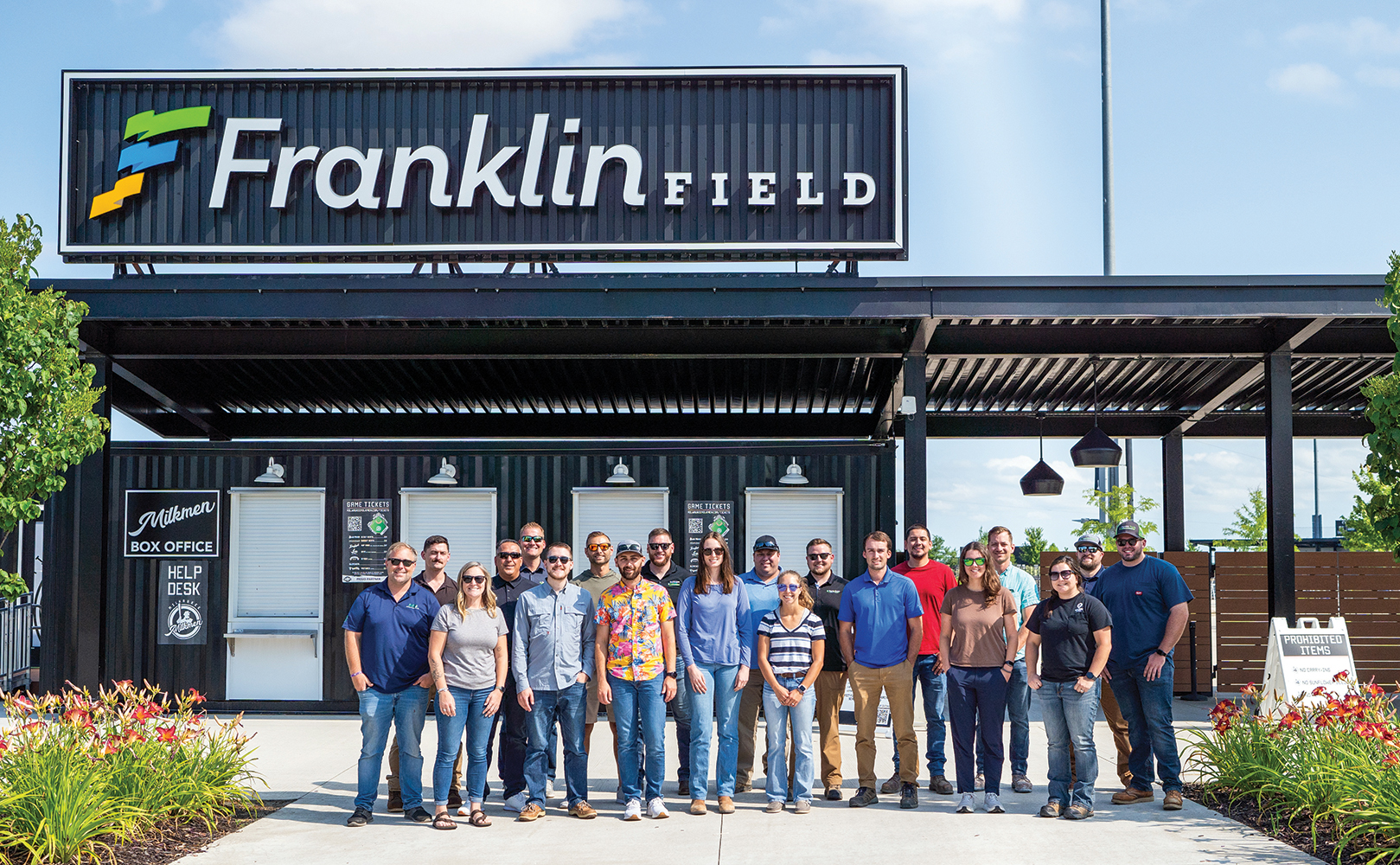
Walbec Group, which was named Fox Cities Chamber’s 2023 Champion of Young Professionals of the Year, has taken a multi-faceted approach that includes adding a sustainability director, says Aaron Green, technical services area manager.
Gen Z is “not here for the money,” Green says. “They want to make a good wage, but that’s not at the top of their list. Sustainability has been one that’s been talked about and stands out.”

Craig Hintz, corporate recruiter for Walbec Group, says students and young professionals want a sense of connection with their work. “They’ll take a pay cut if the purpose is something that they truly believe in,” Hintz says.
On the flip side, they won’t hang around long if they don’t feel connected to their work. “And it happens. It’s quick,” Hintz says. “But I think that’s why the work that we’re doing is even more important — how do we keep you engaged outside of your job?”
That’s one reason Walbec Group has developed three affinity groups, including the mentorship-focused WOW (Women of Walbec) group and UVOW (United Voices of Walbec), which is focused on diversity and outreach, Hintz says.
Walbec’s third affinity group is focused on young professionals, with goals such as building skills, career development and networking, Green says. Recently the group visited Road America in Elkhart Lake, go-karting on the track. It was a networking event, but also a chance to see the end product of a Walbec project. “It seems like those types of things go a long way,” he says.
Additionally, it allows the young workers to meet people in other departments, so they can recognize that there are other roles they could fill if they’re not satisfied with what they’re currently doing, he says.
Green has seen employee satisfaction grow since the company added this multifaceted focus on young professionals. “You can see it just by how long people are staying here,” Green says. “I mean, we get a lot of employee referrals — if I work here and I want my friends and family to work here, that says something.”

