
We have a really generous community, and we have all these wonderful people who are wanting to do bigger and better things in their own backyard. – Megan Spranger, Association of Fundraising Professionals
There are more than 10,000 nonprofit organizations in the New North region’s 18-county footprint.
If that number seems big to you, you’re not wrong. And though it may signal high demand for donor funding, it’s also a strong sign of a vibrant, caring community, says Amber Paluch.
“It’s a wonderful asset of our community,” says Paluch, senior vice president of community impact at the Greater Green Bay Community Foundation, which provides services to donors and nonprofits in Brown, Kewaunee and Oconto counties.
Paluch says it’s important to remember that every nonprofit in Northeast Wisconsin has a unique audience and delivers unique services. And all are needed.
“If you look at, say, the housing sector — yes, there are several shelters. These shelters are serving populations in different ways and there remains a strong housing crisis,” she says. “And so the problem is not being solved, and the problem is not too many nonprofits.”
Megan Spranger, regional development director for the ThedaCare Family of Foundations and president of the Association of Fundraising Professionals (AFP) Northeast Wisconsin chapter, agrees.
Spranger also serves as the chapter presidents’ representative for the AFP Global board, and through that opportunity she has learned that Northeast Wisconsin punches well above its weight class when it comes to philanthropic culture.
“We have a really generous community, and we have all these wonderful people who are wanting to do bigger and better things in their own backyard,” she says.
The business of doing good
The website fiveandrising.org states boldly, in all caps and in no uncertain terms: “We’re done with the broken system.”
The campaign is spearheaded by Social Current, a national nonprofit focused on strengthening the social sector under the leadership of President and CEO Jody Levison-Johnson.
The “Five and Rising” movement, inspired by Dan Pallotta’s record-breaking TED Talk, as well as his book and film, “Uncharitable,” seeks to move public consciousness toward recognition of the social and nonprofit sector as 5.2% of U.S. GDP and 10% of the American workforce — not its own category that exists outside of industry and economic development.
Running it like a business, paying employees a living wage and spending money to make money should be equally valued in the industry, which Levison-Johnson resists being labeled “heart work.”
“When people say ‘heart work,’ it’s like, ‘Oh, you do it because you’re such a nice person’ and not because it’s vital to thriving communities or because it’s the only thing that helps people when they’re truly in their times of need,” she says. “If we’re going to use any [term], it’s going to be hard work.”

Levison-Johnson says the nation’s nonprofit sector is essential infrastructure that demands real investment. Through Five and Rising she hopes to dispel myths about the industry — even the notion that it exists only to serve the “needy and less fortunate.”
“If everybody thinks that, and they don’t realize how we’re such big contributors to the economic engine that is this country, then we’re going to be continuously devalued and shoved aside and not invited to the tables where we need to be,” she says.
“We’re in the business of doing good,” Levison-Johnson says. “I mean, $1.44 trillion, 12.5 million in the workforce. We are businesses.”
Eye on Washington
There are several factors currently affecting philanthropy and support for nonprofits, experts say, starting with the Department of Government Efficiency’s effort to trim $1 trillion in spending, which has included the cancellation or expiration of grants and termination of contracts that had bolstered the nonprofit sector’s work.
“Right now I think we’re seeing a lot of threats coming out of federal government. Funding pauses have really affected the sector; 35% of nonprofits reported a decline in revenue in 2025,” Levison-Johnson says, “and it was already not OK to start with.”
“A lot of organizations have had to cut important projects, important programming and important resources; there have been jobs lost,” Paluch says.
Meanwhile, demand for services is simultaneously rising as economic uncertainty rules the day.
A report by Philadelphia-based Bellevue Strategies asserts that as government funding becomes more uncertain, nonprofits will seek more private donations, corporate partnerships, or state and local government assistance. On a positive note, the report states, this could lead to more cross-sector collaboration; however, “without sustained support, smaller organizations may struggle to stay afloat.”
“Organizations that are more heavily reliant on federal funding have seen that shift affect their ability to fundraise,” says Spranger, who describes the corporate giving landscape as somewhat volatile right now amid economic uncertainty and tax policy changes.
The expiration of key provisions in the 2017 Tax Cuts and Jobs Act (TCJA), which is set for the end of this year, is another issue worth watching. TCJA nearly doubled the standard deduction, which led to itemized filers dropping from 30% to 7.5% in its wake. Without the opportunity to itemize, the tax incentive to give was reduced for many Americans. According to Social Current, human services and small nonprofits saw the biggest declines in giving post-TCJA, and it’s possible those groups could regain some lost ground with tax changes that subsequently shift giving strategies.
But, Spranger says, “there’s still a lot to learn in the corporate landscape.”
Corporate philanthropy and the power of people
While individual contributions are still by far the biggest slice of the U.S. philanthropic pie, corporations were responsible for $44.4 billion in charitable contributions last year, according to data from Giving USA. And the trickle-down effect of corporate philanthropy programs on individual giving is not to be ignored.
For business leaders like Dan Voss, CEO of Miron Construction Co. Inc., it’s a serious corporate responsibility not only to give generously and inspire others to do the same, but also to help tell the nonprofit sector’s story through projects like Insight on Philanthropy.
“We need to better educate the community as far as what all these nonprofits are doing and the challenges they’re facing,” Voss says. “They’re feeling the pinch.”
At Miron, there is no single entity that evaluates giving opportunities, Voss says. Each philanthropic ask is considered by a group of employees that looks at requests from many angles — including whether or not there are associated volunteer opportunities.
Through Miron’s MVP program, employees are challenged to find causes about which they’re passionate and volunteer with the company’s support. Voss says the program has been especially powerful among the younger generation of workers.
“Once they do get involved, they see some of the challenges and issues that are out there in the community, wherever they’re working — they see what’s unique to that community and how they can make an impact,” he says.
Like Miron, SECURA Insurance also works to engage broad swaths of its workforce in philanthropy, volunteerism and philanthropic decision-making.
“It takes all of us to be able to make sure that we have long-term viability, sustainability in our communities,” says Kati Brumlic, SECURA’s director of performance development. “We need all of us to be able to carry that value.”
For Brumlic, this means meeting employees where they are on their individual philanthropic journeys.
“I think maybe a lot of our tenured associates are more used to always giving back financially, but it might be through time — and we want to make sure we instill that value of giving back, no matter what it looks like,” she says.
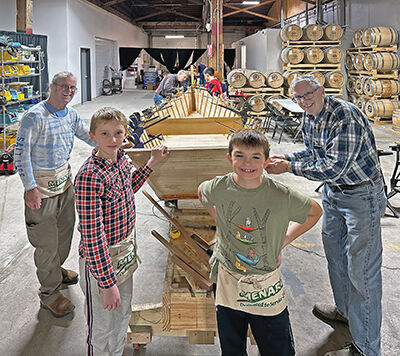
For its 125th anniversary this year, SECURA asked associates to each spend 125 minutes giving back.
“It’s been really fun because a lot of our associates are giving back in different ways, and we have this word cloud going of [the places] they are serving in our communities. It’s amazing to see all the different organizations that are being reached through it,” says Kristin Heiges, SECURA’s vice president for marketing.
“We have a motto of ‘be real, earn it, have fun,’” Brumlic says. “And I think that speaks to the giving back piece, too.”
Coming together
While the challenges facing the nonprofit sector are numerous, Paluch says she takes comfort in knowing how generous and collaborative organizations — both for-profit and nonprofit — in Northeast Wisconsin really are.
“We’ve seen situations where nonprofits have been really, really resilient; their teams have been resilient and their volunteers have stepped up. Donors and funders have stepped up. It’s the community supporting the community’s quality of life,” she says.
And when you think about the nonprofit sector as a vital industry, you appreciate the hard work for what it means on a broader scale.
“When I get down or stressed or worried, it’s just really amazing to be reminded of the work that these nonprofits are doing every day to make our community better,” Paluch says. “And I think with the landscape being what it is, it’s important to be able to focus on that a little.”
“It takes all of us to be able to make sure that we have long-term viability, sustainability in our communities.” -Kati Brumlic, Secura insurance