
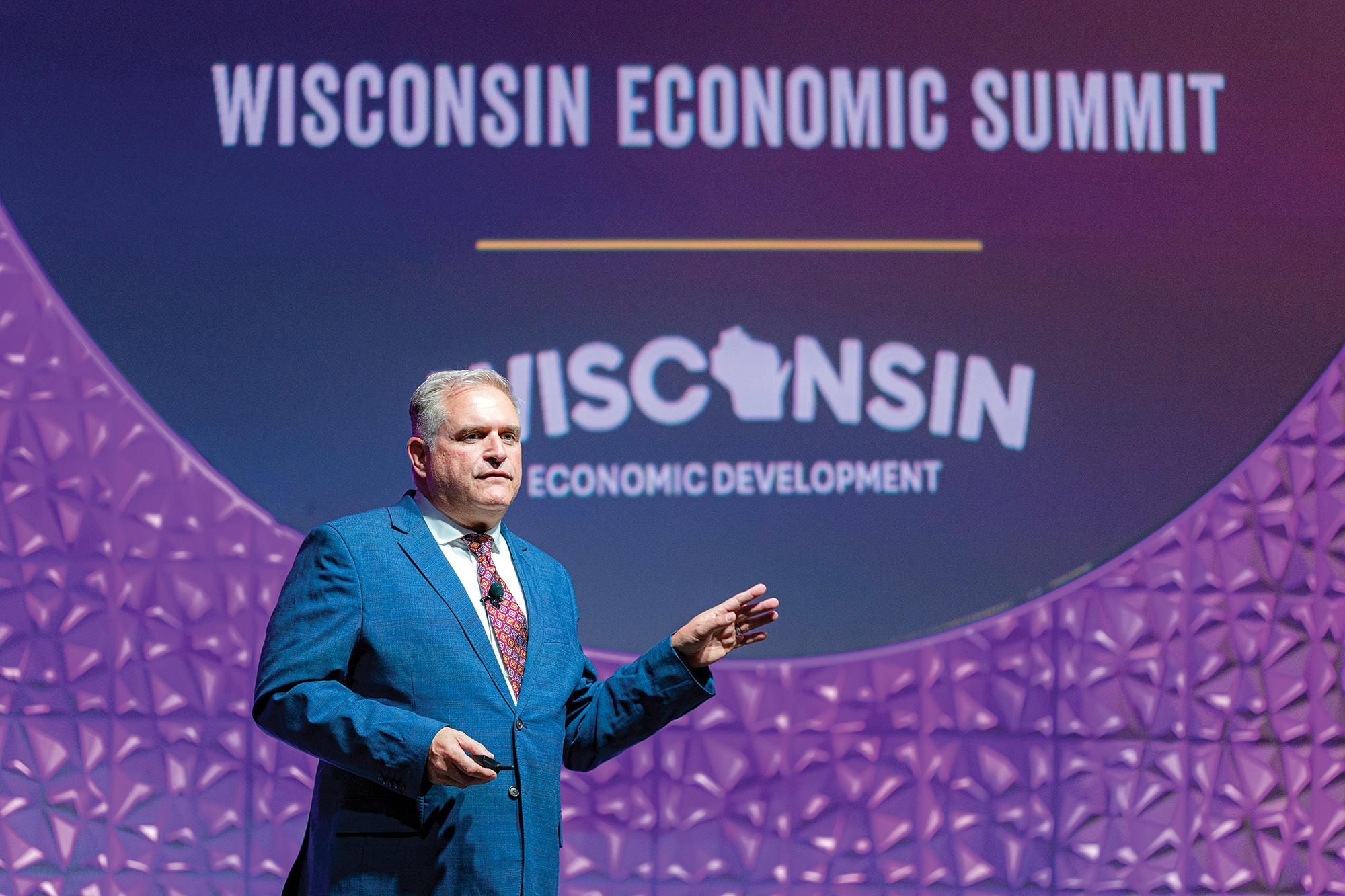

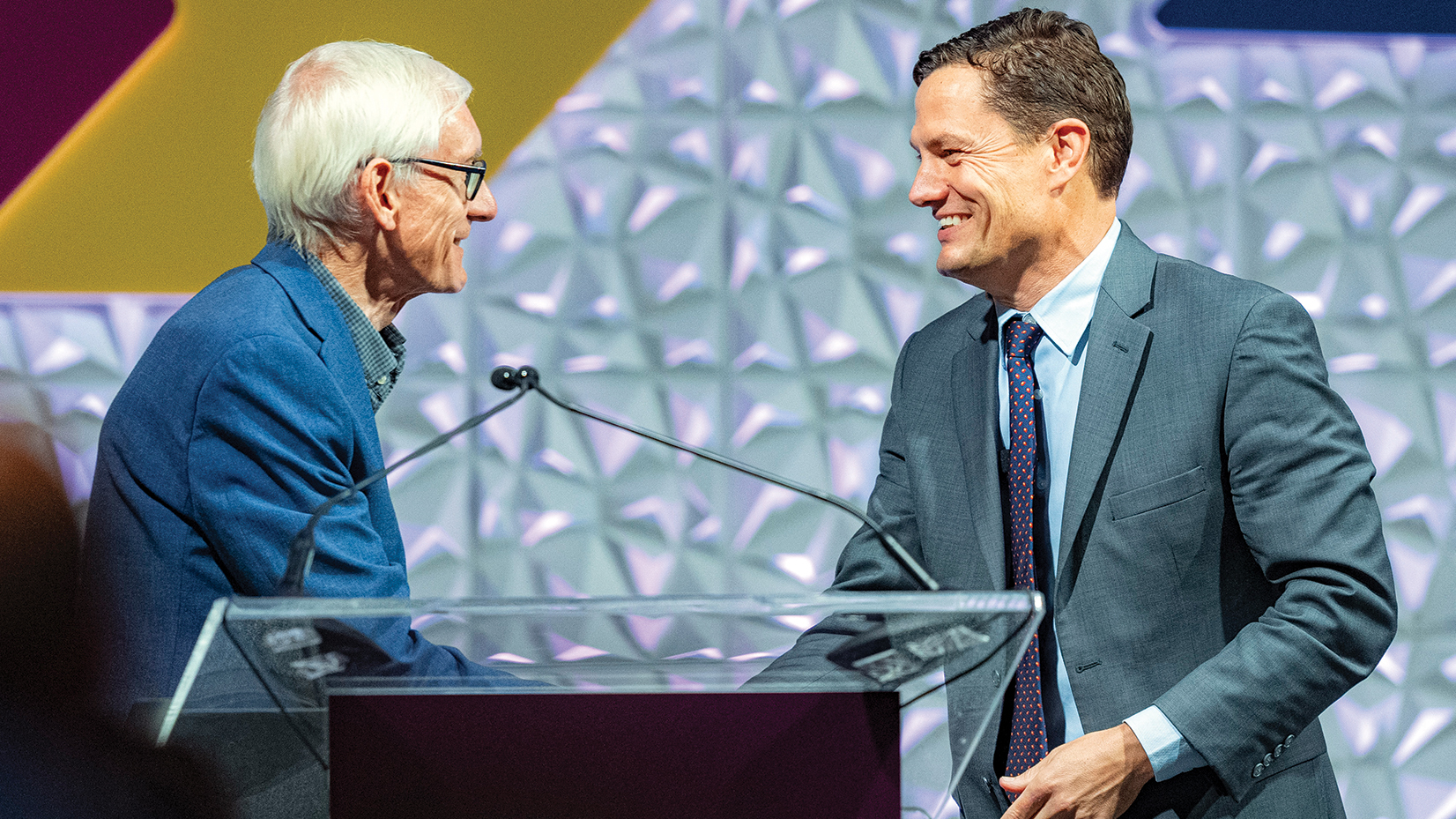
Keynote addresses and breakout sessions at this year’s Wisconsin Economic Summit tackled topics ranging from immigration and data centers to fine dining and the Green Bay Packers, with the two-day event culminating in a surprise appearance by Gov. Tony Evers Oct. 16 at the KI Convention Center in Green Bay.
“Continue building an economy that works for every person in every corner of the state,” encouraged Evers, who has announced he will not seek re-election in 2026. He added that he is especially proud that the Wisconsin Economic Development Corporation committed a five-year high of more than $91 million in grants, loans and tax credits to projects and programs across the state in fiscal year 2025.
Federal funding cuts, inflation, tariffs and the U.S. trade war with China have all created “a rollercoaster situation” for Wisconsin’s economy, said Department of Revenue Sec. David Casey in his keynote address “Dairy to Data: Investing in Wisconsin,” but statewide investments and decreasing tax burden have helped the state remain in a strong economic position.
“In the last five years, over 86% of Wisconsinites are paying 15% lower taxes,” Casey said. “We have the lowest combined state and local tax burden in over 50 years, and we have the 39th lowest burden of all of the states.”
Wisconsin traditionally enjoys low unemployment, and the state’s unemployment rate currently sits at 3.1%, Casey shared, ranking eighth lowest in the U.S.
“Our great unemployment figure sounds great until you’re trying to hire people and you can’t find anybody,” he said.
In addition to the labor shortage, Casey said one of Wisconsin’s biggest economic challenges is housing affordability, with median housing costs currently consuming 40-50% of median household income.
Casey said housing is considered affordable when it’s 30% or less of median income. During the 2009 housing crisis and recession, costs in the Milwaukee area approached 40%. The aftermath of the COVID-19 pandemic has hit Wisconsin housing costs even harder.
“Our housing is becoming very, very expensive,” Casey said. “I want to point this out because I heard in some of the sessions today, ‘Child care is expensive.’ Child care, in some areas, amounts to 30% to 40% of your cost of living. Add that to nearly 50% [for housing] and you don’t have any money left over.”
Northeast Wisconsin leaders speaking at the summit, which drew about 400 attendees, included Oneida Nation Chairman Tehassi Hill and Green Bay Mayor Eric Genrich. In addition, Wisconsin Aluminum Foundry CEO Sachin Shivaram, co-chair of New North, Inc., moderated a breakout panel discussion on the “workforce of the future” that also included remarks from JBS Foods’ Sabrina Zerhouni and Sturgeon Bay City Administrator Joshua VanLieshout.
Shivaram said the state has to continue to think and act differently as it increasingly needs more and more workers. In the last few years alone, he said, WAF’s workforce has shifted from virtually zero to 20% women and from 3% to 22% immigrants.
“We’re having to do things that attract people to come to our communities … and trying to be a more holistic employer, addressing a person’s whole life as a way to get them to come to our company and stay,” he said.
Industry rising
While Wisconsin regularly dukes it out with Indiana for the title of “The Manufacturing State,” manufacturing was not the state’s top employment sector in 2025. “Education & health services” now leads the list for the first time ever, Wisconsin Department of Revenue Sec. David Casey told attendees of the 2025 Wisconsin Economic Summit.
“Some of that is the biotech industry and expanding biotech,” Casey said, adding that “technology” is also a category on the rise thanks to investments such as the Microsoft AI Co-Innovation Lab at UW-Milwaukee and the creation of hyperscale data centers in the state.
“If we look at … manufacturing, agriculture, technology and health, and continue to invest as we have over the last several years, we can keep Wisconsin moving forward,” Casey said.

