
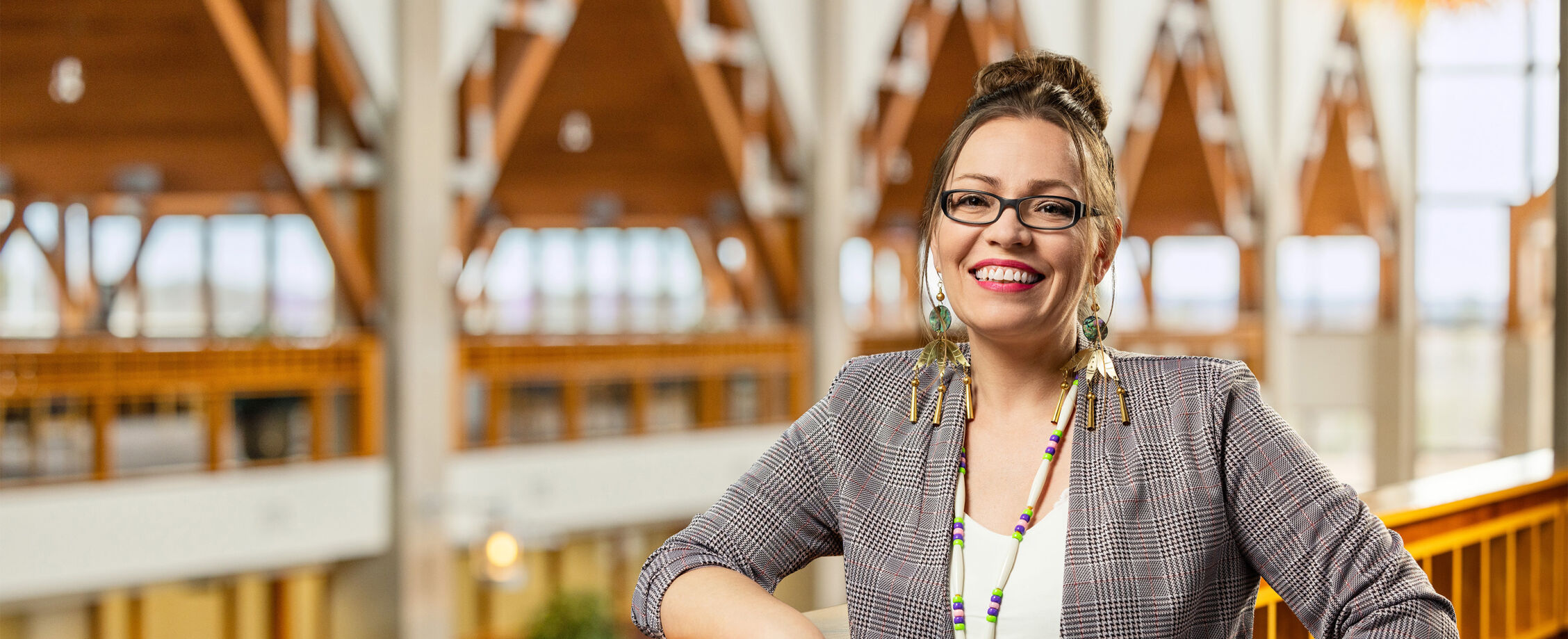

* Photograph by Shane Van Boxtel / Image Studios
Waking Women Healing Institute
Many people who encounter injustice and wrong in the world find it difficult to know how to help. But Kristin Welch, a member of the Menominee Tribe, felt a clear call to act on behalf of Murdered and Missing Indigenous Women, or MMIW. The pull led her to found Waking Women Healing Institute, a survivors-led nonprofit that creates a place of “learning and healing through rebuilding kinships among Indigenous women to the land, original ways of being and languages.”
Welch says her background in behavioral health led her to want to do the work, and she credits her experience with Tribal AmeriCorps for helping develop her as a community organizer and activist. As she began her advocacy work, she quickly realized that working within established systems was too restrictive for her and wouldn’t be a viable option.
“[I saw] how in many different systems our children and families were falling through the cracks,” she says.
Before founding WWHI, Welch worked with a Menominee grassroots organization called Menikanaehkem, whose advocacy areas include water stewardship, food sovereignty, cultural preservation and women’s leadership. It was there that Welch began to work with MMIW, and she later founded a collaborative called the Women’s Leadership Cohort that included Indigenous women from around the state.

Welch’s involvement led to a desire to form a nonprofit focused on Indigenous women, healing violence and working with families. The Gresham-based organization works with Indigenous survivors, allies and partner agencies throughout Wisconsin, Minnesota, Michigan and Chicago around the goals of restoring, uplifting and igniting Indigenous women.
WWHI prioritizes helping survivors, beginning with finding them safe and secure housing. The United States is home to almost 600 tribal nations, but nationwide there are only 58 Indigenous housing shelters. “A lot of the funding is primarily for mainstream programming, and there’s just not enough preventive support for our survivors,” Welch says.
Indigenous people face all kinds of disparities, Welch says. She points to high-profile cases of missing white women and girls that quickly gain national media attention. But when Indigenous women and girls go missing, it’s a much different story. Simply filing an initial missing person report takes a lot of families several days, and that’s with help from advocates.
“It’s beyond epidemic, and it’s actually active genocides that we’re witnessing. It’s that big. There’s such a huge erasure of Indigenous voices in every space that people don’t even know we exist,” she says.
Renee Gralewicz, a retired University of Wisconsin-Oshkosh Fox Cities anthropology professor and MMIW advocate, nominated Welch for the Women of Influence award and lauds her impact. “She uses her experiences of abuse to reach out to others — others who can relate to the pain and fear as well as others who want to help alleviate the pain and fear. Kristin speaks truth to power as well as truth to those whom she wants to empower. She stands straight even when tears fall down her cheeks,” she wrote.
Welch hopes to continue to expand the services the nonprofit offers, and she says she hopes to create a better world not just for the women WWHI serves, but also her three daughters: “I hope they have a real strong sense of who they are, that it’s so unshakable no one’s going to break them, that they’re not afraid to speak up and use their voice.”

