
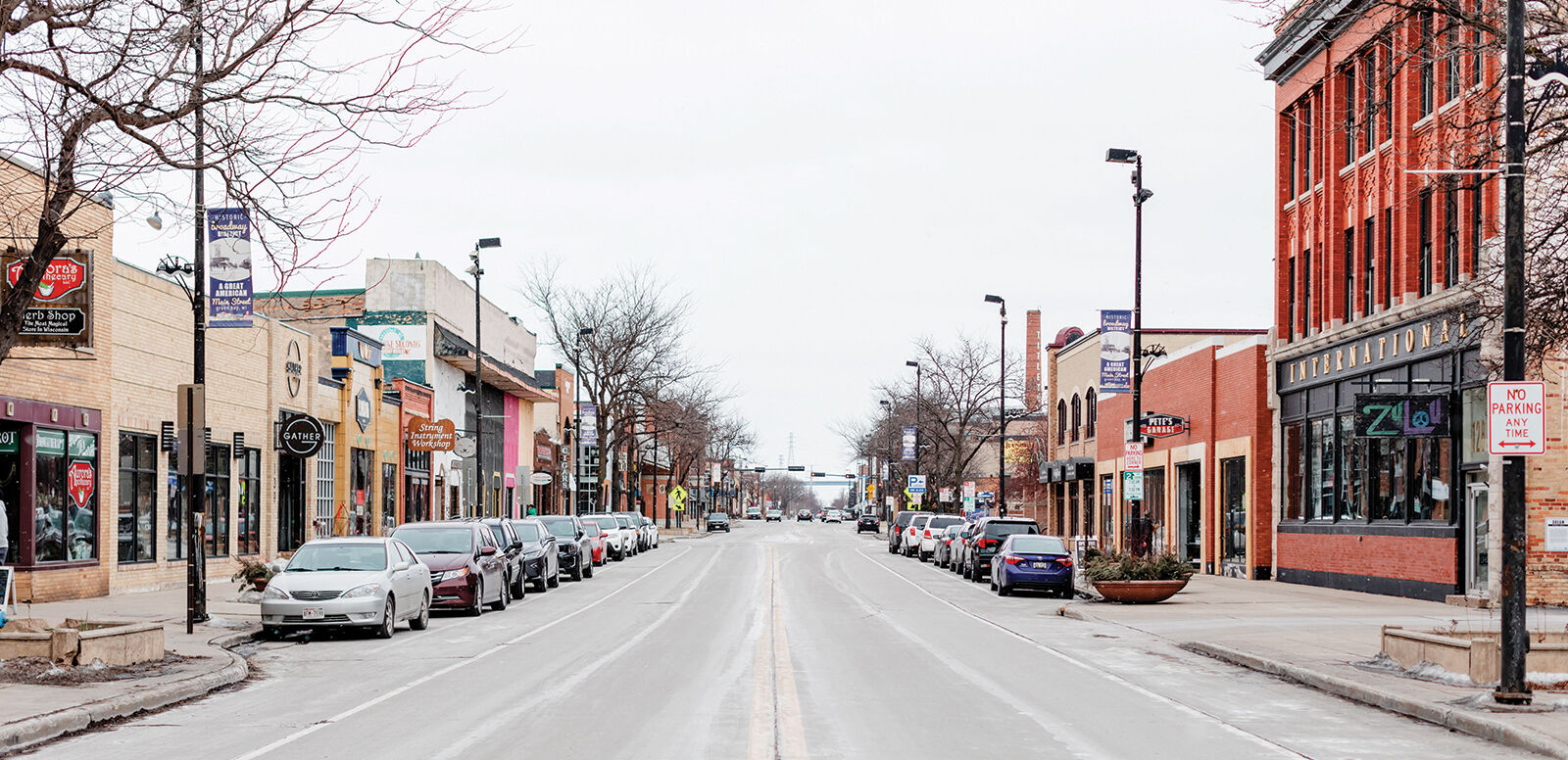

[above] About 30 businesses in Green Bay’s Broadway District received Main Street Bounceback grants. Photo by Audrey Thomas Photography
Despite a gaping hole in the ceiling and extensive water damage, the building at Waupaca’s 111 N. Main Street captured Megan Swisher’s imagination.
“When we walked in, it was in very rough condition, but we popped a couple of the drop ceiling tiles off and saw the original tin ceiling underneath,” Swisher says. “And I literally knew this place was for us.”
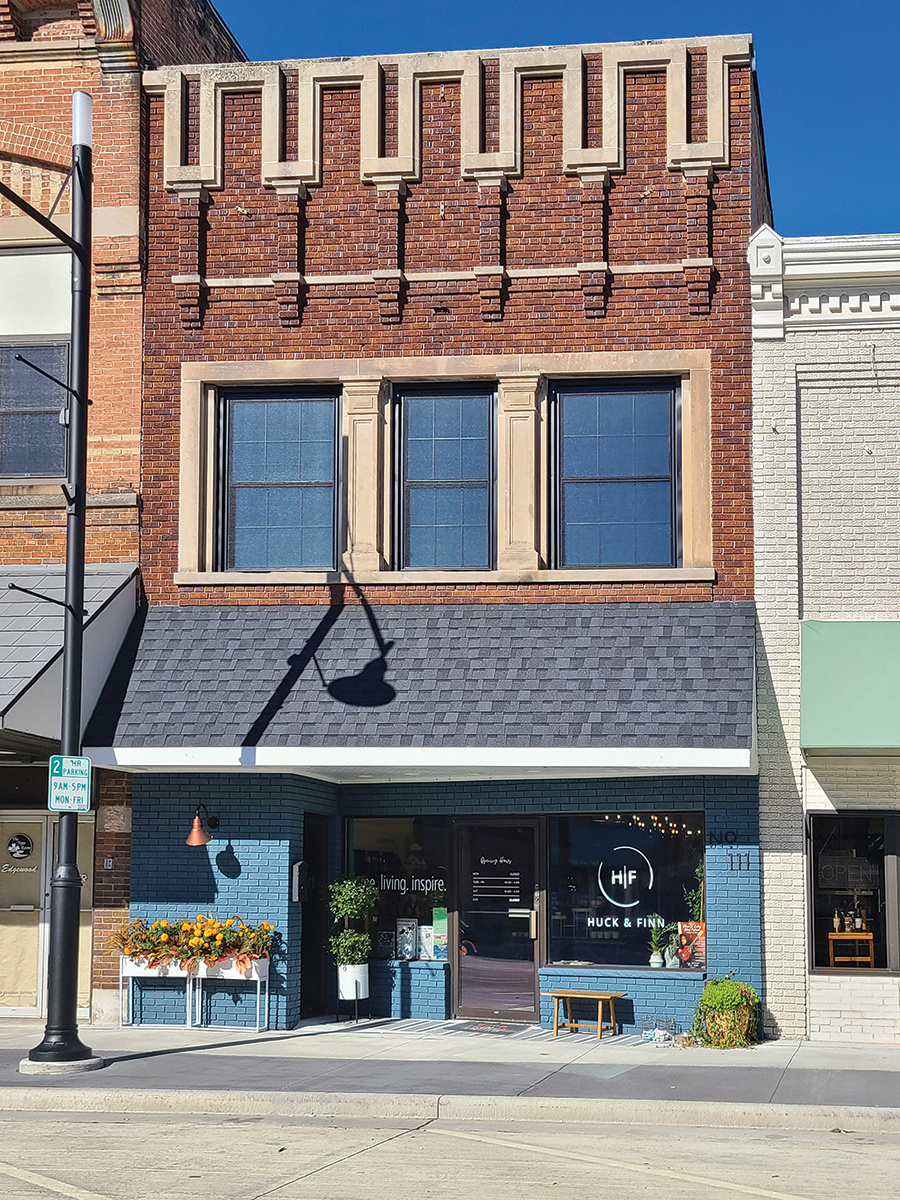
Swisher and her husband, Michael, purchased the historic 1870s building on May 1, 2021 for $35,000. The couple spent eight months and an estimated $150,000 gutting and renovating the street-level storefront, transforming it into Huck & Finn, a home décor store.
But for Swisher, Huck & Finn is more than boho-chic textiles, plants and gifts — it’s the realization of a dream.
Swisher’s business was one of 1,680 in the 18-county New North region that received a Main Street Bounceback grant — a state grant, funded by the $1.9 trillion federal American Rescue Plan Act (ARPA), that provided businesses with one-time $10,000 grants to fill vacant commercial and industrial buildings.
For new business owners like Swisher and her husband, that extra $10,000 helped them stomach the extensive repairs the building required.
“When we were looking at how much work there was to do, it helped us sleep at night knowing that we were buying this run-down building, but we would have money available for repairs,” she says. “The grant was a huge incentive. Knowing we had the grant made it a no-brainer.”
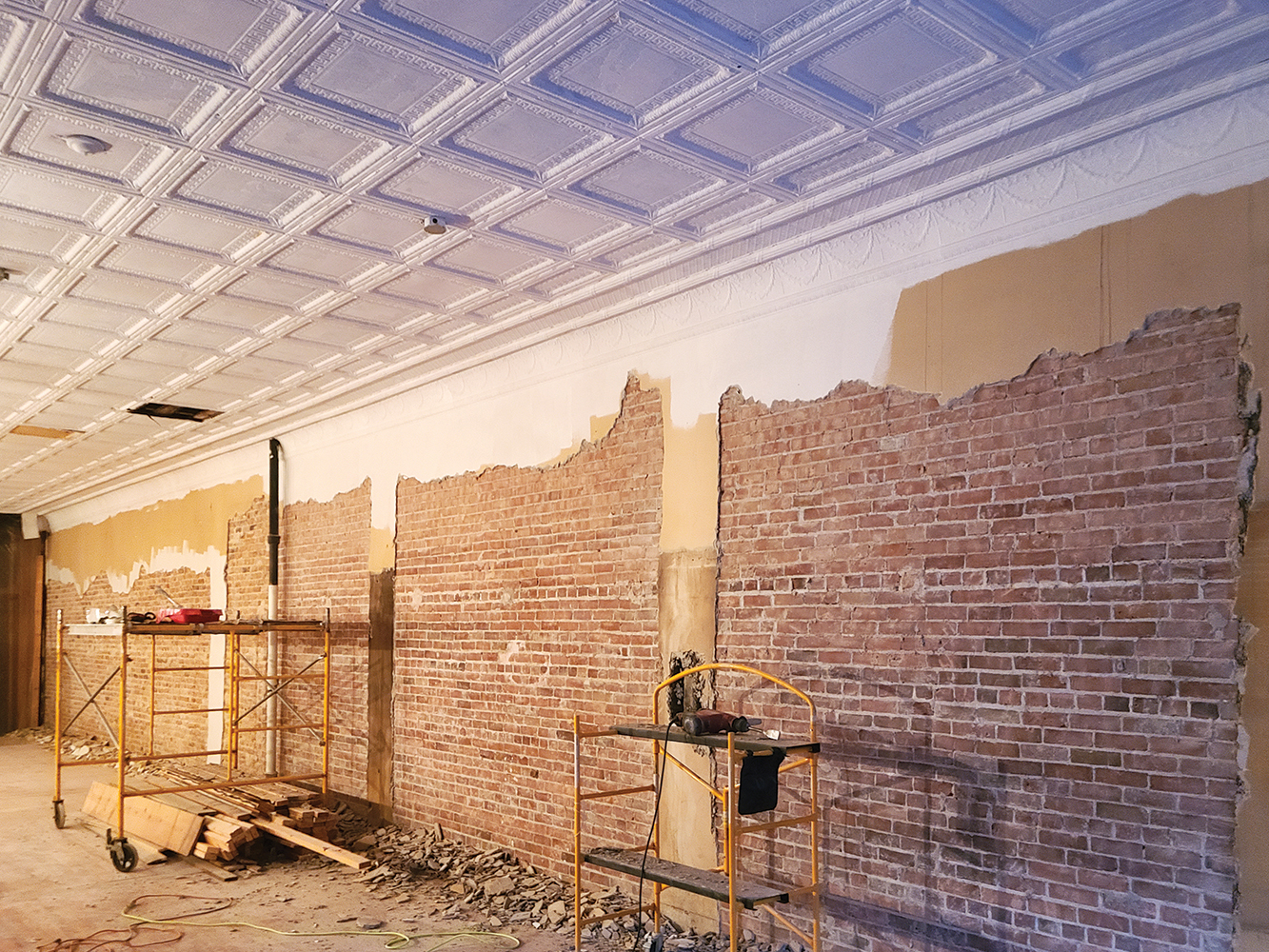
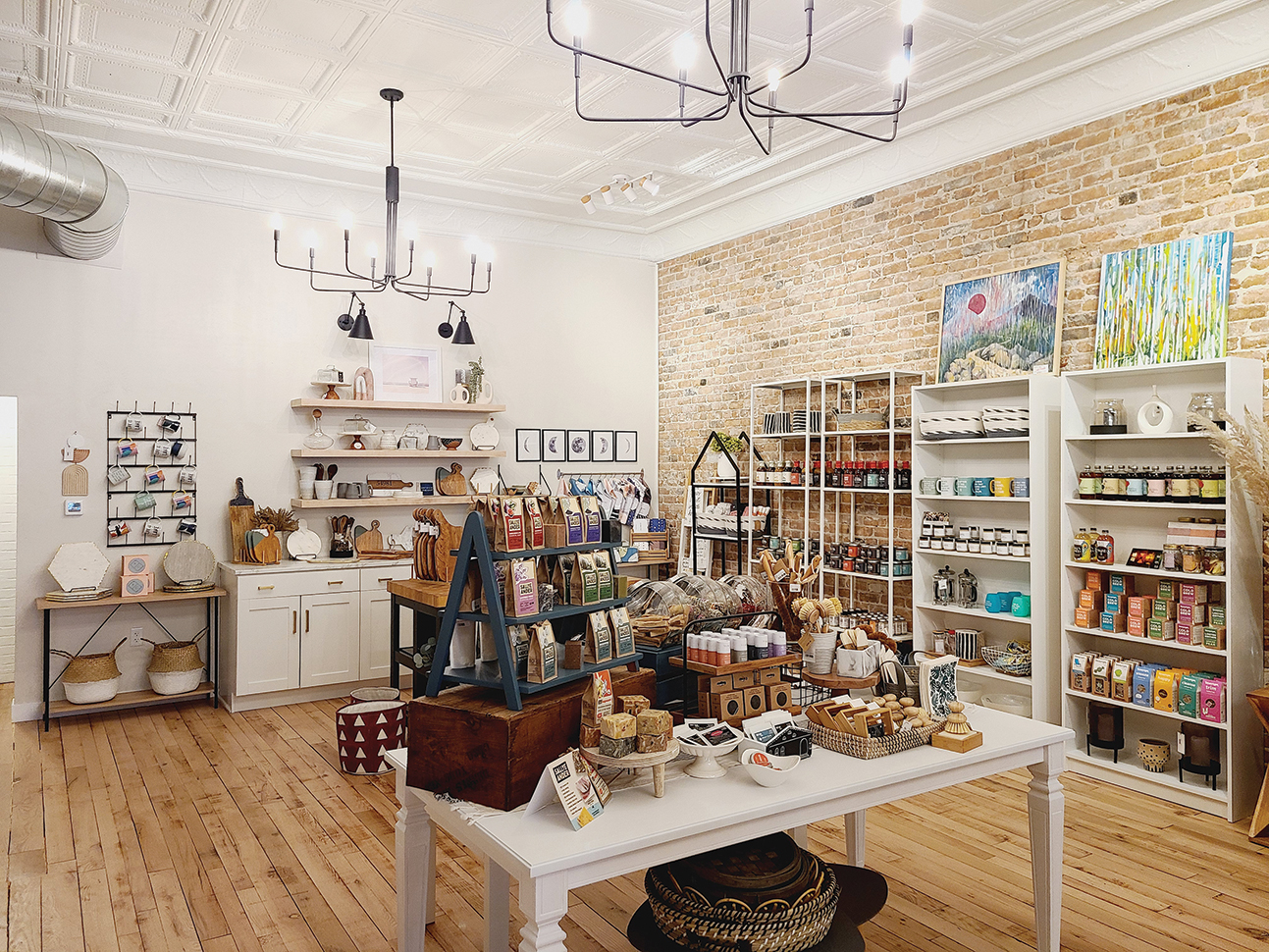
Huck & Finn opened in June 2022 with a new roof, exterior updates, updated electrical, new lighting, windows and plumbing, and an ADA-compliant bathroom. Looking at the storefront now — with gleaming hardwood floors, exposed brick and restored tin ceiling — you’d never know the state of disrepair it was in just two years ago.
Swisher says that without the grant, her business may not have been able to receive the loans she needed to complete the renovation and it definitely would not have been able to open as quickly as it did.
“The grant made it realistic for us,” she says, “like, we could actually do this.”
Reenergizing Main Street
In total, the Main Street Bounceback (MSBB) grant program has helped 8,500 small businesses like Swisher’s expand and move into vacant storefronts in communities across all 72 Wisconsin counties.
This type of support is crucial for Wisconsin’s small businesses. According to data from the Kauffman Foundation, Wisconsin in 2021 ranked 47th among the 50 states and Washington, D.C. for its rate of entrepreneurship, or the percent of the population that started a new business that year. (While there is room for improvement, this beats the state’s 2014 ranking of dead last.)
In his State of the State address in January, Gov. Tony Evers touted the success of the MSBB program in bolstering Wisconsin’s startup activity.
“Since 2019, we’ve seen significant increases in business startups. New business formations increased to more than 71,000 — that’s a 42% increase between 2019 and 2021,” Evers said.
While Wisconsin continues to lag in entrepreneurship, there is one list the state tops — its investment in economic development using fiscal COVID-19 recovery funds. A 2023 Center on Budget and Policy report found that Wisconsin ranks No. 1 in the country for federal ARPA dollars invested in economic development. The state spent nearly 56%, or $1.1 billion, of its ARPA funds on economic development, which includes its $100 million MSBB program.
“A key priority in our strategy for investing federal pandemic aid was supporting Wisconsin’s small businesses, our workforce and long-term economic development. And we were successful,” Evers said in his January address.
“The grant was a huge incentive. It gave us the opportunity to make our dream a reality.”
— Megan Swisher, Huck & Finn owner and MSBB grant recipient
The Wisconsin Economic Development Corp. launched the MSBB grant program on Aug. 4, 2021, providing financial assistance to new and existing businesses to fill vacant commercial and industrial spaces. Grant funds could be used for lease or mortgage payments, operating expenses, building repairs, tenant improvements and other qualified expenses.
The state initially invested $50 million in the MSBB program with a closure date of June 30, 2022. But due to strong demand, the closure date was extended through Dec. 31, 2022 and the state added an additional $50 million investment for a total of $100 million in grant funding.
WEDC contracted with nine regional planning commissions and economic development organizations to administer the program. Bay Lake Regional Planning Commission administered the program for the counties of Brown, Door, Florence, Kewaunee, Manitowoc, Marinette, Oconto and Sheboygan. The East Central Wisconsin Regional Planning Commission (ECWRPC or East Central) administered the MSBB program for its 10-county region including Calumet, Fond du Lac, Green Lake, Marquette, Menominee, Outagamie, Shawano, Waupaca, Waushara and Winnebago.
The East Central region was initially allocated $3 million of funding, but WEDC increased the allocation to $9 million based on demand.
Melissa Kraemer Badtke, ECWRPC executive director, says East Central awarded 900 grants throughout its region over the 17-month program. ECWRPC hired a limited-term employee to help administer the program, which was awarding an average of 53 grants per month.
Using data collected from the grant applications, ECWRPC released its final report last month that revealed the majority, 80%, of businesses receiving grants were less than five years old. Fifty-five percent were in their first year of business. The report also showed that slightly over half of businesses receiving grants were women-owned ventures and approximately 19% reported having owners who are ethnic minorities.
“As I go out to meetings across the region, I get to see the downtown areas and the businesses, and sometimes I’ll stop in and be like, ‘Hey, you were a Main Street Bounceback grant recipient. How is business going?’” Kraemer Badtke says. “It’s really neat to see the different businesses that we awarded funding to across the region thriving and succeeding.”
Accelerating business, building communities
While more populated counties like Outagamie, Winnebago and Fond du Lac may have been awarded a higher number of grants, Kraemer Badtke says rural counties like Waupaca, Shawano and Calumet saw some of the biggest benefits.
“It was your smaller villages and cities that really benefited from the program in terms of being able to have a new business come into their downtown,” she says. “For a smaller community, that’s huge.
This was especially true in the city of Waupaca, where 15 businesses — many in the downtown district — received MSBB grants.
Waupaca City Administrator Aaron Jenson said the grant funding couldn’t have come at a better time and provided relief for businesses after two years of back-to-back challenges: COVID in 2020 and a major Main Street infrastructure project in 2021.
“Waupaca is largely based on tourism and visitors, so having two summers with those kinds of disruptions was challenging for our businesses,” Jenson says. “Main Street Bounceback coupled with a couple other [grants] happening in Waupaca really helped the downtown area and the whole city become what it has.”
In addition to the MSSB funding, the city received a $118,000 WEDC Community Development Investment Grant, and $900,000 in downtown business grants were given through TIF district funding.
“All of those together leveraged some pretty impactful changes,” Jenson says. “We went from 2018-19 when you could list a lot of vacant storefronts to 2022-23 when we have people who want to move into town and are calling to get in but there aren’t many, if any, options because most places are filled. It’s a great problem to have.”
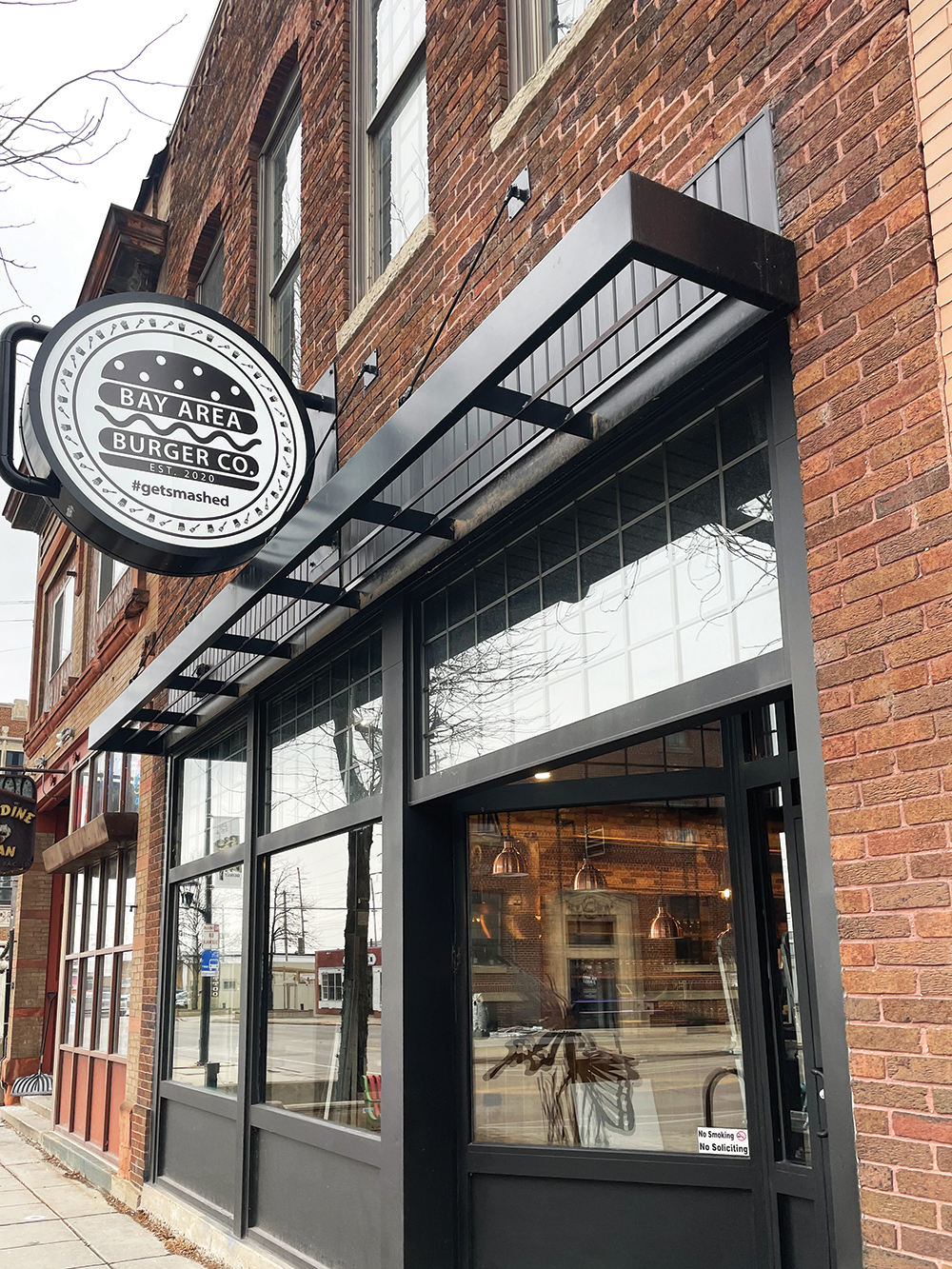
In Green Bay’s Broadway District, about 30 businesses received MSBB grants. On Broadway, Inc. Executive Director Brian Johnson says the grants accelerated the leasing of office spaces and spaces under development.
“We saw a tremendous uptick in the amount of office space that became occupied post-pandemic,” Johnson says. “Having this grant eliminated the risk often associated with signing a new lease and gave people a period of time when they could comfortably lease space and have a runway to determine what their long-term needs are.”
“It’s really neat to see the different businesses that we awarded funding to across the region thriving and succeeding.”
— Melissa Kraemer Badtke, ECWRPC executive director
In addition to the volume of new leases, Johnson saw the lease terms increase as well.
“While the Bounceback grant only required a one-year lease, we saw a lot of people signing longer-term leases. And it was the grants that were really the catalyst that enabled them to make those types of commitments,” he says.
The MSBB program was such a success, Johnson says, that the Broadway Business Improvement District has created a new program modeled after it that is focused exclusively on retail operations — the district’s biggest need. The pilot program, scheduled to launch in 2023, has been allocated $10,000 for its first year with plans to award four $2,500 grants to retailers.
“We want to eliminate barriers and hurdles for retailers,” Johnson says. “We want to encourage those types of startup businesses because that’s what makes the fabric of an interesting and attractive community — those spaces that are destinations and encourage that shopping economy.”
While individual districts and cities are considering their own business incentives, Gov. Evers allotted additional MSBB program investments in his proposed 2023-25 Wisconsin state budget, including $50 million to continue awarding grants and $5 million in ARPA funds dedicated to technical assistance, mentorship and educational training for grant recipients.
Swisher hopes to see the momentum created by the MSBB program continue because the grant money helped her secure further funding and, ultimately, reach her entrepreneurial goals.
“I know that was a huge incentive for banks to take a big risk on us. I don’t know if I would have gotten a business loan without it,” she says. “It gave us the opportunity to make our dream a reality.”

