
By Chad Hayes
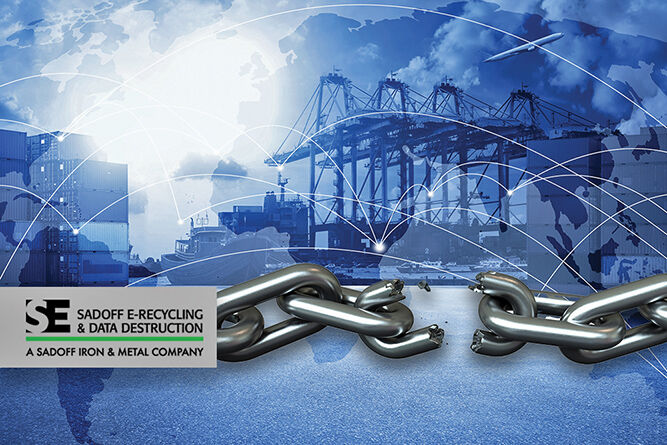
When the pandemic arrived in 2020, nobody could have predicted the impact it would have on the global economy. As consumer demand fell and the workforce dwindled, business around the world shut down. One of the most obvious effects of this shutdown is the disruption of worldwide supply chains.
Government incentives, coupled with rising consumer confidence, have caused demand for products to skyrocket. Meanwhile, suppliers and manufacturers face shortages of raw materials, components and labor. At the same time, distributors deal with similar labor scarcity, border controls and shipping bottlenecks.
E-Recycling’s economic impact goes far beyond environmental issues
The e-recycling industry finds itself in an unexpected position: We can help alleviate some of the impact of these supply chain constraints in a variety of sectors, most notably electronic components, rare earth metals and select raw materials.
When people think about e-recycling, what typically comes to mind are the positive environmental effects. Most are also aware of how recovering various metals from obsolete electronics can help mitigate the demand for raw materials and the energy needed to obtain them. What many don’t know, however, is how e-recycling can simplify many supply chain complexities, shorten delivery timelines, reduce material and component costs, and fill gaps in availability for many products.
For example, one item currently in short supply is integrated circuit (IC) chips. The majority are commonplace and can be used in a variety of applications. They are often found in obsolete electronic devices and, once harvested, can quickly enter the supply chain to refill empty or rapidly shrinking inventories. In doing so, raw materials and energy are saved, pollution is minimized, and items needed to alleviate product shortages become more readily available.
Many raw materials recovered in the e-recycling process are also in high demand, like gold, platinum and palladium, as well as more common metals like copper, iron and aluminum.
Making a difference in the global economic crisis
Nobody anticipated the impact COVID-19 would have on the global supply chain, much less on the e-recycling industry specifically. We’ve always been committed to helping businesses and individuals reduce their impact on the environment, assisting in the preservation of precious raw materials, and saving companies money in manufacturing and disposal costs along the way.
We didn’t expect to have this opportunity to affect people in such a profound and immediate way. We’re honored to be called to the challenge, but we can’t do it alone. Right now, millions of electronic components and thousands of tons of raw materials are inside the devices hidden in drawers, closets, basements, garages, storerooms and warehouses in every corner of the world … and in every corner of your world.
Spend a few moments right now thinking about the obsolete items you have tucked away throughout your home or business and bring them to a reputable e-recycling drop-off location near you. View our list of locations or contact us to find one near you.
About the Author
Chad Hayes
Chief Technology Officer and
Director of E-recycling, Sadoff E-Recycling & Data Destruction Co.
Chad Hayes is the chief technology officer and director of e-recycling at Sadoff E-Recycling & Data Destruction. He joined Sadoff Iron and Metal in 2015, and oversees the strategic planning and implementation of IT. With his extensive 20-plus years of IT and business leadership experience and a passion for data security, he was the perfect choice to establish, build and lead the Sadoff E-Recycling & Data Destruction Company, a company of Sadoff Iron and Metal. He can be reached at hayesc@sadoff.com.
The views and opinions expressed in this article are those of the author and do not necessarily reflect the official policy or position of Insight Publications, LLC.

