
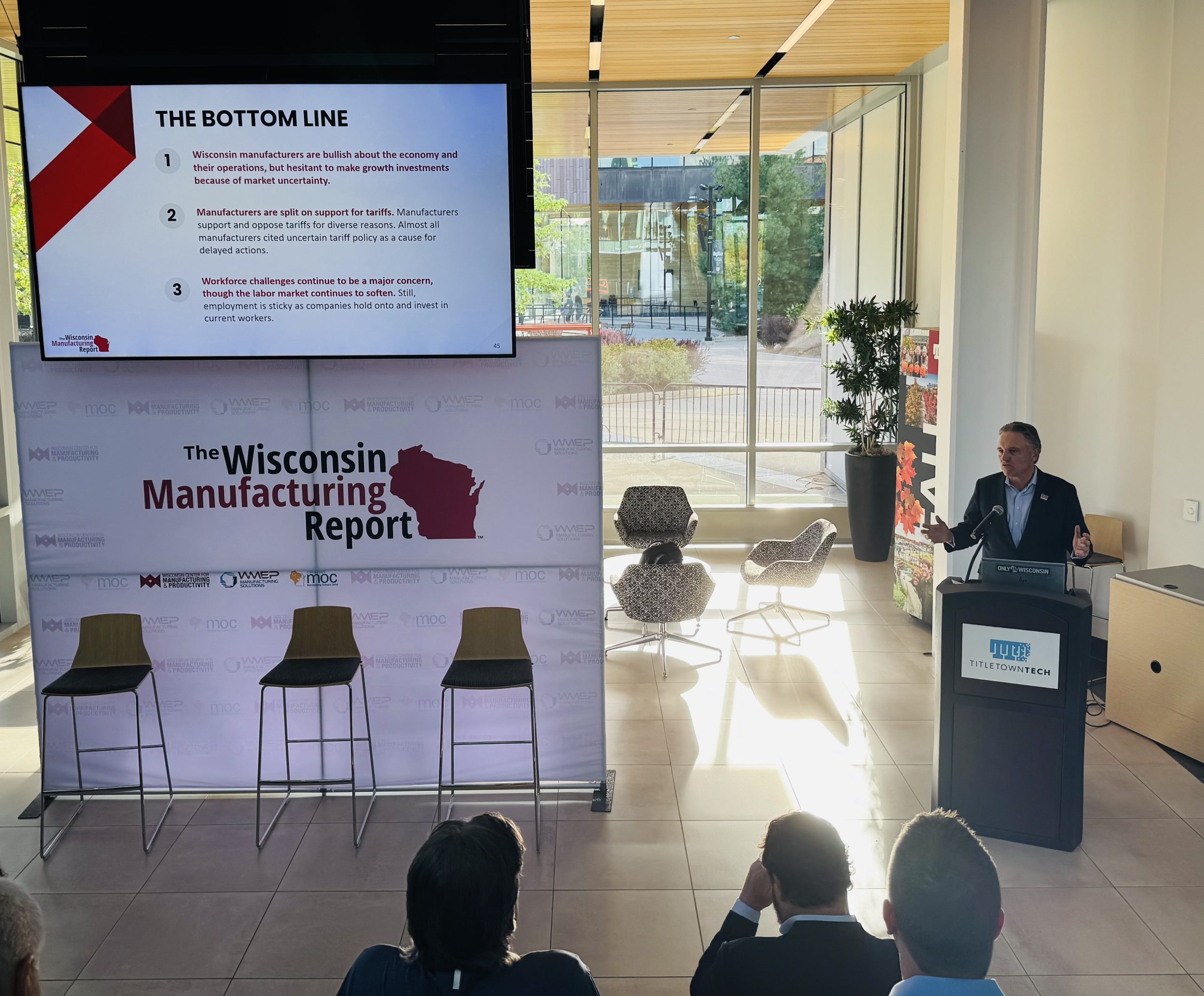

Titletown Tech on Tuesday played host to a readout of the Wisconsin Center for Manufacturing & Productivity’s (WCMP) fifth annual Wisconsin Manufacturing Report.
The report, which was compiled by seasoned pollster Rob Autry of Meeting Street Insights, captures the views of 405 Wisconsin manufacturing executives, primarily representing small- and medium-sized businesses, as well as insights from manufacturing focus groups held across the state.
Key takeaways from this year’s study fell into the categories of workforce, economic optimism, tariffs and AI, according to WCMP CEO Buckley Brinkman. Brinkman and Autry elucidated the findings and answered questions from a public audience that gathered Tuesday afternoon in Green Bay.
Workforce challenges have been a consistent top concern in the study, though Brinkman says a softening labor market is likely reducing the number of respondents saying hiring is “very difficult,” which reached a record low 31% this year and has dropped annually since 57% of respondents made this claim in the study’s first year (2021), which was at the height of post-pandemic labor challenges.
Confidence in the state’s business climate was at an all-time high in the 2025 study, jumping 18 points from the prior year.
Autry says the big jump may have in some ways been an “overcorrection” from last year’s strong concerns about inflation.
“Close to half the [2024] sample was really concerned about inflation; high numbers of manufacturers thought we were heading into a recession,” he said.
And while the market still faces uncertainty, one-third of the 2025 survey respondents said Wisconsin’s economy is growing. Company-level confidence remains extremely high, with 90% of executives optimistic about their financial future.
Economic uncertainty primarily stems from concerns about tariffs and trade policy; nearly three-quarters of survey respondents said their company was affected in some way by the Trump administration’s recent tariffs, either positively or negatively. Larger firms were more likely to feel negative effects, Autry says, and responses often differed based on the category of products being manufactured.
“Manufacturers are pretty divided on this,” Autry told attendees at Tuesday’s event. “Twenty-eight percent believe trade negotiations will help their business; twenty-six percent believe it will hurt.”
One major takeaway in this year’s study is that, regardless of specific tariff implications, companies are looking to grow their customer base within the United States more than ever, with “finding new customers and markets” topping workforce concerns as manufacturers’ most important growth driver for 2025.
“One thing that was really clear in this survey and in the focus groups we did afterwards was that more and more manufacturers are looking in their backyard for new prospective business,” Brinkman said. “A year ago, 80% said that the United States was the part of the world where they see the greatest increase in prospective business. Today, it’s at 87%. And while that may not seem like a huge jump over the span of one year, that data has been remarkably flat for the previous four years. So this was a noticeable change from what we’ve seen in previous data sets.”
Not surprisingly, the study also found that automation and AI adoption is accelerating significantly in Wisconsin. Nearly three-quarters of executives view automation as critical, and more than one-third are already using AI, which is triple the number from 2023. This year, about 55% of respondents fall into the category of “embracing AI,” Autry says.
“They’re either currently using it [or] considering using it and think it will be a part of their long term business plans,” he explained.
For those still reticent to utilize AI, Autry says the study identified four main categories of obstacles: a lack of internal expertise or positions within their company to handle AI, difficulty integrating existing data in the company with AI, upfront investment costs and concern about ROI, and “not really [being] sure where to get started.”
Adoption appears to be more seamless in smaller companies: “Interestingly, we found that smaller manufacturers simply had less obstacles when it comes to using AI,” Autry said.
Overall, Brinkman says, the 2025 report shows that Wisconsin manufacturers are bullish about their operations and the state economy, set against the backdrop of lingering hesitation due to market uncertainty. Companies continue to invest in productivity, workforce training and technology while balancing challenges around tariffs and workforce retention.
“For the fifth year running, this report offers an honest snapshot of Wisconsin manufacturing,” Brinkman said in a press release this week. “It shows resilience, innovation and a determination to thrive despite challenges at home and abroad.”
Read the full report online.