
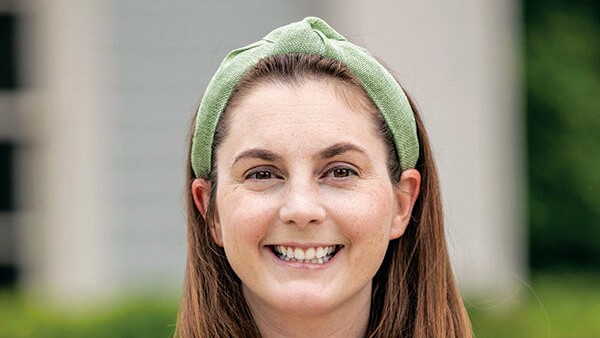

As a startup founder from Kohler, Stephanie Hoskins kept hearing the same advice.
“We had lots of investors and people tell us if you’re really serious, you have to move,” says Hoskins, who used her background in health care finance to launch Debtle, a platform that helps patients negotiate medical debt directly with providers.
But Hoskins had no interest in relocating to a coast or even a larger city in Wisconsin. She loves her life in Kohler where the school district is stellar, quality of life is high and housing is affordable.
Hoskins knew she wasn’t alone. She believed there were many founders like her — serious about their ideas, but largely invisible to the entrepreneurial ecosystems simply because of geography.
“There are tons of startup ideas all through rural Wisconsin,” says Hoskins, who is now an instructor of business administration and the Herbert Kohler & Frank Jacobson Chair in Business and Entrepreneurship at Lakeland University. “They live everywhere.”
From a new state initiative targeting rural startups to a grassroots consortium forming across Northeast Wisconsin, efforts are accelerating to reduce barriers for entrepreneurs living outside Madison, Milwaukee and Green Bay.
“Five out of 6 Wisconsin founders are located outside of those three main cities,” Hoskins says. “I think that’s very unique. For us, if you ignore rural, then you’re ignoring most of the population and that’s just not a way to build an effective strategy around entrepreneurship.”
Connecting Entrepreneurial Communities
The community of Green Lake — population 1,001 — set the stage for the third annual Connecting Entrepreneurial Communities (CEC) Conference May 13-15.
Nearly 200 economic developers, municipal leaders and business owners from 50 unique entities attended the conference “about small towns, for small towns.” The conference was part of UW-Extension’s Community Economic Development program and organized by the Rural Wisconsin Entrepreneurship Initiative.
The event included workshops and tours, programming on rural entrepreneurship, keynotes from area business owners and one-on-one coaching for small businesses — all with the goal of building durable entrepreneurial ecosystems in rural Wisconsin.
John Miller, CEO of the Wisconsin Economic Development Corporation, provided opening remarks at the historic Thrasher Opera House, making a personal case for rural entrepreneurship.
A native of Manitowoc, Miller worked as a congressional staffer in Washington, D.C., earned a master’s in public policy from Georgetown and practiced law before returning home to run his family’s century-old farm equipment manufacturing business in St. Nazianz in rural Manitowoc County.
That path, he said, shaped his approach to economic development. Miller outlined a slate of programs and grants targeting rural communities that face unique challenges. One such program is the Thrive Rural Wisconsin program, through the Office of Rural Prosperity, which partners with local economic development organizations on housing, small business support and leadership development.
“We know that you don’t necessarily live down the street from a university or technical college that could help in those endeavors,” Miller said. “We want to be that resource.”
The program provides technical assistance grants to communities building their economic development capacity — a second cohort of 10 communities and organizations was recently announced. A new round of small business development grants distributed $1.5 million across 10 organizations and, in combination with a technical assistance grant, will support more than 2,000 individuals and businesses statewide.
Wisconsin as a whole has historically lacked the startup and capital density found in hubs on the coast, making it harder for early-stage companies to attract investment, launch and scale. Ignite Wisconsin, which the WEDC launched last year, is another initiative designed to increase the number of high-growth startups and the infrastructure that supports them.
The Cheese Wedge Consortium, led by New North, Inc. with UW‑Green Bay, gener8tor and a network of regional collaborators, received a $1 million Ignite grant in February to provide accelerator programming, pre-seed funding “bootcamps” and corporate engagement efforts. The effort will include equity investments, legal and housing stipends for relocating entrepreneurs, co-working spaces and more.
The consortium plans to support 21 Northeast Wisconsin startups and 42 participants within a year, while providing direct funding to 18 businesses, creating 46 new jobs and generating $3.4 million in revenue.
“We want to give everybody the opportunity to thrive, no matter where they come from,” Miller said.
Jason Pausma, economic development director for Calumet County, said state support is crucial to his county that has a population of just under 54,000.
“I get calls from entrepreneurs throughout the year, [but] we don’t necessarily have the capacity in-house to run a 12-week class, so there are resources we connect with a lot, like the SBDC and SCORE,” he says.
Despite funding being “a tough nut to crack,” Pausma hopes to create a revolving loan fund to support entrepreneurs, similar to models discussed by several communities at the conference.
“The numbers show most of your jobs come from small businesses,” he says. “We have a lot of legacy manufacturing companies in Calumet County, which are awesome, but I’d love to see more entrepreneurs in our rural communities.”
Fueling the fire
Entrepreneurs exist across rural Wisconsin, but the infrastructure to support them is often stretched or scattered. A growing regional coalition is working to change that.
Hoskins is a founding member of the FIRE Consortium — Friends of Innovation in the Rural Ecosystem. The collective of universities, EDOs and nonprofits helps rural founders launch and scale startups.
Current members include Lakeland University, Progress Lakeshore, Sheboygan County Economic Development Corp., Accelerate Sheboygan, ColorBold Business Association, Midwest Founders Community, MKE Tech Hub, Wisconsin Startup Coalition and WISys.
The group is targeting a fall application for a WEDC Ignite grant. In the meantime, the agency provided interim sponsorship funding to keep programming moving.
Under that sponsorship, FIRE Consortium is holding a series of networking and pitch events, including recent Startup Idea Nights in Sheboygan and Manitowoc. The free events feature an open mic quick pitch competition that is open to all.
“Every community has all these hidden entrepreneurs,” Hoskins says. “One of the hardest things is finding them and bringing them out to the sunlight.”
According to the Bureau of Labor Statistics, between the first quarter of 2021 and the second quarter of 2024, small businesses with 249 or fewer employees — which includes most startups — made up nearly 53% of the total net job creation in the United States.
This means lagging in new business startups is a problem that Wisconsin needs to address, Hoskins says, particularly as Gen Z emerges as one of the most entrepreneurial generations ever.
“The new startups today are in the growth phase — and that’s where job creation comes from,” she says. “If you are relying on the big names that we all know, they’re not going to be the job creators in the next decade. That’s one reason it’s so critical to constantly be seeding the ecosystem to farm the next generation.”
BOXOUT: By the numbers
48 million
The number of people living in rural America (defined as nonmetropolitan counties) which is nearly 15% of the population
12%
Percent of all businesses are in rural America, but just 6% of high-tech establishments are in rural communities
>51%
Percent of the rural workforce that wants to own their own business in the future, compared to 41% of nonrural workers
<2%
Percent of venture capital invested in rural businesses
84%