
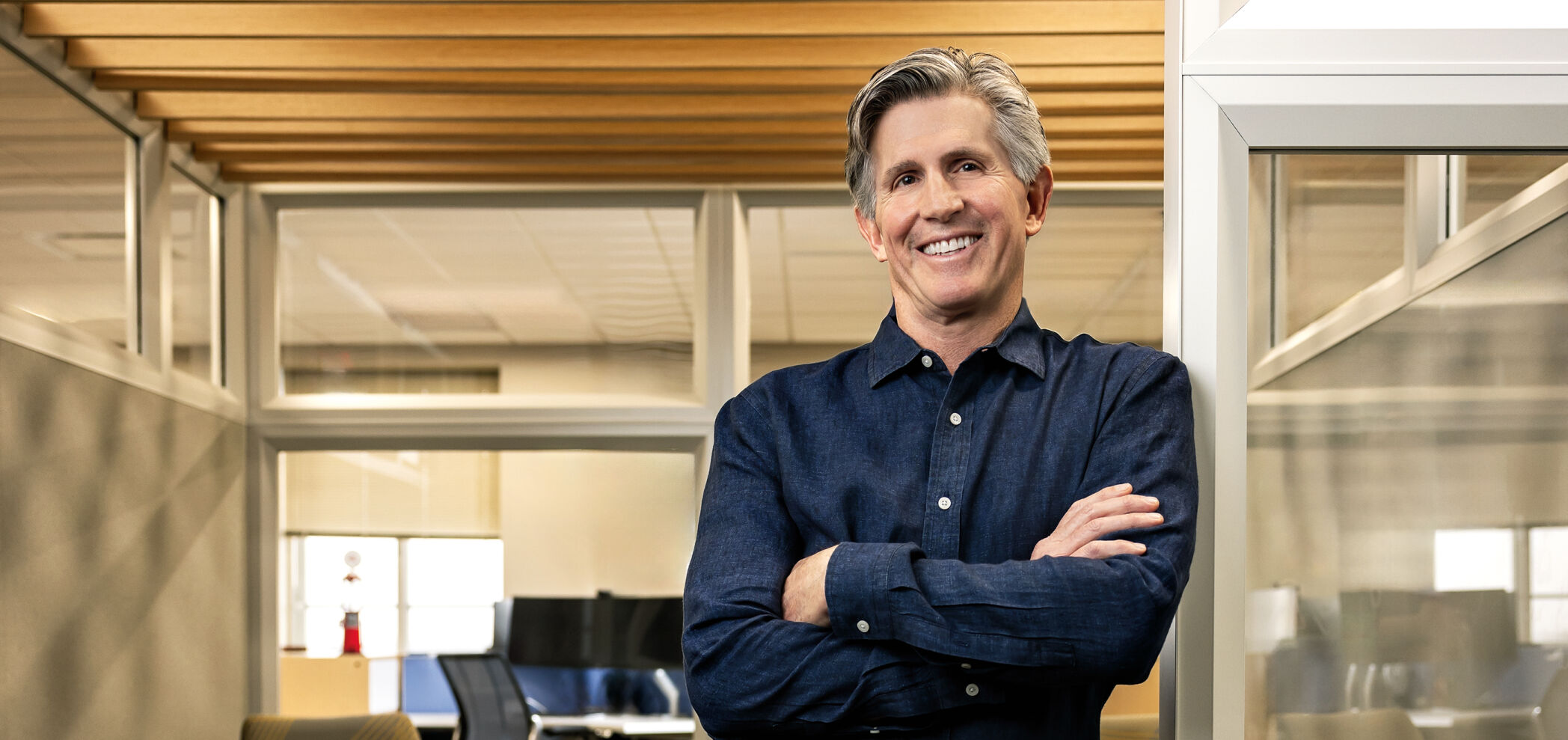

Sitting across from John Schmidt in his office at U.S. Venture’s Kimberly headquarters, a picture taped to the wall behind him keeps catching my gaze.
The eyes of a young John Schmidt twinkle mischievously in what is clearly a school photo. It’s printed on a piece of paper above a report card on which, in the flawless script of his seventh-grade teacher, is written one comment: “John seems to lack control of himself.”
It’s hard to imagine this spritelike boy smiling back at me being capable of any real trouble, but those qualities that tested his teachers’ patience are the same ones that have made Schmidt an effective and transformational leader of U.S. Venture the last 17 years.
Boundless energy — check.
A high level of risk tolerance — check.
Seeing potential where others see impossibility — double check.
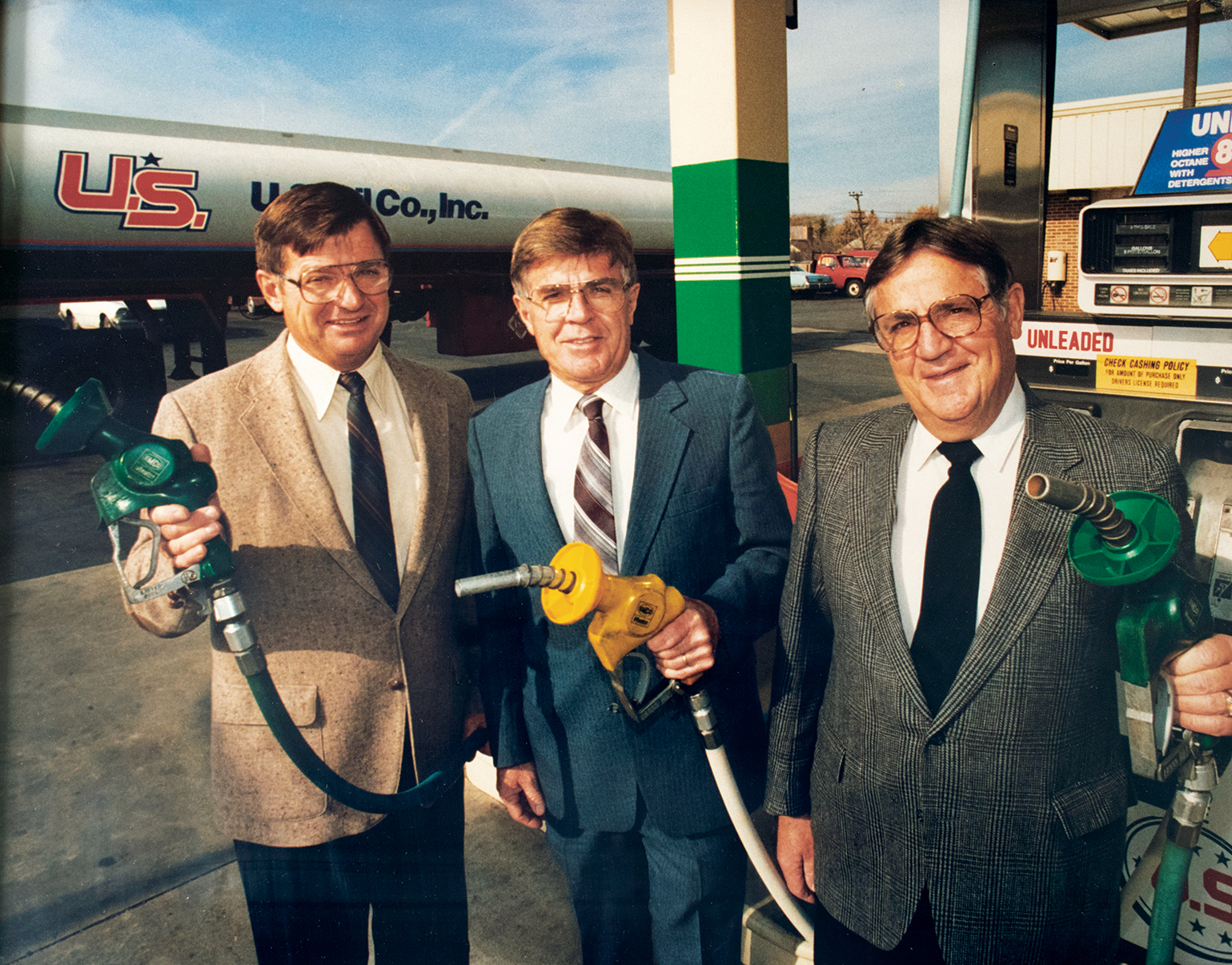
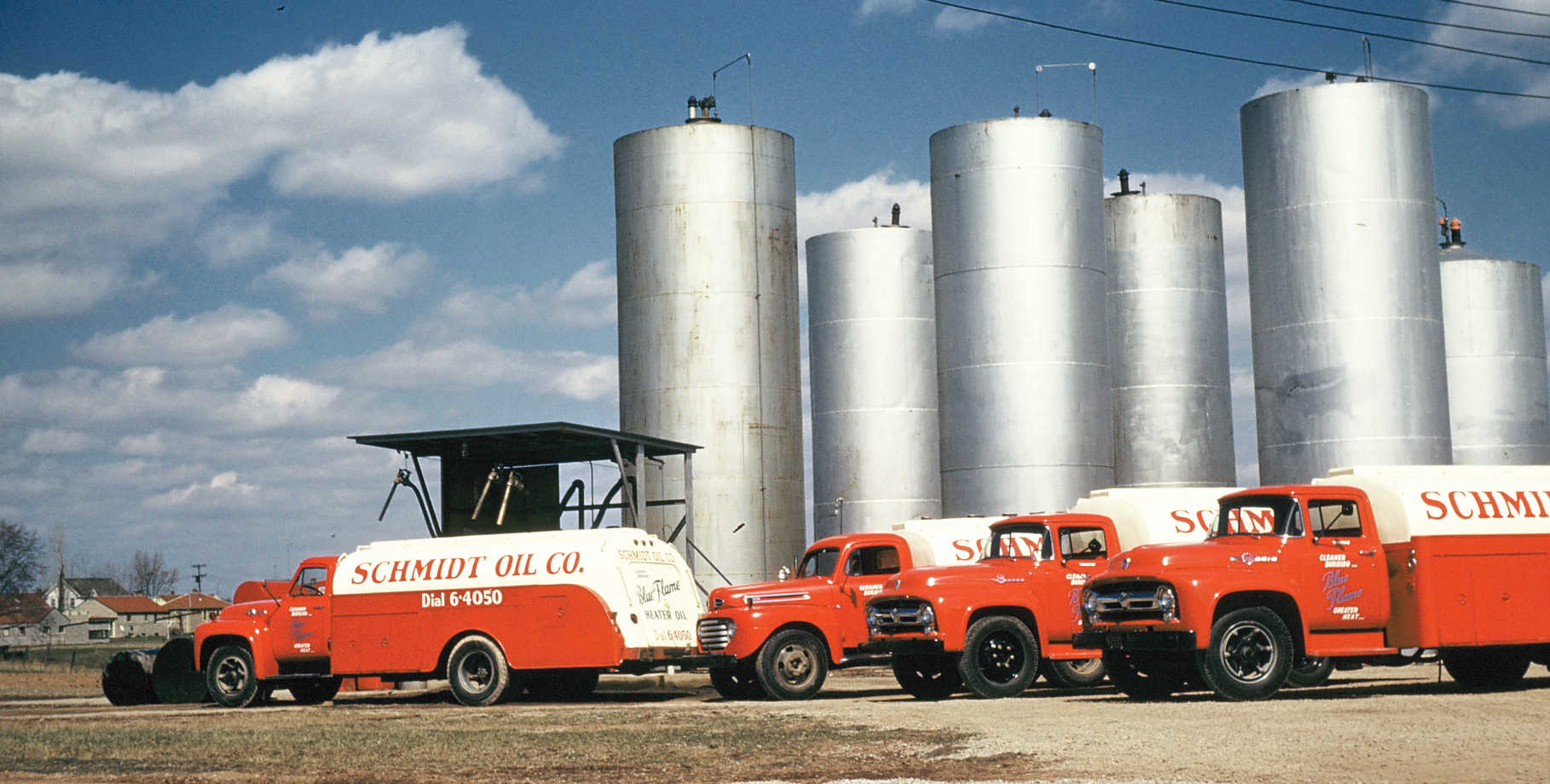
Schmidt’s tenure as CEO came to an end last month, but his report card is a testament to his enterprising family lineage. U.S. Venture was founded in 1951 as Schmidt Brothers Oil Company by John’s father Art Schmidt and uncle Ray Schmidt. Later, his uncle Bill Schmidt would take equal ownership stock in the company as well.
In a 2019 company video, the late Ray Schmidt recalled the many risks he and his brothers took in the early days. About 52% of those were successful, he estimated. From purchasing a truckload of Cooper Tires with no plan for storage or distribution to traveling to Saudi Arabia during the 1973 oil crisis to get King Faisal to reconsider cutting off exports to the United States, the Schmidt family has a long history of taking bold chances that have led to tremendous growth for the company.
“We’re a company that will take risks,” John Schmidt says, “and we understand that when you take risks, you’re going to win sometimes and you’re going to lose sometimes. We are risk takers, and if we fail [we don’t] dwell on the failure but learn from it.”
Ray Schmidt credited this appetite for risk — along with a forward-thinking team — for the company’s growth from a single fuel oil route in Kimberly to a national company with five divisions, 120 locations and a team of more than 4,600 employees.
“If you call us growing then, I don’t know what you’d call it today,” he said in the video. “It’d be skyrocketing.”

driving growth
By the time Schmidt’s seventh-grade school photo was taken, he was already working a full-time summer job at his family’s company. Schmidt’s three brothers, five sisters and several cousins worked alongside him.
After graduating from the University of Wisconsin-Eau Claire with an accounting degree, Schmidt joined Custom Machinery Design Corporation, today known as CMD Corporation, in Appleton. Taking the job outside the family business felt like a risk, so Schmidt consulted his father for advice.
“He said to me, ‘If you don’t take a chance, you won’t have a chance,’” Schmidt recalls. “I think about that line all the time. That’s what I needed to hear from him.”
Over 16 years as president, Schmidt grew CMD Corporation from a startup to a market leader in product development, manufacturing and distribution of high-speed flexible film converting equipment.
In 2006, U.S. Venture approached Schmidt, who was serving on its board of directors, to come work inside the company. It was an offer Schmidt admits he wasn’t completely prepared to take.
“I really loved what I was doing at CMD, but my daughter had just been accepted to Colorado College in Colorado Springs. I was watching how she was educating herself and really challenging herself to do something different,” he says. “That’s actually what convinced me to come to U.S. Venture.”
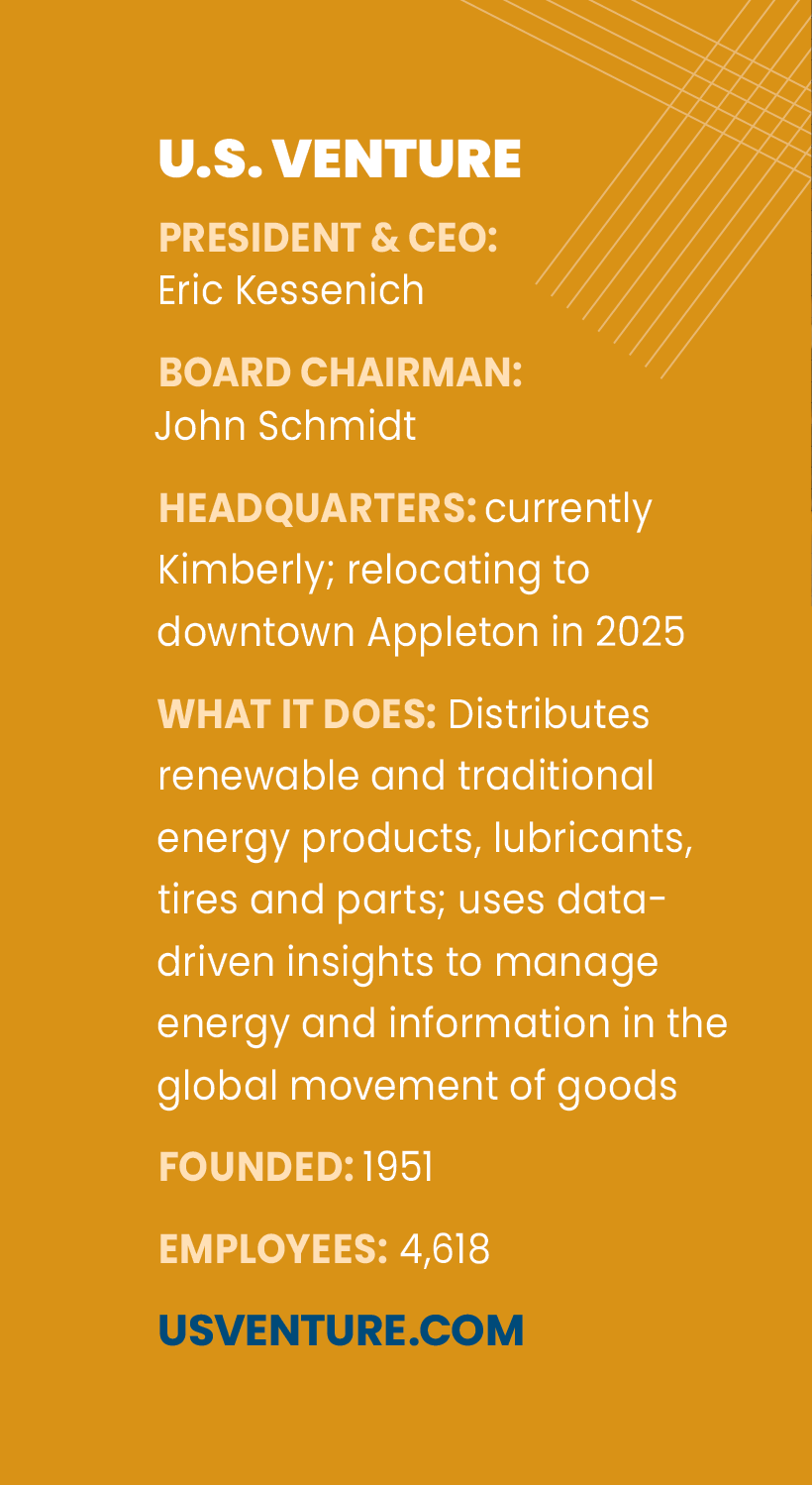
When Schmidt joined U.S. Venture as CEO in 2007, the company had 47 locations and employed 770 people. As he retires, U.S. Venture is made up of five business divisions with 120 locations and 4,618 employees.
U.S. Venture CFO Jay Walters says Schmidt strategic vision has fueled much of the company’s recent growth. Each of U.S. Venture’s five business divisions — U.S. Energy, U.S. AutoForce, Breakthrough, U.S. Lubricants and IGEN — has a strategy.
“John always emphasized a very robust strategic process. It’s quite lengthy, but everybody goes through it,” Walters says. “That’s something that John brought to the company, and that’s really where it all starts with growth.”
When Walters started with the company in 2012, he says it was generating around $3 billion in revenue. Last year, revenue was about $14 billion.
“If I don’t transition out of this business successfully and leave it in good hands, I can’t say I’ve been successful in my career.”
— John Schmidt, former CEO, U.S. Venture
“That kind of growth is crazy, and it all starts with a really good leader and a CEO who has the support of the shareholders, which he does, as well as a very supportive board,” Walters says.
Walters points to the company’s U.S. AutoForce division, which distributes tires, parts and lubricants in the automotive aftermarket, as an example of Schmidt’s strategic foresight.
“When I joined the company, the AutoForce division was relatively small and wasn’t producing the financial results that we wanted as an organization,” he says. “There was a fair amount of discussion going on inside the company about what should we do with it and maybe consider selling that division and divesting of it.”
But Schmidt believed in its potential, so he and Walters decided to grow its distribution from a primarily Midwest footprint to a national one.
“[U.S. AutoForce] has turned into a real winner, and it’s a large part of why we’ve grown so fast,” Walters says. “Today it’s making an extreme amount of earnings and generates a lot of cash flow for us. It’s grown to north of $5 billion in revenue. It’s … added a lot of shareholder value, for sure.”
Any company that has grown the way U.S. Venture has can attest to the challenges it brings. Schmidt says the company has prioritized staying nimble despite the needs for enhanced processes and standard operating procedures that come with growth.
“The combination of being willing to take risks, being very strategic about our growth and a heavy focus on the execution of those plans has helped us to stay entrepreneurial,” Schmidt says. But he credits the success of U.S. Venture to his team members.
“We believe our people are our most important asset — other companies say that, but we really mean that.”

closing the deal
The company has grown through a combination of organic scaling and strategic acquisitions, Walters says. U.S. Venture acquired IGEN, a tax filing, reporting and data reconciliation software company, in 2016. In 2019, it took full ownership of Breakthrough, a Green Bay-based transportation energy and supply chain management company.
Walters says U.S. AutoForce alone has executed upwards of 20 acquisitions over the last 10 years, with most being bolt-on acquisitions in markets where the company already operates. But a particularly significant acquisition occurred in 2018 when U.S. AutoForce acquired California-based TIRE’s Warehouse, which pushed the company into a brand-new West Coast market.
“That was a breakout acquisition that brought significant scale, significant revenue, but in a totally new market that we weren’t in,” Walters says.
In 2022, U.S. AutoForce acquired tire distributor Max Finkelstein, Inc., headquartered in New York. The deal expanded U.S. AutoForce’s reach throughout the Northeast and Mid-Atlantic.
Walters says those two bicoastal acquisitions took U.S. AutoForce to the next level in several ways, including customer confidence.
In February, U.S. Venture officially embarked on a new era as Schmidt transitioned to the role of chairman of the board; former COO Eric Kessenich assumed the role of president and CEO. (In fact, Kessenich originally came to U.S. Venture through its 2010 acquisition of Saracen Energy Partners, where he was serving as an analyst, scheduler and trader.)
Kessenich, Schmidt’s nephew and the third-generation leader of the family company, says Schmidt has been “a transformative leader” of U.S. Venture and credits his entrepreneurial approach for much of his success.
“John is somebody who sees opportunities when many other people don’t,” he says. “When most others see a problem or a reason not to do something, he sees an opportunity to make something better.”

finding a better way
Striving for improvement is core to U.S. Venture’s foundation. So much so, the company’s current Kimberly headquarters is located at 425 Better Way — a nod to the company’s core value.
But “finding a better way” applies to more than just business operations. It can be seen through the U.S. Venture Open golf tournament, which has raised $65 million to fight poverty since its inception; the U.S. Venture/Schmidt Family Foundation, which awarded more than $2.7 million last year in program grants and sponsorships; and a partnership with Kenya Works, led by Schmidt’s wife, Julie Schaller-Schmidt, which provides education, nutrition, social services and medical care for schoolchildren in Nairobi.
It can also be seen through the company’s involvement in solving some of the Fox Valley’s most challenging social issues, such as unemployment, poverty and homelessness.
When Riverview Country Club in Appleton filed for bankruptcy in 2011, Schmidt saw the 72-acre golf course as an opportunity to offer job training and employment to vulnerable populations. He helped purchase the property and founded Riverview Gardens, a self-sustaining social enterprise that focuses on job training for individuals in need by utilizing urban farming.
The nonprofit’s ServiceWorks program is a 90-hour, no-fail, no-cost, job-training program that teaches participants transferable work skills to help them obtain stable, permanent employment.
Cindy Sahotsky, executive director and president of Riverview Gardens, says Riverview Gardens annually serves about 500 people, many of whom are involved in the criminal justice system.
“You really start to see all the social inequities that take place for individuals as they try to become self-sufficient,” she says. “I really appreciate John’s vision about helping people become self-sufficient. He pushes for innovation all the time, and we continue to do things differently.”
ServiceWorks participants can work on Riverview Gardens’ organic urban farm located on the former golf course fairways. They can tend the hydroponic greenhouses growing produce that is donated to food pantries and sold to Festival Foods. They can provide general building maintenance, lawn care and snow removal through Riverview Gardens’ maintenance contracts with other local nonprofits and businesses.
Since 2012, there have been 748 ServiceWorks graduates, 75% of whom remain stably employed after three years.
Sahotsky says unemployment is one of the leading causes of homelessness and that addressing the root causes of social issues impacts the entire community.
“John’s vision is not siloed,” she says. “Riverview Gardens was … created for the community to address the needs of many — not only those who are experiencing homelessness but many individuals who are marginalized. It’s bigger than the nonprofit.”

coming clean
If it wasn’t obvious by looking at U.S. Venture’s business divisions, Schmidt has been passionate about creating a diversified portfolio.
“I always have viewed my job here as needing to transition the business to products and services that are relevant for the future, that are synergistic with our existing operations and could build sustainable and repeatable earnings,” Schmidt says. “Those three things have been the catalyst for us diversifying the way we have.”
U.S. Venture has long recognized and led the transition to renewable energies. About 14 years ago, the company launched its U.S. Gain division as a platform for alternative fuels. “It’s one of the pioneering companies in renewable natural gas,” Schmidt says.
Last year, U.S. Oil and U.S. Gain combined to form U.S. Energy, an energy solutions provider with an asset portfolio of more than 35 refined product terminals, 40 renewable natural gas development projects, 50 alternative fuel stations and two forestry projects.
“We’ve got a really, really strong foundation. We’ve been in business for 72 years, and we intend to be in business for another 72 years.”
— Eric Kessenich, CEO, U.S. Venture
The combination of the two businesses was an important step in meeting the changing needs of customers, Schmidt says.
“U.S. Energy is an energy-agnostic fuel distribution business. We’re recognizing that the world is changing. Everybody wants alternative energies. We do, too, and we’re well equipped for that,” he says.
Kessenich, who started his U.S. Venture career in its U.S. Oil division and was promoted to president in 2017, says U.S. Venture is positioned with a unique capability to help customers through the energy transition.
“We can leverage the capabilities and the knowledge that we’ve built up over the years in conventional energy, risk management and logistics to help the world adopt cleaner energies,” he says.
Schmidt’s focus on successful transitions doesn’t just pertain to fuel — it’s been on the leadership of the company as well.
“If I don’t transition out of this business successfully and leave it in good hands, I can’t say I’ve been successful in my career,” he says.
Five years ago when Schmidt announced his retirement timeline, the company worked with an outside consulting firm to explore internal and external candidates. Ultimately Kessenich rose to the top.
Walters says that Kessenich brings great strength in operational efficiency, but his passion and understanding of the business made him stand out.
“During the interview process, his passion, that burn in the belly, you could just feel it. You could see it,” Walters says. “He has that drive, that entrepreneurial spirit, that you see in his family members.”
Kessenich officially took his position as president and CEO Feb. 16. He plans to tackle some communication challenges of operating at scale that have resulted from U.S. Venture’s tremendous growth. He will also be guiding the company as it relocates to its new headquarters in downtown Appleton next year. But for the most part, he’s just lucky to get to build upon the strong groundwork laid by the two generations before him.
“We’ve got a really, really strong foundation,” Kessenich says. “We’ve been in business for 72 years, and we intend to be in business for another 72 years.”
Insight’s Fastest Growing Companies Awards
Insight is pleased to present its inaugural Fastest Growing Companies Awards — and U.S. Venture is on the list. The Top 25 companies were celebrated at an awards event Feb. 29 at Lambeau Field. Click here to learn more about the region’s most innovative, thriving businesses.