


On a Friday afternoon in October, Lisa Johnson found herself in a Colorado Wal-Mart high-fiving strangers and shrieking with excitement.
“This woman asks me, ‘Did you just win the lottery or something?’” Johnson remembers. “I said, ‘Yes. Yes, I did.’”

Johnson is the CEO of BioForward Wisconsin, an association of 230 member organizations that focuses on initiatives to strengthen the state’s biohealth industry. She was vacationing in Colorado when she got the call that the Phase I application she had submitted on behalf of the Wisconsin Biohealth Tech Hub Consortium was accepted by the U.S. Department of Commerce’s Economic Development Administration (EDA).
The call meant Wisconsin had been designated as one of 31 regional tech hubs across the country. It also cleared the path for the consortium’s application to Phase II, where $50 to $75 million of federal CHIPS and Science Act grant funding is at stake.
The Wisconsin Biohealth Tech Hub will work to position the state as a global leader in personalized medicine, an emerging health care approach that customizes medical treatment to each individual patient by considering differences in genes, environment and lifestyle.
After months spent working tirelessly on the application, Johnson says it felt like she had indeed won the lottery — Wisconsin’s designation application was one of just 31 selected out of 192 across the country. Not only that, but the state was one of just 19 to receive a $350,000 strategy development grant, out of 172 applications submitted.
But while the lottery is a game of luck, receiving the designation was a strategic effort that required collaboration from 15 public and private members that make up the Wisconsin Biohealth Tech Hub Consortium, which BioForward Wisconsin is leading. These members represent a variety of biohealth industry companies, economic and workforce development organizations, and higher education institutions.
“They’re not recognizing one another as competitors. They’re recognizing that we have to work together on this to strategize on how our state will become this global tech hub on multiple fronts in the personalized medicine space,” Johnson says. “It makes me proud that we’re all coming together to work on something and we see it as a team.”
Building on strengths
Johnson says applying for the tech hub designation as a state was an unusual but effective approach. Most applications came from single cities or counties, but few took on a statewide perspective.
While Madison and Milwaukee boast strong biohealth hubs, every region offers its own industry asset; harnessing the capabilities of each is one reason Johnson believes the consortium’s application was selected and even received a special mention from President Joe Biden during his Oct. 23 announcement of the tech hubs.
“A tech hub in Wisconsin is going to bring together research labs, medical device manufacturers and engineers,” Biden said in his address. “They are going to build technology that supports personalized medicine like tests, treatments and therapies specifically tailored to a patient’s genetic code and medical records. I believe it’s going to save a lot of lives in the long run.”
The biohealth industry is an interdisciplinary sector that fuses various fields related to biology and health, including biotechnology, biopharma, medical devices, diagnostics, digital health and advanced manufacturing.
According to BioForward Wisconsin, the state’s biohealth industry grew by 10.6% between 2018 and 2021. The biohealth industry’s growth generated $32 billion in statewide impact in 2021. It also employs more than 129,000 individuals and contributes to products and services valued at $6 billion.
The tech hub will help create the infrastructure and attract the talent necessary for developing innovations in personalized medicine, which is becoming increasingly important in many areas of health care. By understanding each patient’s unique health profile, health care providers can make more informed decisions when treating complex diseases like cancer and neurological disorders. This leads to improved outcomes, fewer side effects and more efficient use of resources.

“It’s all about how do we improve patient care, while lowering overall costs as we do it. It’s about getting better products to patients to improve outcomes, to improve patients’ lives and to make improve the whole medical experience. That is ultimately why we’re here,” says Michael Tendick, market sector vice president – healthcare and life sciences at Plexus Corp. in Neenah.
Tendick, who is also a Wisconsin BioHealth Tech Hub steering committee member, points to Plexus’ work in engineering, manufacturing and supporting medical robotics that result in faster recoveries and better outcomes for patients.
As a leading manufacturer of complex electronics for the health care industry, Plexus represents the strength of existing industry, which was a major requirement for the Phase I application.
“The focus of this investment is on areas of the country that have existing strengths supporting the industry. The Exact Sciences, the GEs, the Plexuses within Wisconsin create that nice baseline and contribute that biohealth strength from an industry standpoint,” Tendick says. “A key part of this designation is collaboration between all aspects within the state, from education all the way up through industry, making sure we knit those together and really build on these existing strengths.”
In addition to BioForward and Plexus, consortium members include: Accuray, Employ Milwaukee, Exact Sciences, GE HealthCare, Madison Area Technical College, MadREP, Milwaukee Area Technical College, Milwaukee7, Rockwell Automation, University of Wisconsin-Madison, University of Wisconsin System, Wisconsin Economic Development Corporation and WRTP | Big Step.
Johnson says fostering entrepreneurship is another critical piece of Wisconsin’s burgeoning tech hub, and the New North is showing significant movement in this area.
“Sometimes we have perceptions and we think of Green Bay as only a manufacturing area, but it goes beyond that. It’s also tech,” she says. “TitletownTech is sitting in Green Bay, and they are taking innovation to the market. That’s what the EDA is looking for. We need entities like TitletownTech that are doing that and doing it well.”
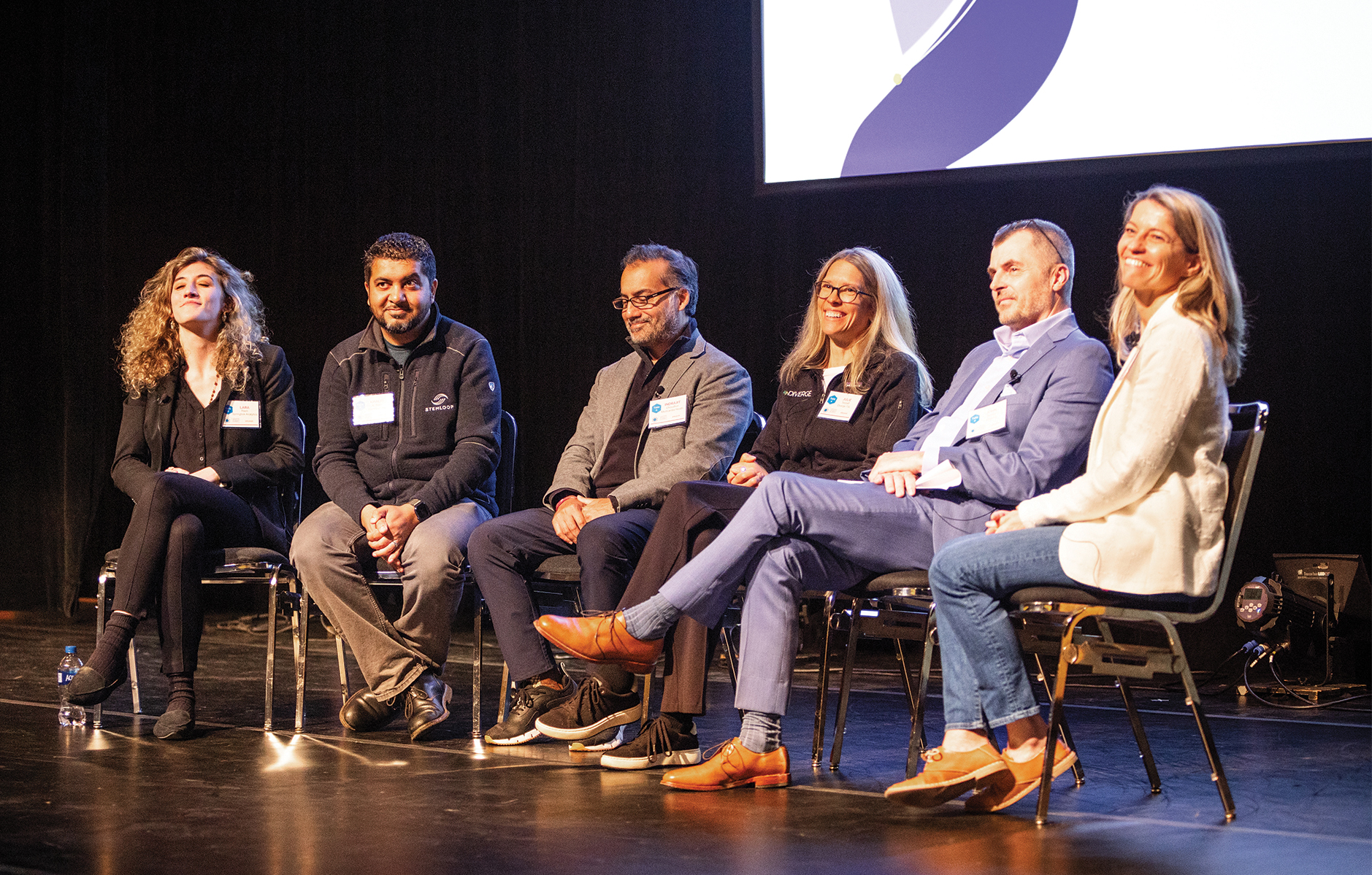
At the 2023 Wisconsin Biohealth Summit held in Madison, TitletownTech Managing Director Jill Enos said the venture capital firm invests in industries that are central to the strengths of the region. This includes digital health.
“Digital health is a really important part of the state and of the region and one of the primary reasons why we’ve made it a core part of what we invest in,” Enos says. “We’ve invested in companies focused on solutions and innovations in both human health, health systems and health equality and trying to improve what we can in this region. We have invested in categories like brain health, allergy detection, next-level analysis and MRI muscle development symmetry.”

What’s next: Phase II
Only the 31 Phase I designees are eligible to apply for the EDA’s Phase II implementation grants. Approximately five to 10 applicants will be selected for Phase II and receive between $50 and $75 million in federal grants, supporting projects aligned with the program’s overarching goal.
“I think we’re really poised to win Phase II, [which] is about receiving money from the EDA, but now it’s a very different approach,” Johnson says. “We had to convince them ‘why’ in Phase I. Now we have to convince them ‘how’ we’re going to do it, and it’s all project-based.”
Phase II applications must present three to eight projects that drive innovation and economic growth within four categories: manufacturing, workforce development, entrepreneurship and technology. Johnson says the consortium divided itself into groups to define projects within these focus areas, and this will be the priority until the Phase II application deadline Feb. 29.
New North, Inc., the economic development organization serving the 18 counties of Northeast Wisconsin, has been involved in the tech hub conversation since the beginning, says President and CEO Barb LaMue.
LaMue sees the New North playing a significant role in developing a biohealth industry workforce.
“We want to make sure there is room for companies and organizations in Northeast Wisconsin to plug into this,” she says. “We have a lot of companies manufacturing medical devices or medical products. That will all be extracted as we work through Phase II of the application.”
Phase II funding announcements are expected to be made this spring, but no official date has been released.
While anticipation for the Phase II funding announcement builds, LaMue says the commitment of stakeholders to the consortium’s mission of advancing innovations in personalized medicine will remain, regardless of the outcome.
“The consortium itself, the tech hub, is not going to go away even if we’re not selected as one of the [hubs] to receive the funding,” LaMue says. “We will still move forward. The hub initiative will live on well beyond a decision on the Phase II funding rounds.”
More on the web