
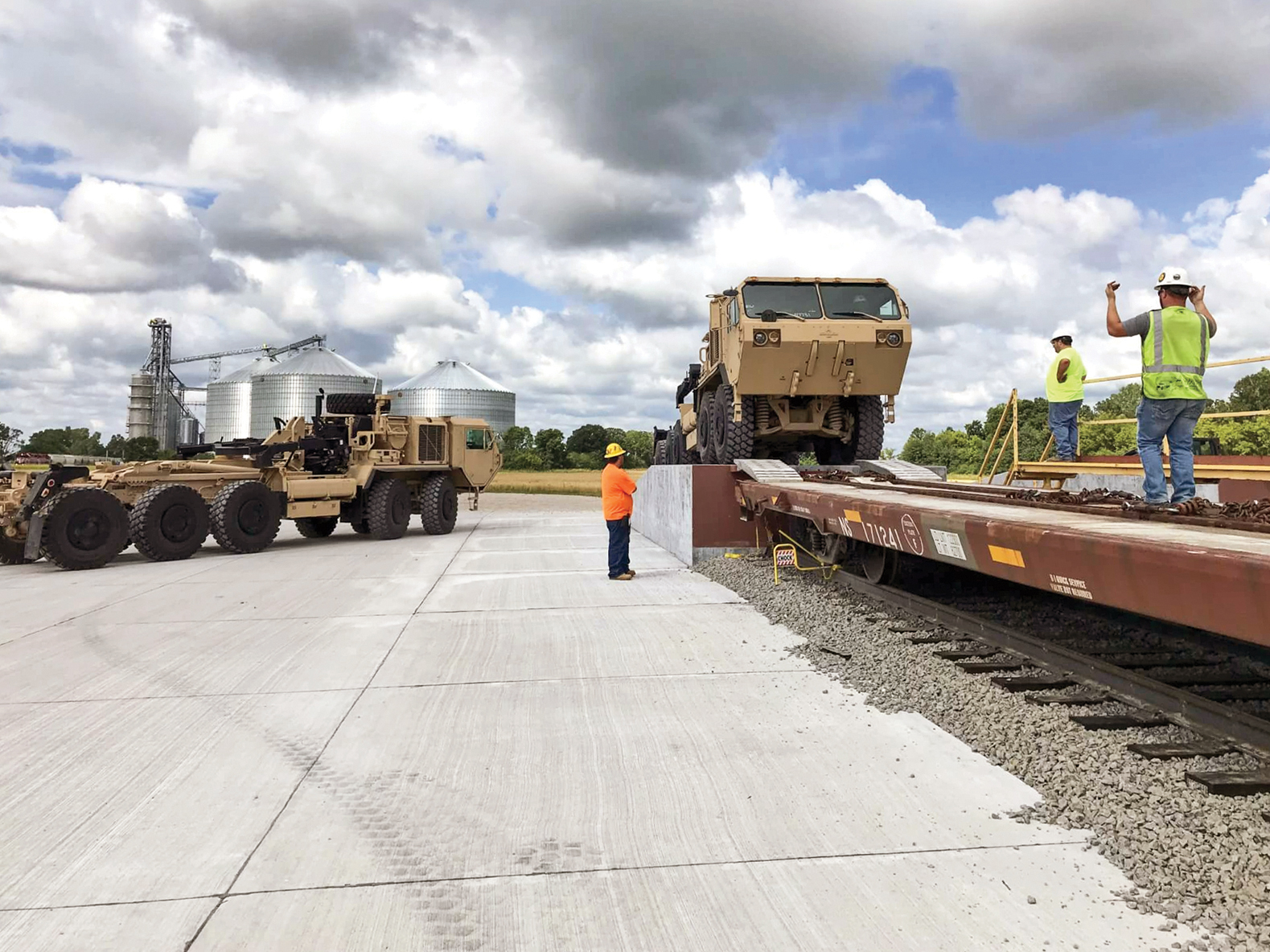

What started five years ago with a noise complaint about Oshkosh Corporation loading vehicles in a residential neighborhood has become a trusted hub for New North companies seeking supply chain efficiencies: the Oshkosh Transload Facility, located in the city’s Southwest Industrial Park. Many of the issues the construction of Northeast Wisconsin’s first and only transload facility sought to address in 2018 still exist for manufacturers today, including truck driver shortages, gas prices and emissions.
That’s why, says Greater Oshkosh Economic Development Corporation President and CEO Tricia Rathermel, rail remains an attractive option for Northeast Wisconsin manufacturers.
“The number one thing rail does is provide access to transportation without the scale to staff — you can ship way more in one train with a conductor or two than you can with how many trucks down the road,” Rathermel says. “The other part is rail is much more efficient than running a vehicle up and down the road, and this is a great time for rail because with some of the federal funding that’s coming down … we are hopefully going to see some additional investment and become even more efficient.”
Not only is there growing interest among manufacturers in utilizing rail, there’s opportunity to grow the Oshkosh Transload Facility. Community members gathered for a fifth anniversary celebration at Shea Electric during Manufacturing Month in October to mark the milestone and learn more about the facility’s history and future opportunities.
“These operations are the lifeblood of modern manufacturing, connecting supply chains and fueling the engine of industrial excellence,” Greater Oshkosh Economic Development Corporation Communications and Research Manager Andrea Aurigue told about 40 attendees gathered at the event, which also featured remarks from City Manager Mark Rohloff, Community Development Director Kelly Nieforth and Account Manager Jamaar Benton of Watco, which operates the facility.
During the event, Benton noted that Wisconsin railroads are unique nationally because of the amount of state support they receive. He also pointed out that the Oshkosh Transload Facility is different because it is publicly owned.
“The reason we wanted to do that event was because [the Oshkosh Transload Facility] is something that’s extremely unique — something that makes us stand out in Wisconsin, but compared to other states as well,” Rathermel says. “We wanted to make sure that people are seeing it as something that can be an asset.”
Benton and Rathermel both describe the facility as “running close to capacity,” but there are opportunities to expand the service because it’s not currently utilized five days a week. Adding warehouse space and additional equipment (“without going full intermodal,” Rathermel clarifies) are also potential areas for growth. Rathermel says growth is contingent on finding the right users, the availability of grants and public funds and just general awareness of the facility’s benefits.
“This is access to rail without having to own real estate,” she says. “It’s like [renting] a car versus buying a car. I can use it when I need it and not have to pay to maintain it all the time.”
She also says she has heard from users that access to the transload facility has helped them be more competitive in project bids. “The fact that you can have this rail solution, which has better cost efficiencies and shipping reliabilities behind it, makes them more competitive in the market,” she says.
Speaking at the anniversary event, Rohloff says the facility is a strong selling point to site selectors.
“I had the opportunity to meet with a business that was looking to locate a manufacturing facility here, and they talked about how the East Coast had better access to rail,” Rohloff told attendees. “We took them out to the transload facility, and their eyes opened up to the possibilities. You can bring raw materials in, but you can also get your product out — and you’re better centrally located in the country.”