
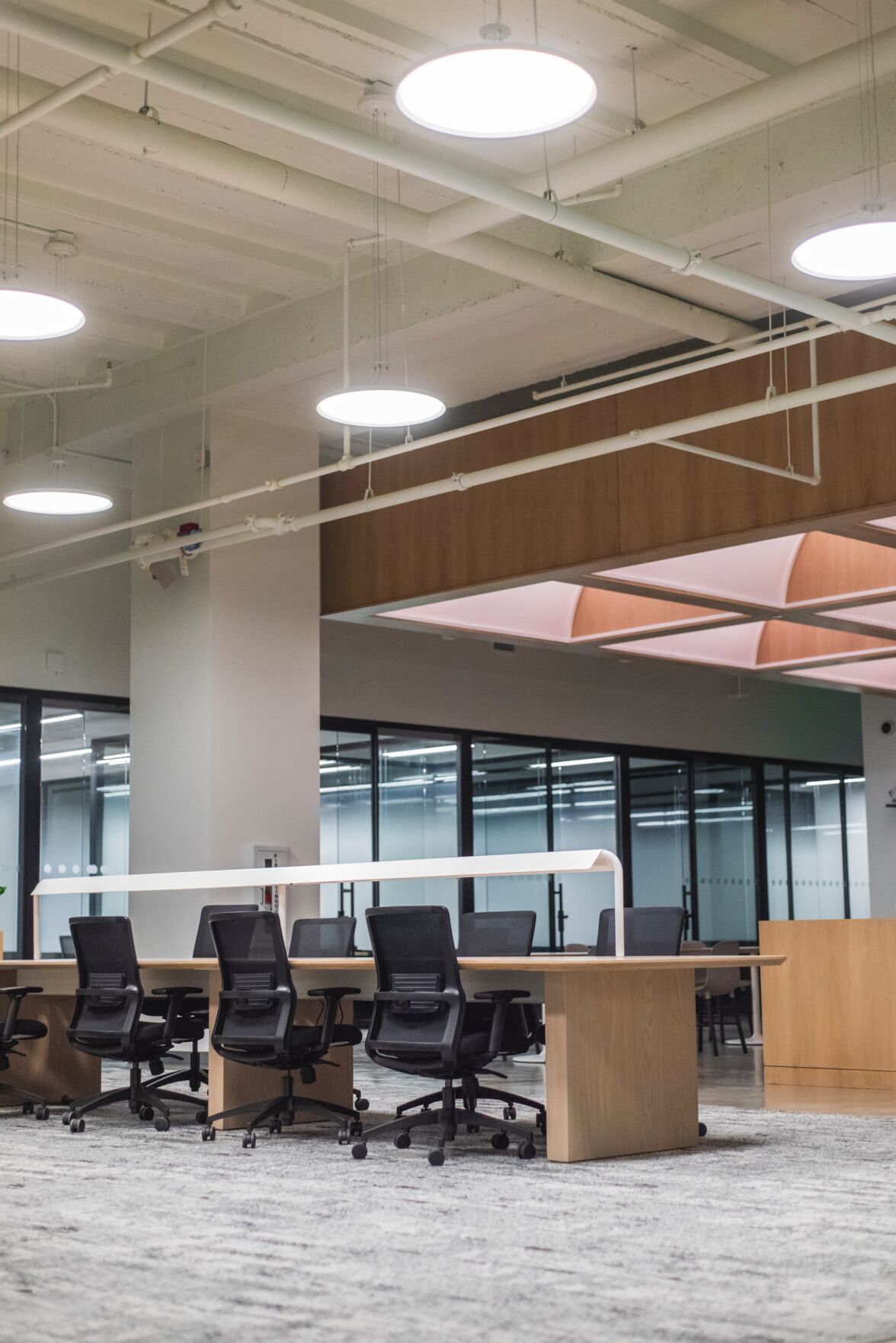

A recent New York Times opinion piece presented an intriguing fact to help readers visualize the city’s changing work landscape: 26 Empire State Buildings could fit into New York’s empty office space.
Of course, remote and hybrid work trends are at the root of this change. With more people working remotely, the city is experiencing office building occupancy rates around 50% of pre-pandemic levels.
Luckily, things aren’t looking quite that extreme in the New North. (Although it did make me wonder by which regional landmark would we measure vacancy — Lambeau Fields?)
Last month NAI Pfefferle released its 2023 Real Estate Forecast, which addressed the decreasing demand for office space in the New North. The report presented data on office vacancies in Green Bay, Appleton and Oshkosh/Neenah. Last year all three markets were under the national average vacancy rate of 16%, with Green Bay at the highest rate (just over 12%). In Green Bay and Appleton, Pfefferle forecasts some improvements in vacancy rates, with both communities expected to fall under 10% by next year.
Yet these vacancies have a real economic impact now, so the question remains: what to do with them? Many cities struggling with high vacancy rates are considering converting office buildings into housing.
Manny Vasquez, vice president of Pfefferle Companies, Inc., says to do this, it’s important that communities think creatively. He points to a successful example in the Zuelke Building, one of Appleton’s earliest and tallest office buildings, which was recently transformed into 66 luxury apartment units.
“It was a huge investment for that developer, but it addresses a critical gap in the market for housing that’s so in demand right now,” Vasquez says. “As long as the numbers make sense and local zoning regulations allow it, we can and probably will see more creative uses for office space. But it’s going to be a long process to get there.”
Take a look at the full report, with data on multifamily, office, industrial and retail spaces, at naipfefferle.com.