
The Fox and Wolf rivers have been an engine of the Wisconsin economy for hundreds of years.
That legacy continues today, but in recent decades there has been a growing realization that the way forward for the Fox-Wolf Watershed requires more active stewardship.
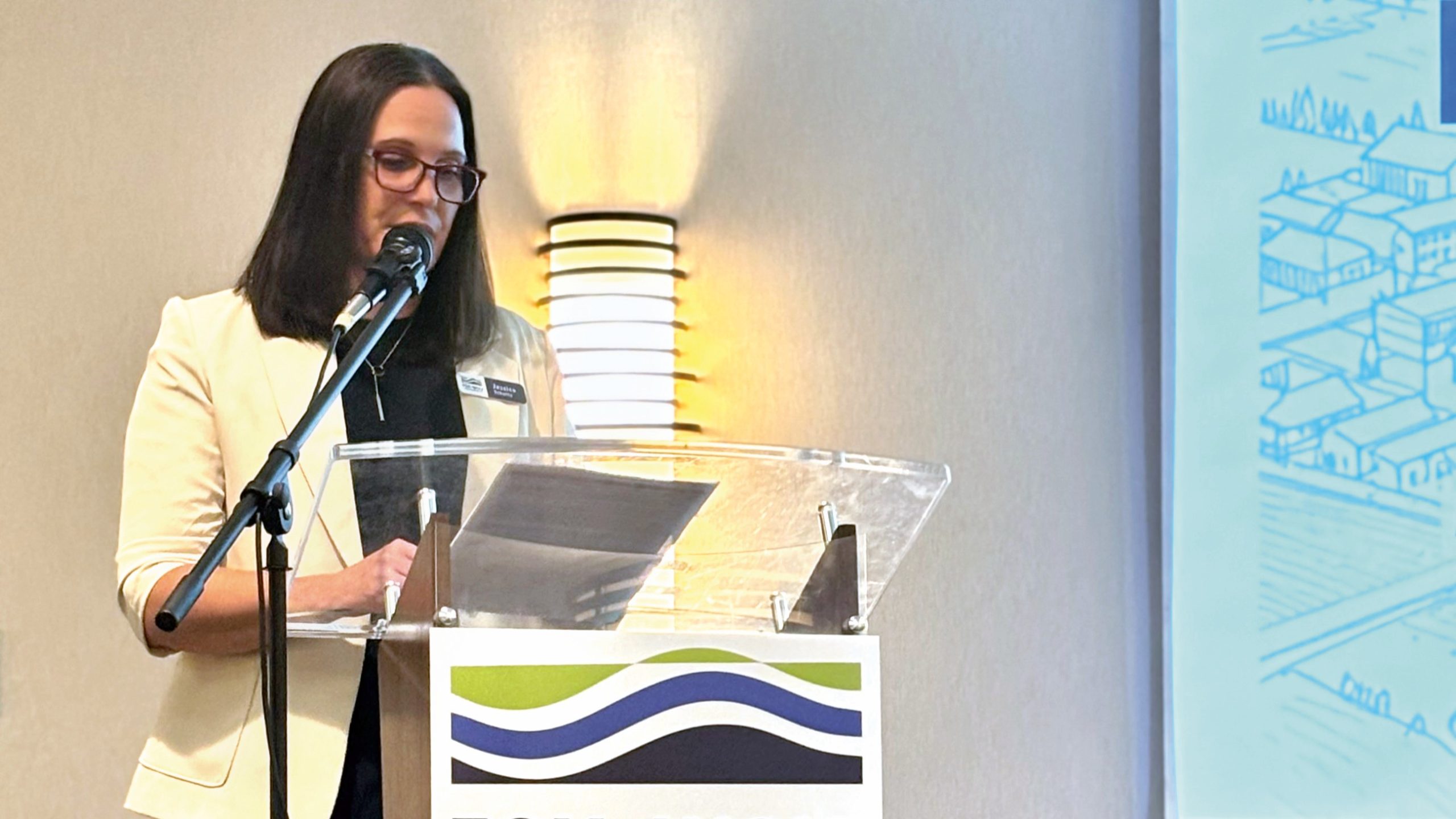
“If you had asked me 17 years ago what I knew about local water quality, my answer would have been really short,” says Jessica Schultz, executive director of the Fox-Wolf Watershed Alliance.
Prior to joining the Alliance, Schultz says she never questioned why people didn’t swim more in Green Bay or think about wetlands loss, agricultural runoff and wastewater treatment.
“I realized there’s a lot of people like me, people who care but who just haven’t had the opportunity to connect the dots yet,” Schultz says.
The first Fox Wolf Summit, hosted by the alliance May 12 in Neenah, aimed to build those connections.
“We’re here because watershed recovery doesn’t happen in isolation, and it doesn’t happen by accident,” Schultz told attendees gathered at the DoubleTree Hotel. “It happens when businesses, communities, conservation professionals, farmers and local leaders all see themselves as part of the same system.”
The 2026 impact report was issued at the summit, which featured videos and guest speakers who focused on four pillars of conservation efforts.
Those are:
- Wastewater
- Stormwater
- Agriculture
- Nature-based solutions
The report, which this year focuses on the Lower Fox River and Winnebago waterways, was meant to show how water moves through the large system and the progress that is being made to improve water quality.
When spotlighting the wastewater efforts, it was noted that there have been generational investments responding to increased regulation and recognition that the water resource is widely shared.
In a video played at the summit, NEW Water Executive Director Nathan Qualls said: “Clean water doesn’t happen by accident. It takes real, ongoing work. We do the work because we know what’s at stake: healthy communities, clean water and a watershed worth passing on.”
Through equipment upgrades, conservation practices and optimization, NEW Water has met 82% of its phosphorous goals and 165% of its sediment goals.
Mike Moore, strategic environmental manager at Georgia Pacific, oversees water compliance for the papermaker. He grew up in Green Bay and says he has personally seen how the water quality and fishery have improved.
“Even though we’ve seen progress I know that there’s still a lot of work that can be done…” Moore says. “Our daily goal is simple: have the best effluent possible leaving our facility. And we take that responsibility seriously.”
The efforts at Georgia Pacific include capturing all the stormwater runoff on its 275-acre site in Green Bay for use in its production process. The plant also tries to recycle as much water as possible, and of the 30 million gallons it uses per day only 6 to 10 million gallons are discharged after treatment.
Like wastewater management, stormwater management efforts have benefited from significant investments and gradually increasing regulations.
“As development increases, so do hard surfaces — roads, rooftops parking lots. Water has fewer places to go so it moves faster and carries more with it,” says John Neumeier, director of public works and city engineer for the city of Kaukauna.
The efforts in the Fox-Wolf Watershed, and specifically the Northeast Wisconsin Stormwater Consortium, have involved slowing down water as far upstream as possible through ponds, bioswales and rain gardens, permeable paving and more.
Efforts can include large-scale projects but also need to include individuals and smaller efforts, says Neumeier.
Similarly, addressing the agriculture sources of water runoff involves both collaborative large-scale efforts and landowner specific solutions, according to Nick Peltier of the Brown County Land and Water Conservation Department.
Peltier credits a demonstration farm network started in 2014 for building collaboration and driving implementation of best practices such as cover crops, streambank restoration and manure management.
“We use the lessons every day when we go to other farms,” he says of the Fox Wolf Agronomy Team.
The final pillar of watershed recovery emphasized at the summit was finding nature-based solutions. Jeremy Freund of Outagamie County Land Conservation clarified that “we’re not trying to return to pre-settlement conditions.”
Instead, he says, his organization is focused on structural storage of water on site that can fill the role wetlands used to fill. Finding suitable sites and willing landowners can be a challenge. Freund also says it needs to be recognized that there are both substantial initial investments and long-term maintenance costs for such systems.
But, Schultz says, “the widespread flooding we saw across the watershed [this spring] made something very clear. It’s not just a pillar of our work; it’s an urgent priority. When water moves through the system this quickly and at this scale, the need to slow, store and manage it differently becomes even more apparent.”
It’s why the Fox-Wolf Watershed Alliance has invested in four water storage projects and plans to ramp up those efforts in 2027 with what she describes as the first major fundraising effort in the alliance’s 35-year history.
The summit ended with calls to action for everyone from elected officials to farmers, land conservationists, business leaders and individuals.
Katie Woodrow, the alliance’s watershed recovery director, says: “Progress depends on continued engagement and collective effort.”
BOXOUT: Winnebago Waterways to Green Bay
The Fox River stretches 39 miles from Lake Winnebago to Green Bay
Green Bay is the largest freshwater estuary in the world
The Winnebago Waterways includes lakes Winnebago, Butte des Morts, Winneconne and Poygan
Winnebago Waterways is 169,000 acres of freshwater, 17% of the total in Wisconsin