

Photograph By Shane Van Boxtel/Image Studios
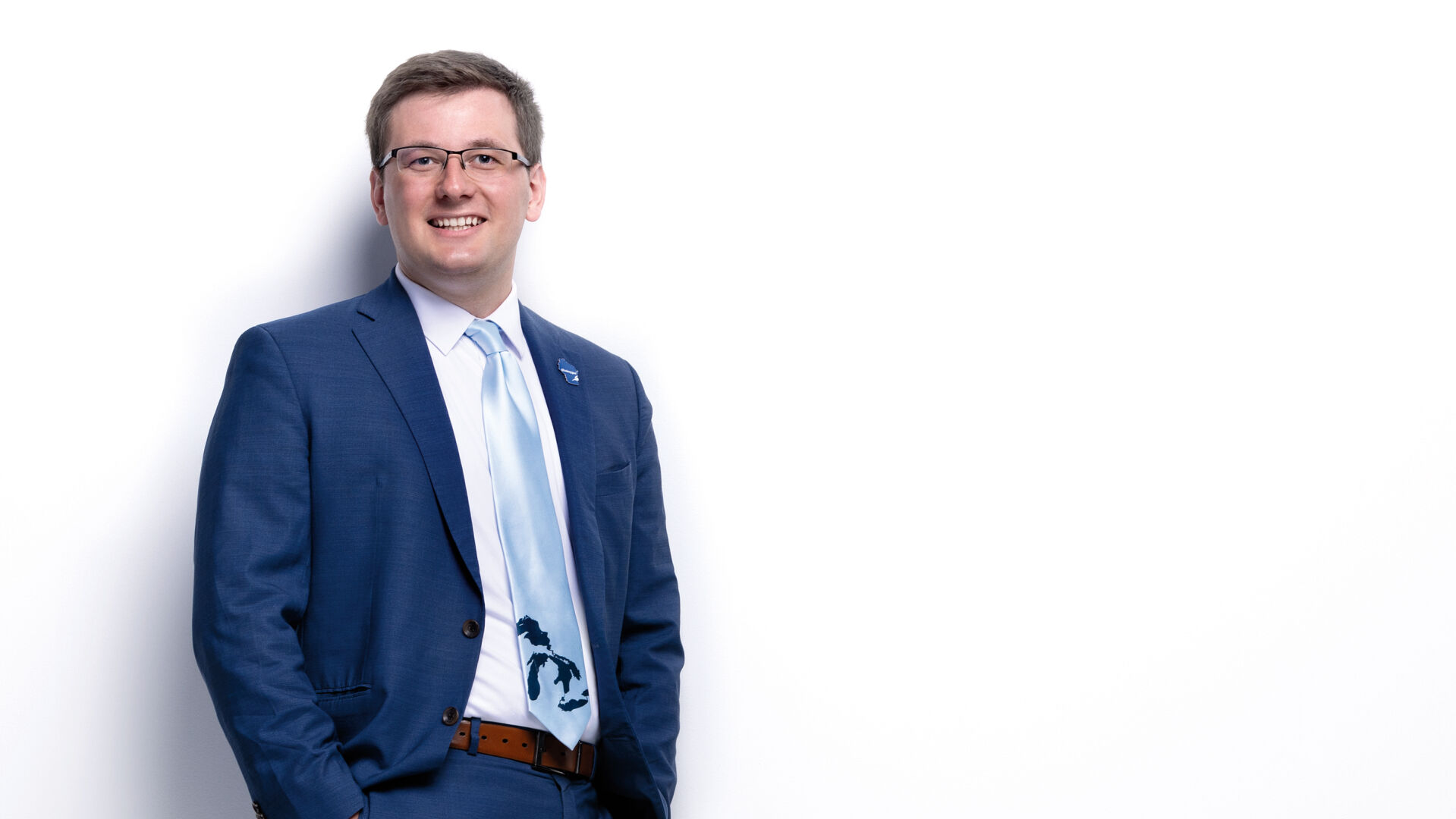
Elected in 2021 at the age of 27, Ryan Sorenson made history as the youngest mayor of Sheboygan. This spring, Sorenson took on an additional role as co-chair of the Great Lakes and St. Lawrence Cities Initiative — a coalition of U.S. and Canadian mayors and local officials dedicated to protecting and restoring the Great Lakes and St. Lawrence River Basin.
Read on to learn more about Sorenson and his efforts to safeguard the Great Lakes while driving growth in Sheboygan.
What inspired you to join the local government space, especially at such a young age?
Sorenson: I was born and raised in Sheboygan, then I went to [UW-Milwaukee] for college and got very involved in student government. That’s where I sharpened my teeth in politics. I came home after college and ran for city council, which I was on for four years and became council president my fourth year. I made it a goal of mine to meet with as many business leaders, nonprofit folks, community organizers and locals to just say, “Hey, what’s working? What’s not? What can the city do to help support your business? What can we do differently that’s not working?” So it was this collective snowball effect from a lot of folks who said Sheboygan is a great community, but it’s time to step it up with some new energy and vision. Getting that support and encouragement from community and business leaders really helped motivate me to make that next jump from city council to mayor. There’s something truly special about being mayor of your hometown. When you see a project, when you see an initiative benefit the community and help neighbors out, that’s really special to me.
Congrats on your recent election as co-chair of the Great Lakes and St. Lawrence Cities Initiative. Why is your involvement in this organization important?
I’m a big believer that when you’re part of a bigger group with a bigger vision, you’re able to get more done. As the Great Lakes region, we’re definitely a powerhouse between the United States and Canada, and when we’re advocating for issues at the federal level and state level, our voice is heard and it results in stuff happening, which I think is very powerful. I definitely love to be part of this organization, especially as it grows. Our membership continues to increase; we’re about 270-plus member mayors from the United States and Canada. As the organization grows, so does our credibility, so does our ability to influence policy. That’s what gets me excited — being a part of an organization that can advocate and influence policy that directly impacts a city like Sheboygan. Normal cities have a police department, fire department, library, but when you’re on the Great Lakes, you have a whole other portfolio that you have to deal with and that’s just water, Great Lakes water — how you manage it, how you protect it, tourism, recreation, the impact of erosion and climate change. You have to be involved in those conversations. Wanting to continue being involved in this organization, I feel like it’s very important for not only Sheboygan’s voice, but just for our proximity to Lake Michigan.
Are there any particular policies or initiatives on which you are currently focused?
One big one for me is the Brandon Road Inter-Basin Project, which has to do with invasive carp getting into the Great Lakes. It’s a very niche issue, but it’s something that I’m passionate about because if invasive carp get into the Great Lakes, they can destroy entire ecosystems. For our communities like Sheboygan, that could impact our charter fishing economy, it can impact tourism and recreation. That would have a detrimental impact not only on the ecosystem, but on many economies [throughout] the entire Great Lakes Basin. That’s been something our organization has been very steadfast on and very involved in as well. Being in a post-industrial area, the Great Lakes region has a much higher proximity of lead pipe laterals in homes, so making sure we’re getting secured funding for our communities and our cities to get caught up in replacing those lead lateral lines is very, very important. We are also working on an initiative right now regarding lakeshore erosion and creating some resiliency strategies when it comes to that. That’s the behind-the-scenes work that we do that is so important for a community like Sheboygan and other cities on the Great Lakes. Facilitating conversations with fellow mayors in Canada, especially when it comes to water issues, gives us a greater voice. It’s super exciting to work with one of our greatest allies on issues that impact millions of people in our area. Water doesn’t know political boundaries. Water doesn’t behave one way in Canada versus in the U.S., so having that collective, unified voice between the U.S. and Canada is something that I’m really excited about.
Beyond water issues, what else are you focusing on in the mayor’s office?
Housing has been a big initiative for us. We just rolled out our housing study, and we have to build 5,200 new housing units in the next five years to meet the current demand. We have to get very aggressive when it comes to that. We’ve seen a lot of business growth in our community — Kohler, Sargento, Johnsonville, American Orthodontics, Acuity. A lot of our area businesses want to grow and expand right here in Sheboygan County. We’ve heard some consistent themes from them, which are that they want to hire more but [that] they need local municipalities to step up and help facilitate more housing development. When companies grow and expand, they need places for their employees and those employees’ families to live, work and play and have a place to sleep at night. The status quo definitely does not work when it comes to housing. You have to get creative with funding and you have to modernize zoning too. What you’re going to see from Sheboygan is definitely an all-the-above strategy. We need single-family homes, but we also need duplexes, quadplexes, townhomes, walk-ups, and yes, that means more apartment buildings too. I hope Sheboygan is a leader when it comes to housing funding. You either grow or die as a community, and I think the path we’re on is definitely one of positive growth.