
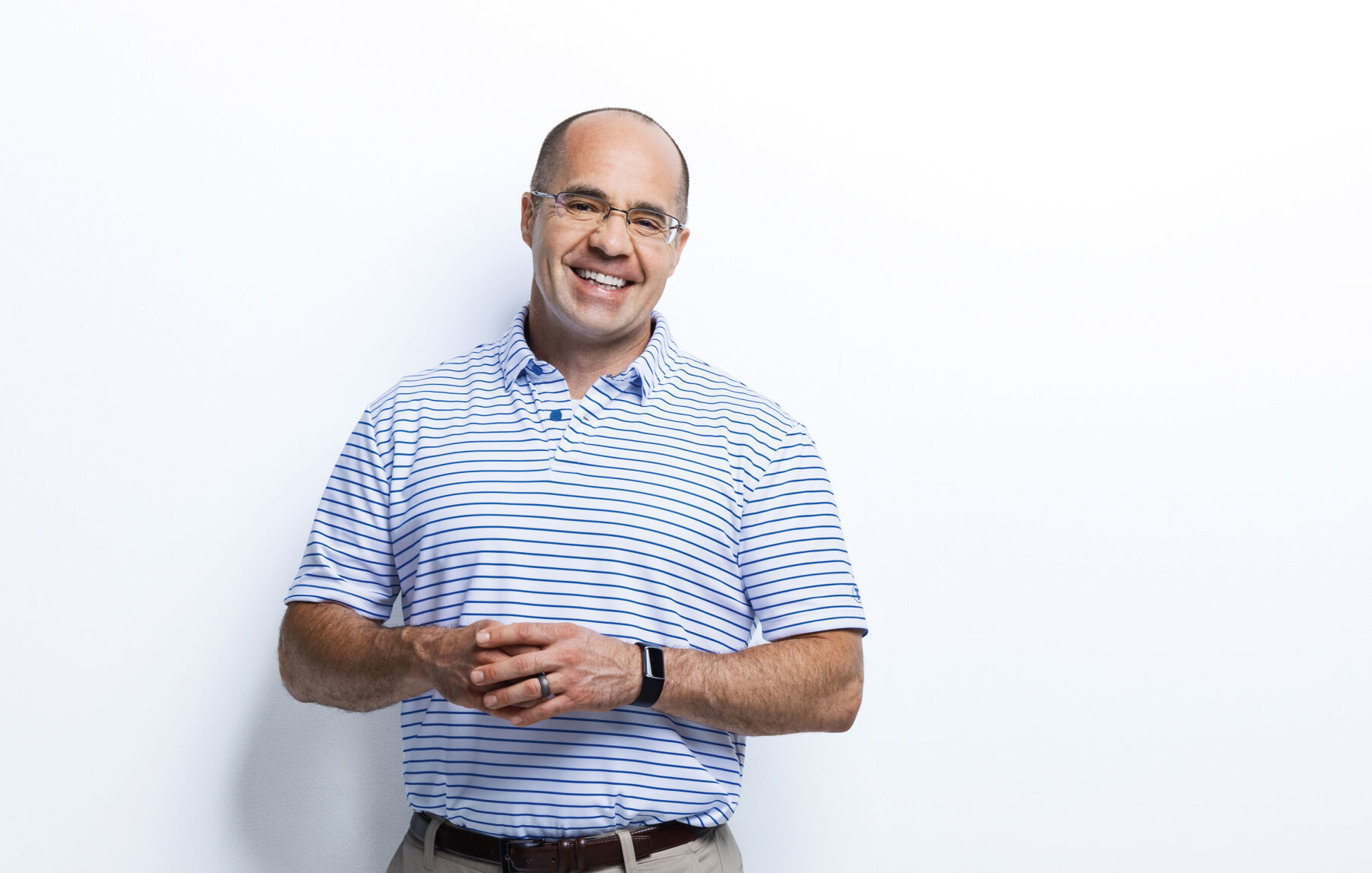

Photograph By Shane Van Boxtel/Image Studios
Shopko Optical CEO Russ Steinhorst doesn’t call his a comeback story, rather a steady rise to success predicated on his unwavering belief in the optical business that now boasts 1,100 employees at 142 locations in 13 states.
Steinhorst sat down with Insight to share his journey with the company, from navigating Shopko’s 2019 bankruptcy to its rebirth as Shopko Optical, emphasizing the importance of a steadfast focus on solutions.
Insight: Can you walk us through your career with Shopko and now Shopko Optical?
Steinhorst: My background is all in accounting and finance. I have an accounting degree from UW Oshkosh, and I worked for various different companies prior to joining Shopko as controller in January of 2009. I was promoted to senior vice president of finance, and later became CFO of the old Shopko stores. I had that role for about three years. When you’re responsible for the financials, you see a bit of everything. You’re exposed to all the different aspects of the business, both the good and the bad, and you can see how they interact. I think that’s what has allowed me to be CEO of Shopko Optical for four years: being able to just understand the business, how things interact, where do we focus our efforts and investment in driving the business forward. In 2017, I became interim Shopko CEO for probably three or four months, then they promoted me to CEO until Shopko filed for bankruptcy in January 2019. Then I was obviously heavily involved in trying to figure out if there was a piece of Shopko that moves forward. We had gone through a number of different iterations of how we keep the profitable pieces of the business, and that required somebody to see the potential and invest into the business. Unfortunately, we couldn’t find that for the general merchandise side of the business.
Shopko Optical emerged as a standout amidst the challenges. Can you share how it evolved and found its footing?
Even after we announced the full liquidation in March of 2019, I continued to work on trying to find a sponsor for the optical business because it really was a gem. It was small — about 3% of the revenue of Shopko in total — but even during the tough times, it kept growing and thriving. It just needed somebody to believe in it and see it as a standalone business. So in March, everybody was notified that they were losing their jobs, including all the optical people and [me]. Ultimately, in April, we connected with Monarch Alternative Capital, and within 45 days we had closed the deal to keep 80 of those [optical] centers open.
The Shopko name carries a 60-year legacy. How did you manage to preserve its brand identity while starting anew?
That required a heavy lift, because the optical centers all basically were starting from scratch. We have this 60-year-old business brand in Shopko. The optical side itself is a 45-year-old business. It was a debate initially, because prior to the bankruptcy we had had one freestanding Shopko Optical and we said we could grow this business in freestanding optical centers. The challenge was the brand — can you apply the brand to something separate? What does the brand name mean to people and can you take that into new markets? One of the questions in the back of our minds was, will the bankruptcy carry a negative perception? Will people focus only on that? We decided it was worth the risk. And lo and behold, after the fact, everyone I talk to just has nothing but fond comments regarding Shopko.
Shopko Optical underwent a significant transformation when it spun off as freestanding centers. What changed and what didn’t?
Shopko had been underinvested in and in many cases these centers hadn’t been remodeled for a couple of decades. They have essentially doubled in size. They’re all in freestanding storefronts. You don’t need to go into another retailer to access them. That visibility allowed us really to lean heavier into the health care aspect of it. Now it feels like more of a health care practice versus a discount retailer. Our vendor community actually saw that, too. When the optical centers were in the big box stores, brands like Ray-Ban or Oakley or Coach would not sell to Shopko. But once we were freestanding, now all of a sudden we have all of those major brands that we didn’t have access to before. It was all of those things to make it more shoppable, make it a better experience from an environment standpoint, that changed. The foundational pieces did not change. We maintained 95% of the staff. We continue to operate our manufacturing facility in De Pere. All of our eyeglasses are manufactured here in De Pere.
Shopko Optical has experienced impressive growth, expanding from 80 locations in 2019 to 142 today. What’s next for the company in terms of growth?
We’re continuing to focus on growth, including infill markets — that is, opening in the markets that know the Shopko name — but then also we started doing acquisitions. We did a large acquisition last year of Midwest Vision Centers that [added] 18 locations. We’ll continue to grow on a combined basis of opening brand-new locations and then also continuing to acquire. Recently, we opened a brand-new location in Baraboo, where there never was a Shopko. In early March of this year, we opened a location in Portage, where there had never been a Shopko. A key differentiator when we talk about what makes us different is we are going into underserved areas. And some of that relates back to the old Shopko. When you think about some of the communities Shopko was in, they were communities that Walmart and Target said were too small. Shopko does have this history of being in more underserved areas, and that continues to fit very well with Shopko Optical.
If you could share one piece of wisdom with other company leaders facing challenges like bankruptcy, what would it be?
There is a solution to every problem. If you step back and assess, there is always a solution. It’s just spending time on the solution versus what the negatives are. There were a ton of different challenges that came up as we went through the bankruptcy. And then we had COVID, right? But the team figured it out. That is the mantra of how we operate, and I think why we’ve been so effective as a leadership team. We focus on the solution.