
By Meghan Diemel
Located just outside of Stockbridge on the eastern shore of Lake Winnebago, the Lakeside Vision Center is helping manufacturers and other interested business leaders imagine what’s possible with off-grid microgrids, eMobility charging and digital power solutions.
The 19,000-square-foot, multi-function meeting and lodging space is the brainchild of Faith Technologies Incorporated and its division brands Excellerate and EnTech Solutions. FTI officials see it as an embodiment of the future of the company, where customers and the community can see energy independence through the execution of new technologies in real time.

Tom Clark, Faith Technologies’ executive vice president, says the company made the strategic decision to engage in this market because it aligns with the company’s vision to not only develop practical energy solutions, but become the leader in clean energy solutions. Clark says one of the largest future challenges the country will face is energy production; this center helps current and potential customers understand the possibilities of renewable energy.
“We can demonstrate to our customers everything we can do, at eye level,” Clark says.
The Lakeside Vision Center was built to the size of structures like fire stations and industrial garages. It is powered by a main microgrid, including ground-mount and rooftop solar, battery solar, a natural gas generator, and DCentrlQ power controls. All power at the center is managed by FTI’s proprietary EnTech Energy Center platform. A second microgrid enables FTI to demonstrate different solutions for renewable off-grid power and is made of two Xcape microgrids. Interactive digital exhibits highlight the impact of energy independence and resilience, all while teaching customers and the community how the systems operate and the value they can bring to businesses and communities.
The planning for the project began pre-pandemic and, like so many others, was affected by pandemic-related delays — and advances in technology.
“We had to pivot on numerous things throughout that process,” Clark says. “Not only supply chain challenges that came related to the global pandemic — but in renewable energy, things change very, very quickly.”
Stockbridge, which is located in Calumet County, recorded a population of 678 in the 2020 decennial census. Mary Kohrell, the county’s community economic development director, says the local community benefits from the center’s existence.
“When they have meetings and have people there,” she says, “they’re supporting the local businesses in the community.”
Collaboration with Pierce highlights possibilities
As municipalities and airports worldwide make green initiatives a priority, fire departments are seeking environmentally conscious fire apparatus that reduce emissions, produce less noise and minimize fuel consumption. Oshkosh Corporation’s Fire and Emergency segment, which includes Pierce Manufacturing, Oshkosh Airport and Frontline Communications, developed and built a solution: the Pierce Volterra zero-emissions pumper, which in October was crowned Wisconsin Manufacturers and Commerce’s “Coolest Thing Made in Wisconsin.” The first Volterra found a home in Madison earlier this year, and Pierce partnered with FTI’s EnTech Solutions to provide the electrical vehicle (EV) infrastructure support necessary to charge the truck.

Eric Linsmeier, director of electrical and software technology for Pierce Manufacturing, says he sees great value in having the Lakeside Vision Center available to Pierce customers. As businesses continue to develop in the EV space and try to figure out how to manage an EV product, company leaders can show customers in real time what possibilities exist for larger vehicles and fleet vehicles.
“It does a lot of great things to help folks understand what is possible and how you can approach electric charging infrastructure and other supporting needs,” Linsmeier says.
Linsmeier further explains that in firefighting applications, there is value in overhead charging capabilities. A pedestal-style charger can be problematic to install in a fire station because there isn’t a lot of room between vehicles or on the floor in general. The cables that would be left behind with a pedestal-style charger when the vehicle is disconnected for emergency response could be left in a spot where they can be run over, become a trip hazard or be dropped and damaged.
“Overhead charging solutions really help in those settings, and it’s important to demonstrate how those would look and share that with our customers,” he adds.
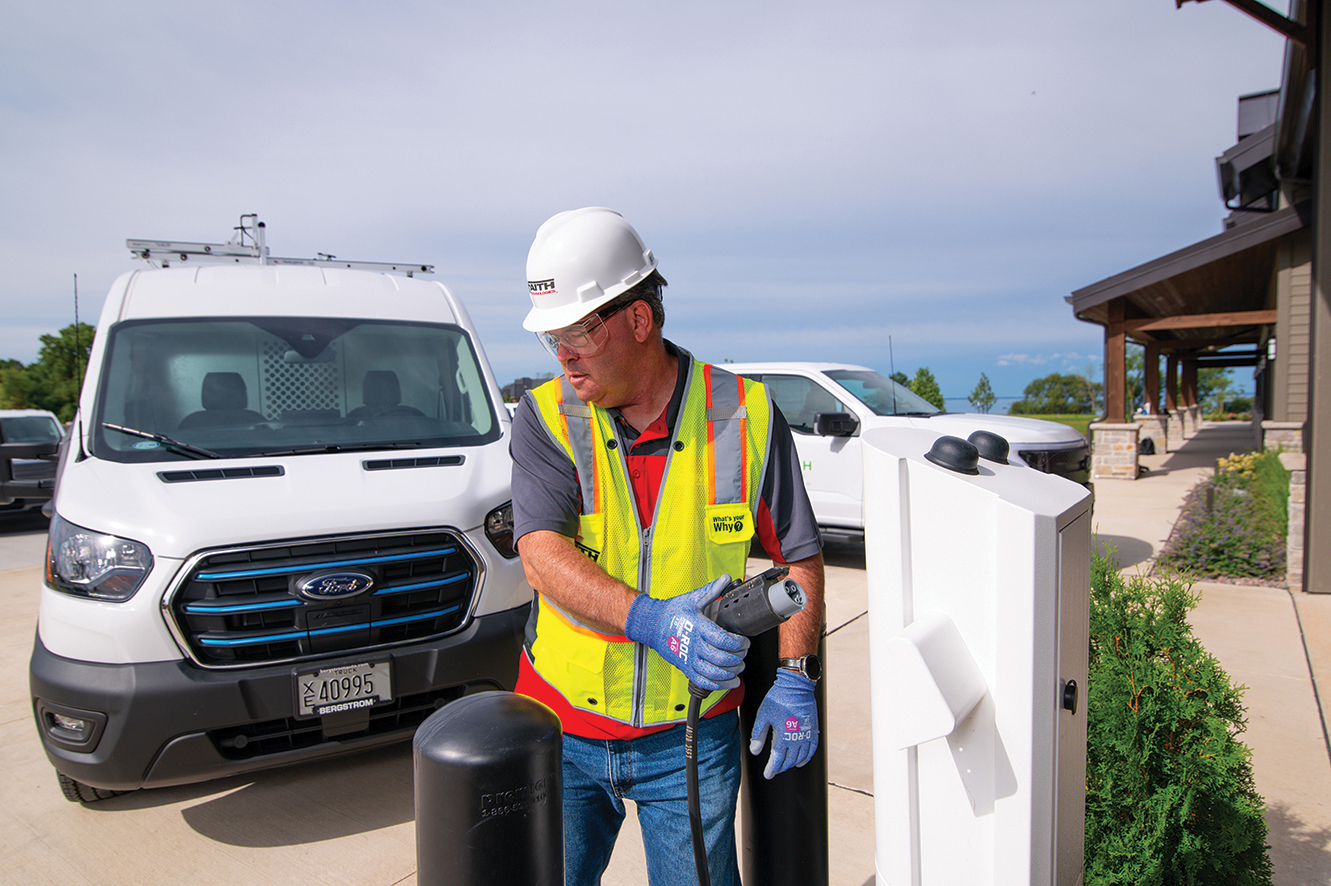
EnTech’s EV charging solutions are fully renewable, can be used off-grid, and unlike other options on the market use no fossil fuels. EV chargers that are off-grid accessible in Northeast Wisconsin include those found at Austin Straubel International Airport, Gordon Bubolz Nature Preserve, the Bergstrom Neenah car dealership, Excellerate Appleton North, Excellerate Neenah, and the Plaza in downtown Neenah.
Linsmeier says it was helpful to see the scope of the possibilities that exist through FTI and its divisions, whether it is with the chargers, the solar panels in use on the buildings, or demonstrating the resiliency of charging through the microgrids.
“There’s great demonstration of how the technology can be inserted into the buildings without making it look super industrial or changing its façade, and still be effective,” he says.
FTI’s next step: An off-grid community
The Lakeside Vision Center is set within a 40-acre area, which will also be home to an off-grid community in the near future. Thought to be the first of its kind in the Midwest, the individual residences will feature a variety of clean energy solutions, such as grid-tied solar, solar with storage, a residential microgrid solution for short-term outages, a residential solution for a stand-alone microgrid, and other types of solar implementations.
Homes in this area will also feature options for ownership with lake access, walking trails, ponds for site water management, organic gardening and barns, and private and semi-private driveway access.
“I think it’s really ground-breaking,” Kohrell says of the future community. “It is very cutting-edge. And to have a development of that caliber in rural Calumet County is an amazing opportunity.”
Kohrell says there is potential for the village of Stockbridge to explore creating its first tax increment finance (TIF) district on the heels of the development. And though established landowners in the area may not be fond of additional development in and around the shoreline of Lake Winnebago, she notes that there could be additional area amenities that come with projects inspired by FTI’s off-grid community, as well as the regional and national visibility it will bring.
“It would help money stay in the local community, rather than losing it to Fond du Lac or the Fox Cities,” she says.

Big renewable energy impacts, straight from rural Wisconsin
The center will become increasingly important to FTI as energy independence is embraced by more businesses and communities. The center and the future community are unique projects that will have an impact on global research and development in the renewable energy industry, Clark says.
“I think it’s a testament to Wisconsin and the cool things that can come out of the state of Wisconsin and a rural community,” Clark says. “There will be some lessons learned and some things going on out there that someday will be in larger cities like New York and L.A. and Boston, that came out of [rural] Stockbridge, Wisconsin.”
Of course, establishing the goal of building an off-the-grid center and community — and bringing that goal to fruition — are two separate tasks. Clark says FTI’s culture fosters an atmosphere in which, when the challenge is great, everyone comes together to achieve the goal.
“To see our team really get excited and be passionate about what their goals were on this, and really work to achieve it … it was a great thing to see how proud they were of what they accomplished,” Clark says.