
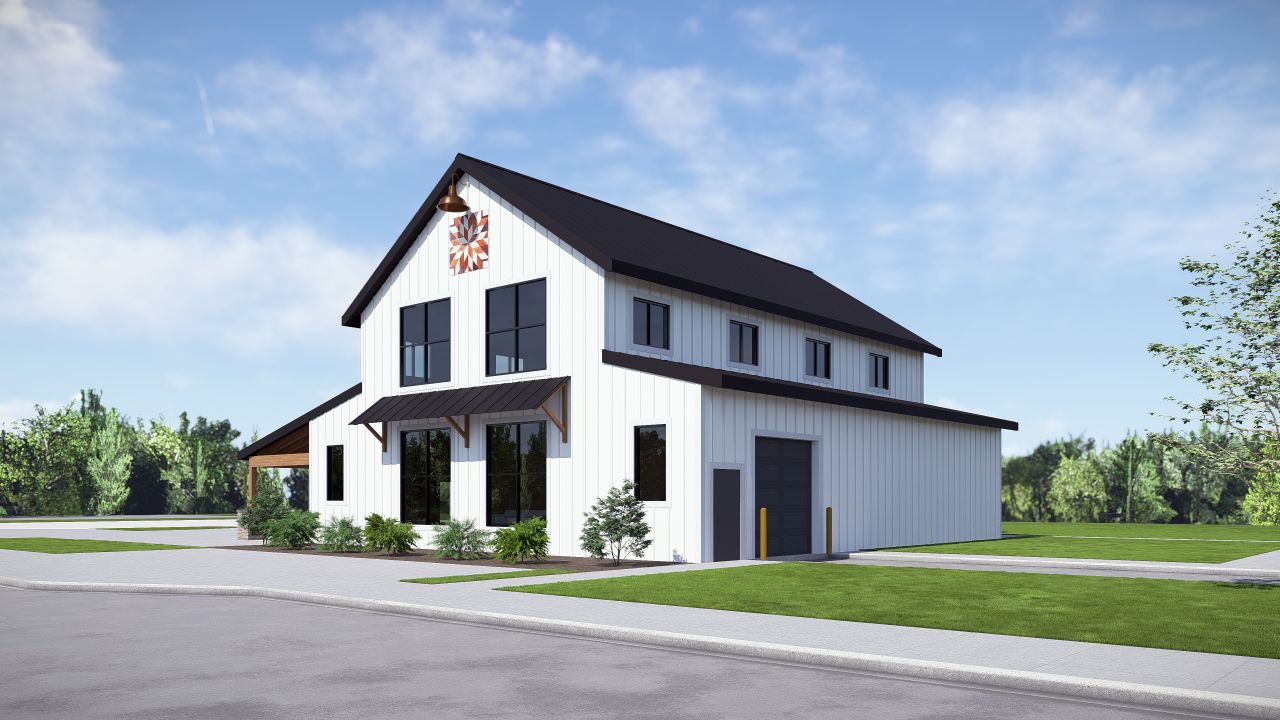

Access to fresh food is about much more than farming. For growers and food entrepreneurs in Greater Green Bay, the first-of-its-kind-in-Wisconsin Food Innovation Center, scheduled to be complete in December as part of the city’s 26.5-acre JBS Redevelopment Project, will break down some of their barriers to success — including physical space and other food processing resources.
Some produces are unable to scale and sustain their food businesses primarily because they lack access to capital for large equipment purchases, explains Tara Yang, agriculture and business development strategist with Wello, which is partnering with the city to create the center.
“It’s a shared-use space,” Yang says, adding that the Food Innovation Center will be home to a pack wash station, walk-in cooler and walk-in freezer. “We pulled together public-private resources and funding to be able to cut that barrier for them.”
The storage space offered within the 3,500-square-foot facility will also be a boost to producers, she adds, extending the selling season in our cold Northeast Wisconsin climate.
“A lot of the farmers we spoke to, their season extends well beyond the farmers’ market season,” Yang says. “Long-term fall products like squash, onions and potatoes can last into December if you store them properly.”
It will also allow small farmers to pool resources to create larger businesses, she adds. For example, cucumber growers can work collectively to fulfill an order from a pickle manufacturer.
“They can actually have inventory to sell, and so that’s where it’s an economic development facility,” Yang says.
Originally dubbed the “Urban Barn” but renamed because it doesn’t house animals, Yang says, the Food Innovation Center has been an evolving project and some of its programming is yet to be determined. But the goal is to provide education in addition to access.
Yang says there are farm families with generations of expertise who aren’t necessarily credentialed in agriculture or food manufacturing. And even when the short growing season remains a barrier, the Food Innovation Center can open up doors for new food industry careers with more stable, less seasonally-dependent income.
“We want the space to be a starting point for them,” she says of young farmers. “They can [get experience] working on smaller pieces of equipment and [earn] a certificate that they can put on their resume. The space is meant to build on skills and build businesses and scale businesses.”
Recent infusions of capital from a $468,900 Wisconsin Department of Administration non-state grant and a $300,000 commitment from Oneida Nation have closed the gap on construction costs and allowed the city to also build a road connecting the JBS Development with the Imperial Pride neighborhood, Yang says.
The idea to create the Food Innovation Center resulted from focus groups that identified access to farmers’ markets as a community need and economic development gap. Because of Wello’s history working on well-being and health initiatives and the opportunity for the city to dedicate ARPA funds toward the initiative, the nonprofit was identified as a great fit to help bring the Food Innovation Center to life.
“Because they have that strong trust and that strong food systems work background, I think it just made sense for them to lead this,” says Yang, who was subsequently hired by Wello as a consultant to oversee the project because of her background with nonprofits and agricultural business development. “Another [reason] Wello is really great is because Wello does a lot of great data collection and analysis. They can … look at what the baseline of farmers’ incomes are, and in two to three years … look at the financial impact for them.”
While Yang points to models like the University of Minnesota’s The Good Acre as being similar to the Food Innovation Center, the project is in many ways breaking new ground. Green Bay Mayor Eric Genrich describes the project as a key pillar of not only the new neighborhood, but the local food system and broader economic development.
“We are deeply grateful to the State of Wisconsin and the Oneida Nation for stepping up to invest in this uniquely transformational project,” he said in a press release. “Their partnership and generosity, coupled with Wello’s longstanding commitment … bolsters our belief that what we’re constructing here will be built in the right way and operated with the right people at the table.”