

In 1992, the exhibits that would go on to make up Appleton’s first and Wisconsin’s largest children’s museum were fabricated on site in a 6,000-square-foot basement workshop on College Avenue.
Today that workshop remains, as does the museum above it — continuing the tradition of in-house fabrication that has made The Building for Kids Children’s Museum a Fox Cities gem, catering to the under-12 crowd, for more than three decades. Its most recent creation? Realistic foam molds of avocadoes, potatoes and kohlrabi designed to inspire culinary curiosity.
“Food to Grow,” which opened Oct. 6, is all about food production, access and preparation. The exhibit, says Executive Director Oliver Zornow, has been a vision of the museum’s board and staff since February 2020. The COVID-19 pandemic delayed progress, but thanks to a $200,000 federal grant and sponsorships from Children’s Wisconsin, Schreiber Foods and the Fox Cities Convention & Visitors Bureau, the vision is finally and quite literally bearing fruit. Zornow says he expects 1 million visitors to view the new core exhibit over the next decade.
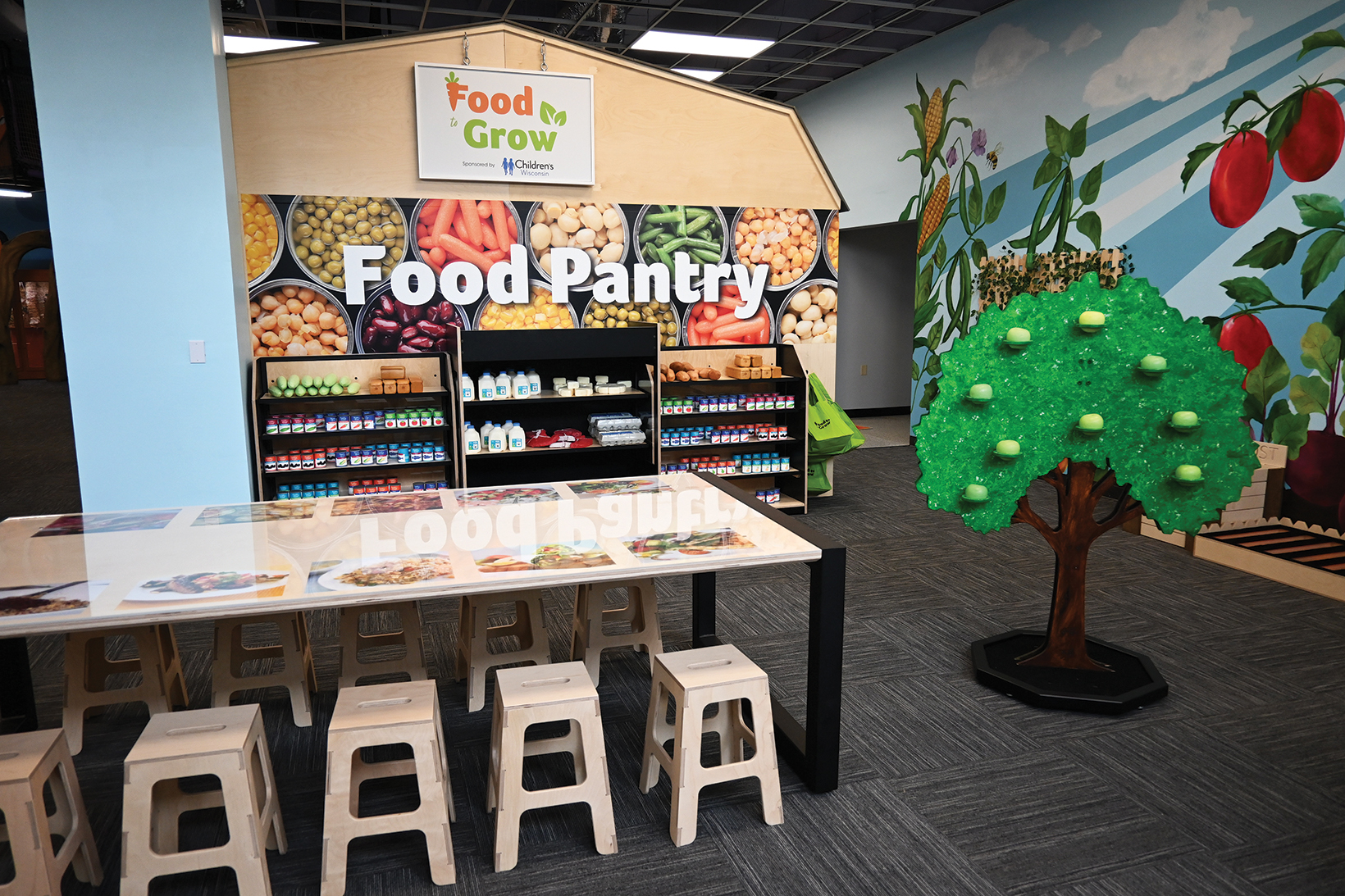
“Food to Grow” includes a bright red barn, well-stocked food pantry, garden and orchard, tented market, modern kitchen and shiny dining table that all work together to showcase the food system and promote healthy eating. Each element of the exhibit is colorful, promotes play and is thoughtfully designed to be inclusive of all cultural experiences around food, Zornow says.
“[We have our] food pantry; we don’t have a grocery store here,” he explains, acknowledging that the latter is a popular exhibit at other children’s museums. “There are families that receive healthy foods through non-transaction-based spaces. We want every kid to be able to see their experience here. The farm market may be where you access your food, or you might live on a farm.”
And while it’s impossible for the exhibit to be fully inclusive of all food cultures and experiences at one time, Zornow says BFK plans to rotate the recipes it shares and food it showcases, constantly seeking feedback from the community as well as the nutritional anthropologist with which the museum is consulting.
“We’re very careful that this isn’t a ‘healthy food’ exhibit,” he says. “The whole concept of what is healthy is a culturally defined piece and is different for each individual. It’s really about exploring variety [and] understanding the role that different types of food play in our bodies and cultures.”
A natural addition
That inclusive focus is paramount at Building for Kids, where the nonprofit organization is constantly striving to expand its reach. With admission prices below BFK’s operating cost of $15 per visitor, as well as a robust access program for those who can’t afford admission, Zornow says the museum relies on community support — and wants not only the Fox Cities, but the entire region, to in turn appreciate the resource.
“For a community our size, we like to build it big — like our P.A.C. and expo. Most communities our size don’t have a children’s museum of this caliber,” he says.
Food-related exhibits have been a staple of BFK programming from the beginning, Zornow says, because children almost universally start exploring the world through their mouths. Education around food also checks all three of the boxes BFK’s board seeks to emphasize in programs: physical health, mental health and developmental outcomes.
Casie Holdcroft, the museum’s marketing manager, says “Food to Grow” has already proven to be educational for all ages, whether that means a family learning a new recipe to make together at home or a toddler recently discovering that apples grow on trees.
“[That family] got to talking, and then it was about how maybe they should visit an apple orchard,” Holdcroft recalls. “It was like taking the next step in real life, and I thought it was really cool.”
Zornow says the thing that makes “Food to Grow” stand out is its intentional collaborations with community partners. It was a reason BFK received its grant from the Institute of Museum and Library Services, which is now also holding up the exhibit as a model for other applicants. “Food to Grow” will also have a robust daily programmatic element allowing for the exploration of real food, whether that’s tasting an herb or veggie from BFK’s hydroponic garden or eating a meal with classmates on a school field trip. Zornow says the museum is currently developing its on-site commercial kitchen to support the exhibit.
“It’s a really innovative way of looking at how a children’s museum can pair with community efforts like Be Well and food equity partners,” Zornow says. “We have these opportunities as a community to improve the vitality of everybody.”