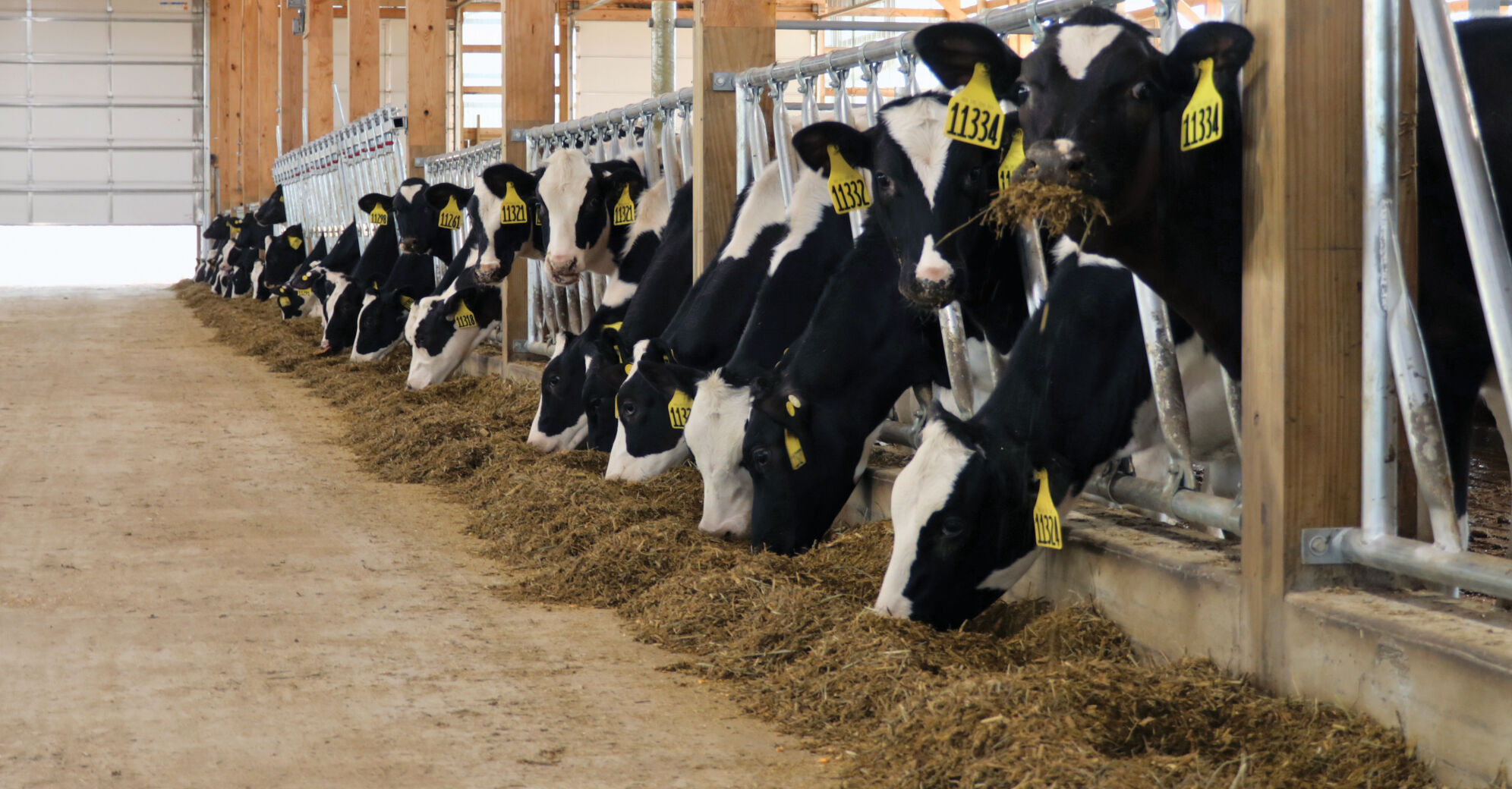

Kinnard Farms in Casco milks about 8,000 cows, utilizing technology with a focus on preventative health care.
Kinnard Farms photo
The traditional red barn housing a dairy operation may not belie the sophistication of what’s happening inside — including the ever-increasing adoption of technology and other innovation.
It comes as no surprise, as a dairy farm is a business. And in a world plagued by talent shortages and a general need to “do more with less,” having an innovative mindset is a must nowadays.
Hub propels innovation forward
The state’s Dairy Innovation Hub is supported with $7.8 million per year. It is designed to harness research and development at three UW System campuses with the goal of keeping Wisconsin’s dairy community at the global forefront in producing nutritional dairy products in an economically, environmentally and socially sustainable manner. Since its launch in 2019, the Hub has funded more than 150 projects and 17 faculty positions. It embraces a four-pronged approach that includes growing farm businesses and communities for the future; faculty and staff members may apply for research funding for projects, talent and infrastructure. The Hub’s project showcase runs the gamut from rethinking nutrient management planning to bringing AI to dairy barns to using smart technologies for streamlining herd management.

“When the Dairy Innovation Hub began, we were in a long period of very low milk prices and there were a lot of farmers exiting the business,” says Maria Woldt, program manager at the Dairy Innovation Hub. “What could change that includes giving farmers more tools to be successful, including researching emerging [opportunities].”
While research is a “long game,” the Hub provides smaller grants for pilot-level projects that provide the data people need to then apply for federal grants.
“We can see what works and pursue a bigger study with broader reach, more technology, more capacity, more people, more cows, more acres,” Woldt says. “That’s where they can take the investment the state is making and amplify it. We’ve seen it happen countless times, and it’s exciting for Wisconsin to be an incubator, almost, for innovation.”
What the USDA grant means for innovation industrywide
The recently-announced up-to-$50-million USDA grant secured by Edge Dairy Farmer Cooperative and Farmers for Sustainable Food can empower broad-reaching innovation to position dairy farmers for the future.

This grant is for a broad initiative aimed at expanding climate-smart markets and establishing dairy and beet sugar as climate-smart commodities. Edge Dairy Farm Cooperative CEO Tim Trotter says it allows for innovation by providing opportunities for farmers to identify areas in which they want to improve, as well as access to a virtual toolbox and processes farms can use to make business decisions with a strong tie to climate change and better farming practices.
Trotter says there is a direct correlation between the grant and dairy farm innovation, as it allows for scaling sustainability to more Upper Midwest farms.
“We’ve got the system and now, thanks [to] the partnership with the USDA, we have a mechanism to deploy it,” he says. “There are so many areas a farmer has to choose from and invest in to advance their business. Every farm is unique. Every farmer is unique. Every business plan a farmer creates is unique. It’s important to give them access to a robust set of tools to help them be successful.”
Forms of technology and other innovations
At a deployment level, the Dairy Innovation Hub sees two keys for technological advances in dairy farming: incorporating robotics to alleviate labor shortages and improve work-life balance for farmers, and improving animal health and productivity through the use of technology and sensors that can streamline diagnostics.
Most dairy cows today wear activity trackers to gauge exercise, milk production and overall health. In addition, rumination collars can gauge what’s happening in a cow’s body — including pinpointing disease indicators.
“This allows us to treat her much more quickly with a higher success rate,” Woldt says.
Monitoring activity also can help a farmer make more accurate breeding decisions, as a cow in heat tends to be much more active.
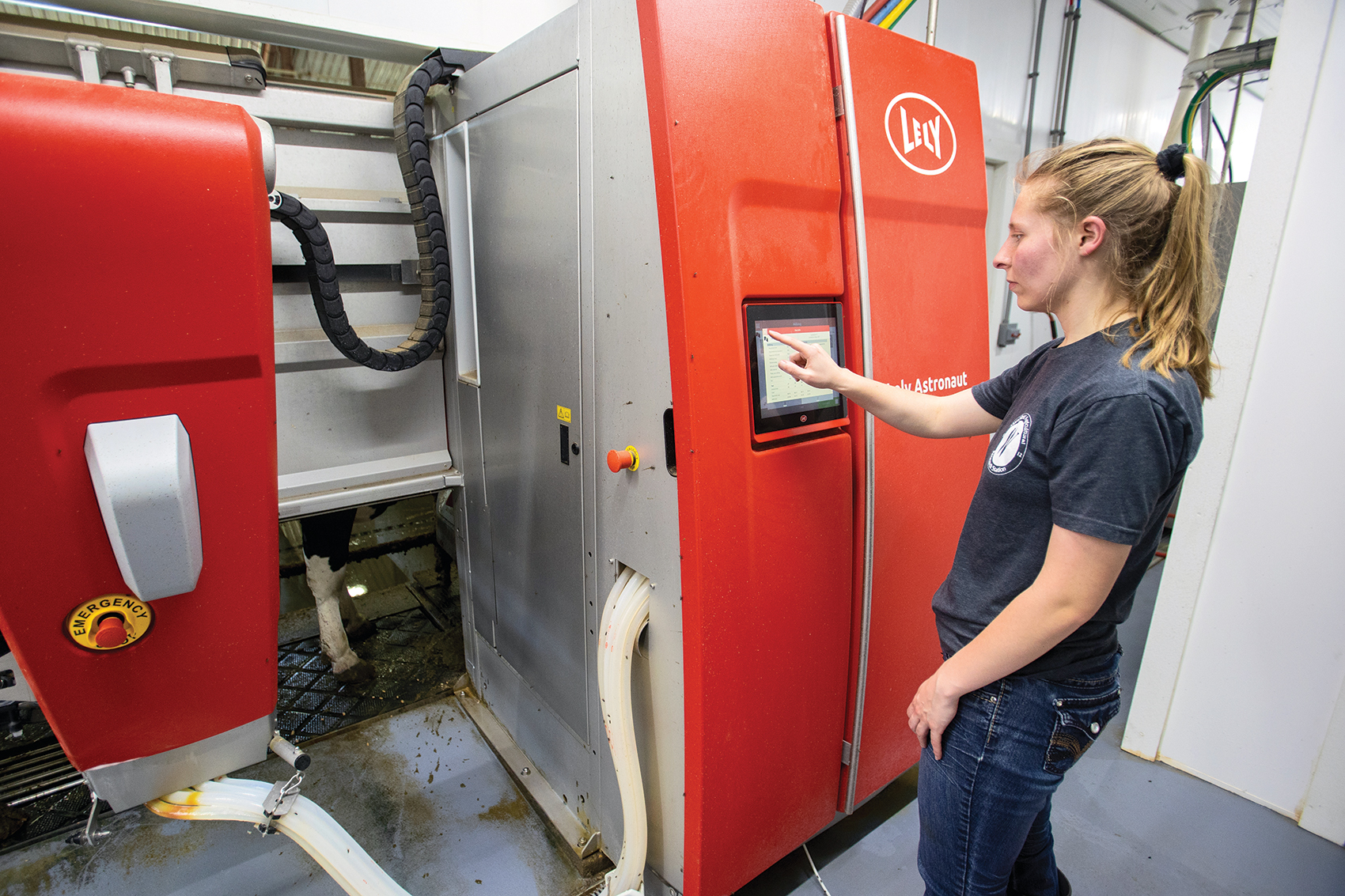
Robotics are also increasingly commonplace; this includes robotic milking. Thanks to funding from the Dairy Innovation Hub, UW-Platteville installed two milking robots on its Pioneer Farm for research purposes.
“The robots have opened the door for us to do a number of research projects that involve these systems,” Woldt says. “If a dairy farm in the state is looking to do an improvement on their farm, they are considering robotics. Nobody is doing a renovation in the state without at least considering robots.”
Other robotic systems exist to scrape and clean up manure, as well as to perform automatic feed pushing.
“Cows are very messy when they eat, and the feed has to be pushed back to them whether it’s with a person and a shovel or a machine,” Woldt says.
Personalized nutrition is also an area of great interest. A robotic system can add specific nutrients to specific cows’ feed, prompted when the system reads a specific cow’s ear tag.
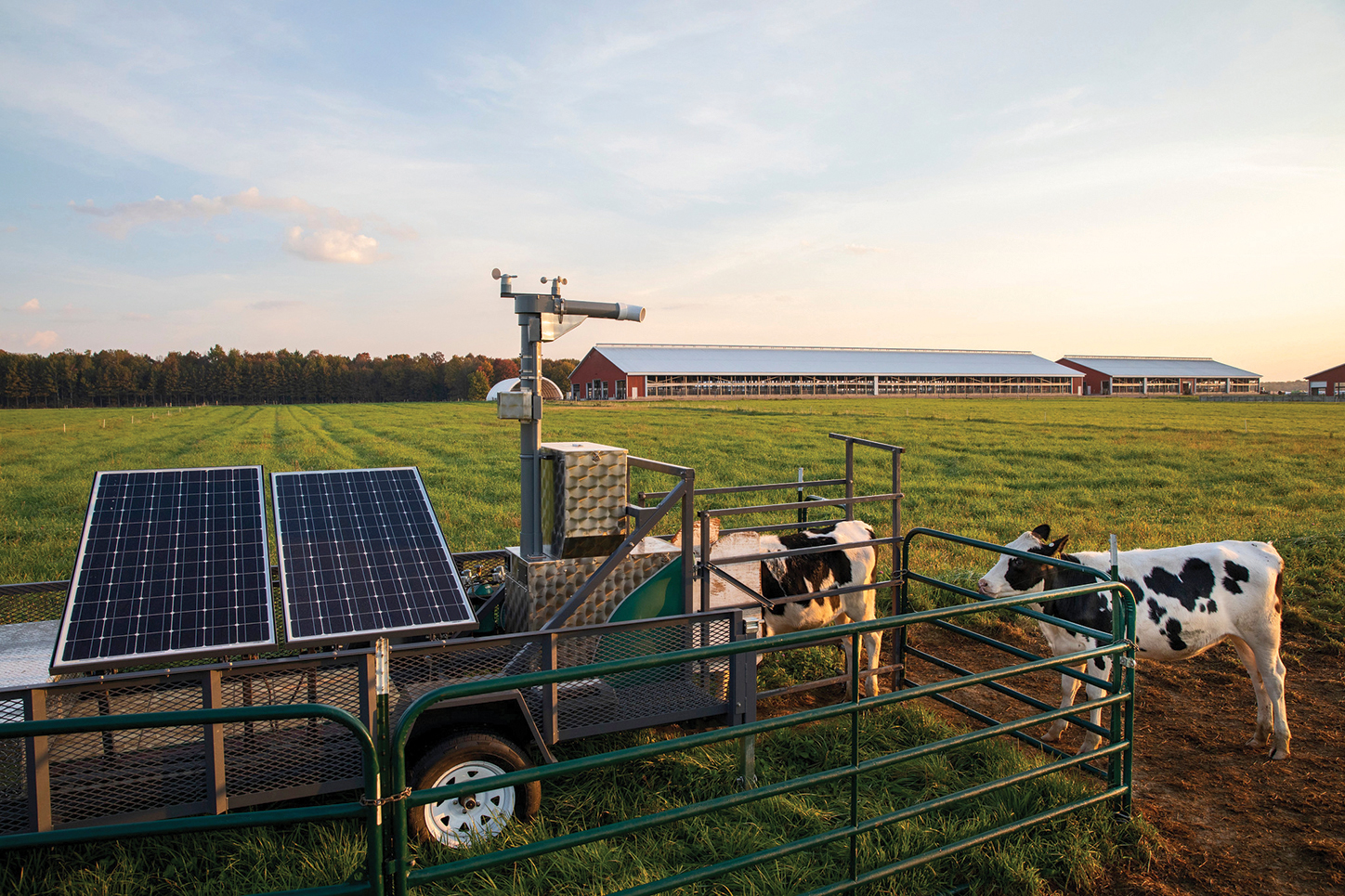
Yet another innovation is a GreenFeed unit that entices cows to place their heads inside the machine with a sweet pellet — which then measures the methane emissions in their breath or burps. The unit is on a trailer and solar powered so it can be used in the barn or out in the pasture. Most research to date has focused on cow methane emissions from the back end of the cow, Woldt says.
“Moving greenhouse gas emissions to net zero is top of mind for everybody,” Woldt says. “The Dairy Innovation Hub is funding the measurement of methane from a cow’s breath. Farms are unique, because not only are they greenhouse gas emitters but [they] also can reduce emissions, positioning them really well to be part of the solution to climate change.”
Other technologies being deployed include the use of methane digesters — large closed tanks where micro-organisms break down organic material and capture the resulting biogas. That gas is then used to power the dairy farm or is sold for other use.
Case study: Kinnard Farms in Casco
Fifth-generation Kinnard Farms has continued to grow even as others leave the dairy farming business, now farming about 9,000 acres and milking about 8,000 cows. Being progressive is a “bedrock of everything we’ve done for generations,” says Lee Kinnard, president of Kinnard Farms. “We are forever trying to farm in a way that leaves everything in a better condition than when we found it.”
First and foremost, animal care is top of mind.
“For us, it’s about preventative health vs. only treating animals, thanks to technology like Fitbits,” he says. “There is very seldom an animal that needs treatment, which is pretty incredible. That’s the result of technology — monitoring temperature, steps, how much they have eaten, how they’re ruminating.”
On the crop side of the equation, Kinnard employs the use of GPS-guided machinery that allows the farm to look at crops large scale and then drill down to the square foot of land being farmed and determine the yield from it.
“It comes down to, how do you most sustainably grow that crop? It’s easy to do the science and math to figure out what we need to replenish the soil when we can measure the harvest down to the square foot,” Kinnard says.
Kinnard Farms utilizes strategies like regenerative farming and planting green, he adds. For example, it may plant a cover crop after a corn crop is harvested to prevent soil erosion, minimize nutrient loss and sequester nutrients back to the growing corn crop.
“This is what is referred to as ‘planting green.’ It’s relatively new to our region and only possible thanks to innovations in planter technology as well as the use of tractors guided by GPS,” Kinnard says. “This system of farming allows farmers to rebuild and improve soil health and productivity through regenerative agriculture.”
Embracing technology has largely been driven by a desire to allow employees to focus on more value-added activities on the farm.
“We look at technology from a sustainability standpoint, from an animal care standpoint and whether we can improve our people and bring the community along with them,” he says.
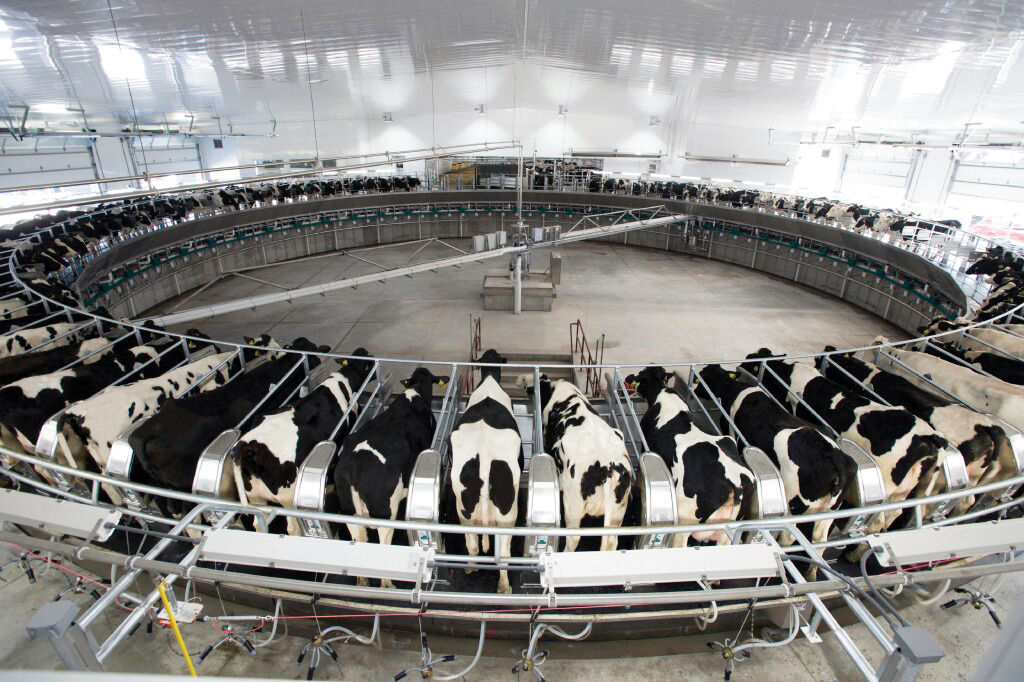
The farm has been using its rotary milking parlor for eight years now, managing its entire dairy based on the parlor’s operation. Each cow wears a Fitbit-like device, and the parlor reads and downloads the information in real time when a cow is milked, allowing the herd management team to focus on preventative health care. It’s another example of how technology has increasingly allowed Kinnard Farms to better its operations to benefit the animals and the team.
“Good business sense is good business sense. We look at ever-improving our land, our people, our girls and our community,” Kinnard says. “Nine times out of 10, if something checks all those boxes, it usually checks the box from an economic standpoint as well.”