

The Experimental Aircraft Association, or EAA, was founded in 1953 and found its forever home in Oshkosh in 1983. It’s an organization of global significance, best known for the annual AirVenture event that draws more than half a million people to Northeast Wisconsin from around the world. But many say the myriad opportunities to embrace EAA year-round are among Greater Oshkosh’s best-kept secrets.
Chuck Galipo, director of customer solutions at Oshkosh-based Muza Metal Products and a long-time supporter of EAA, says locals can sometimes see the organization only through the lens of its prominence as a global entity, missing the opportunity to embrace it as a community resource.
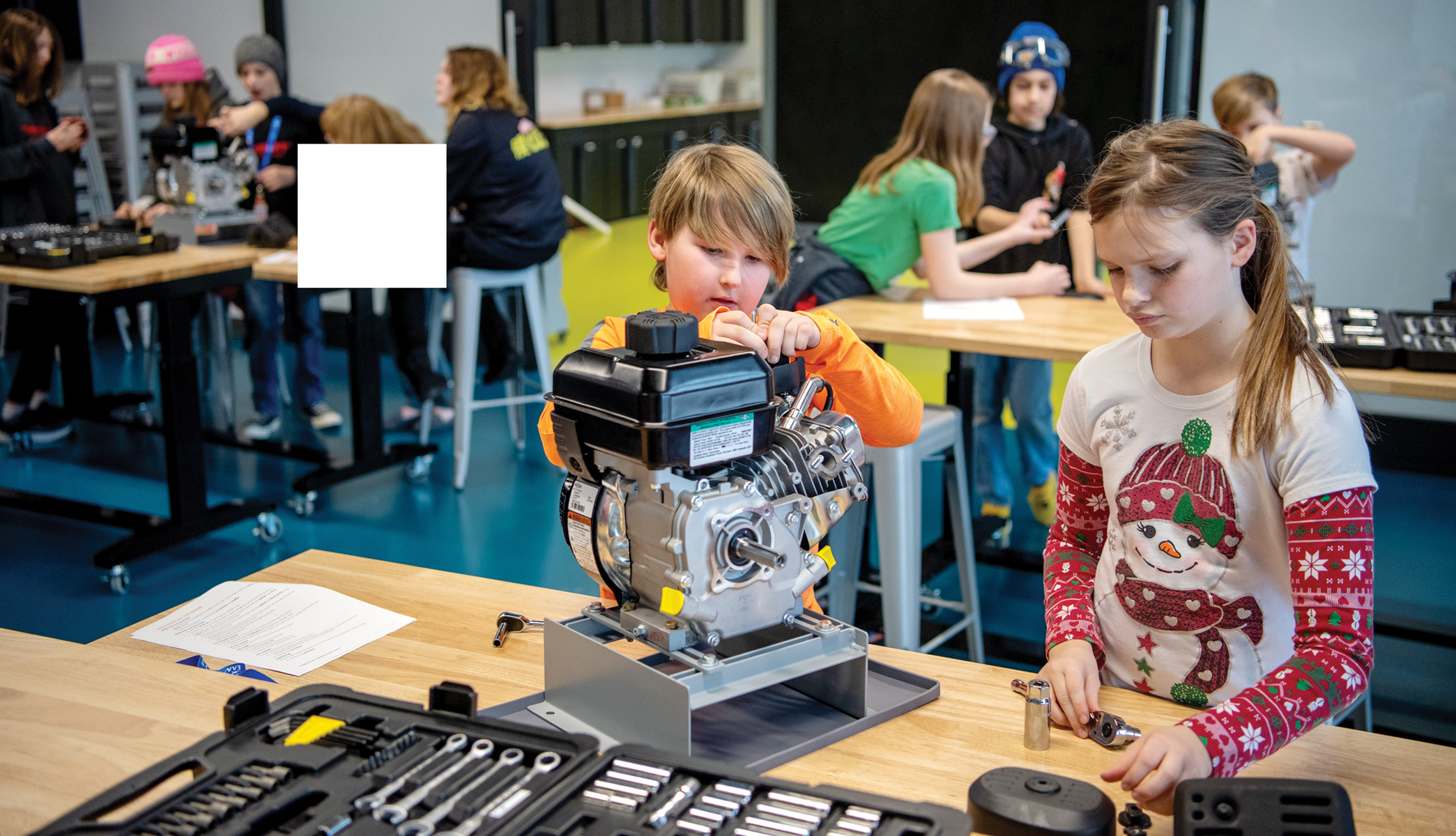
Today, that includes the 30,000-square-foot EAA Youth Education Center, which opened in July 2022 with a focus on inspiring the next generation of aviation enthusiasts through targeted, high-tech and hands-on programming. Alyssa Horpedahl, program manager for the center, says EAA has always had children’s programming such as group paper airplane and parachute builds, but the new, dedicated facility allows EAA to reach older student audiences with much more sophisticated programming year-round.
“Our mission is to share aviation, and it doesn’t matter who you are or where you are. And so in order to keep that going we have to reach our youth,” Horpedahl says, adding that the youth education center was created entirely through private donations and that ongoing support from companies such as Gulfstream and aviation influencers like YouTuber “Citation Max” Weldon continue to be integral to its operations.
The facility includes multiple learning labs and even a wind tunnel donated by Embry-Riddle Aeronautical University. A room on the lower level, which Horpedahl describes as the “competence center,” is dedicated to EAA’s impressive collection of high-tech Cessna 172 flight simulators, which Horpedahl says used to be placed in storage except for during AirVenture. The pilot proficiency center, which shares space with the youth education center, will even be leveraged for some youth programming, she says.
The center employs three full-time educators with K-12 teaching backgrounds, including Horpedahl, Cindi Pokorny and Courtney Condon, as well as three part-time adjunct educators who primarily help with weekend programming. In the last year alone, the center has grown from nine to 20 program offerings, Horpedahl says, and the number of children engaged has tripled.
Those programs include everything from tried-and-true ones like the annual Air Academy summer camp for teens to an after-school club at which teens build drones to “Girls on the Fly,” a new event for middle and high-school girls to discover aviation careers and hobbies that has become one of the center’s most popular programs.
Workforce shortages, both across the country and across industries, have made career inspiration an important pillar of the center’s work, Horpedahl says.
“There are so many possibilities,” she says. “The aviation industry is vital to everything in the United States, from passengers to cargo. So it’s just important that we have the people in those positions to keep that industry going. We’ve seen and we’ve recognized that not only do we need pilots, but we need engineers and mechanical avionics people. So it’s an industry-wide mission to reach the kids and get them interested in it.”
Teachers spread their wings
One of the best ways to reach kids? Through their teachers. Another popular EAA Youth Education Center event is Teachers Day, a four-hour morning session held on the Friday of AirVenture that draws educators from across the country.
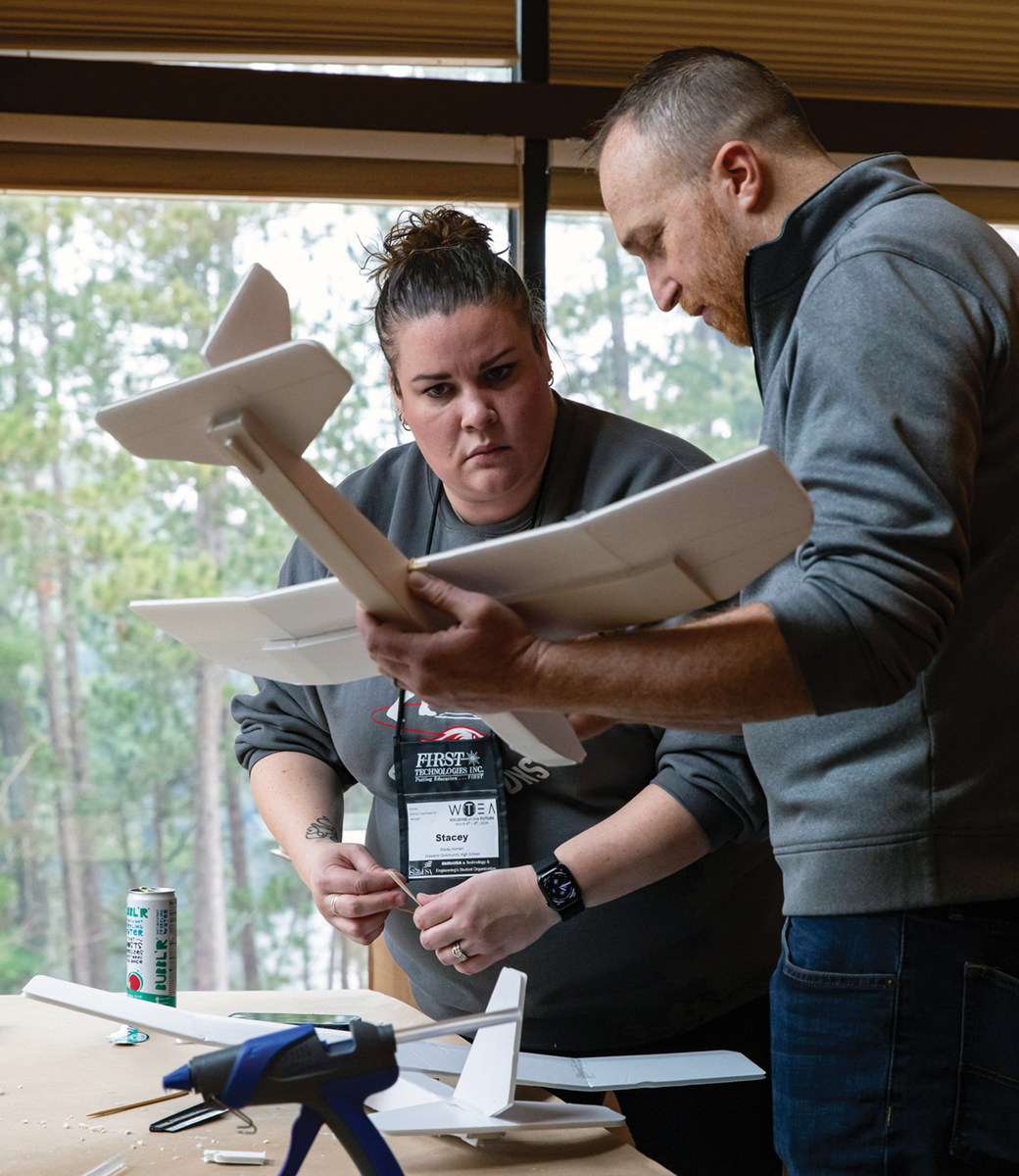
But connecting Wisconsin teachers in particular with the resources of the EAA Youth Education Center was the priority in March when the Wisconsin Technology Education Association (WTEA) held its annual conference in Wisconsin Dells, bringing together more than 400 teachers for two days.
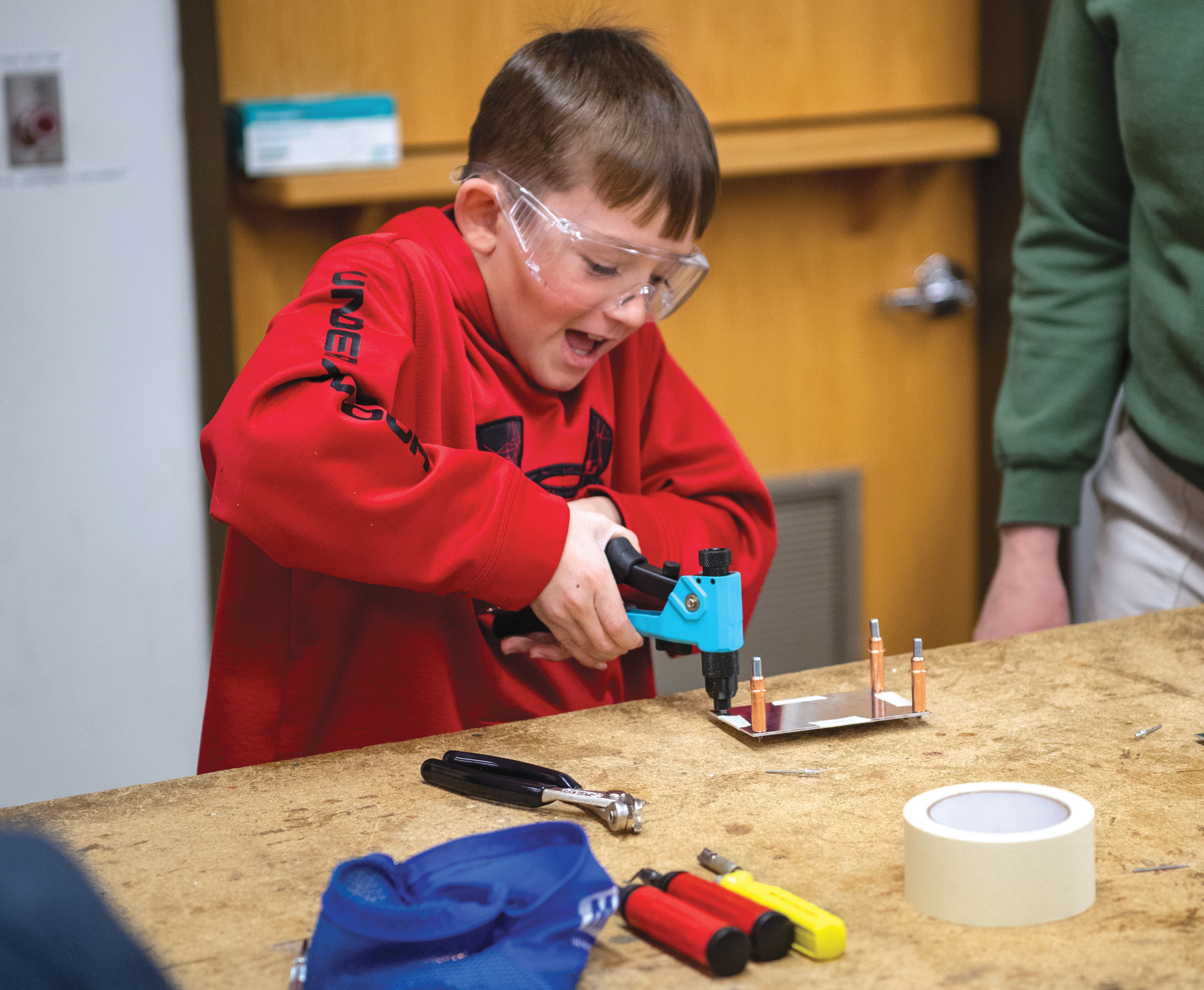
Horpedahl, Pokorny and Condon attended the conference both days, hosting a “Make-and-Take” session — essentially providing teachers with the tools and experience to replicate some of the center’s most popular lessons and activities, including soldering a printed circuit board, building a cross-section of airplane wings out of balsa wood, shaping a basswood propeller, making foam gliders and turning those gliders into radio-controlled airplanes.
“Teachers learned and did activities they can take right back to their middle schools, high schools and summer camps, and also learned about the resources from EAA,” says Steve Meyer, manager of STEM education for Fox Valley Technical College, which sponsored the Make-and-Take event along with the Northeast Wisconsin Manufacturing Alliance and Flite Test. “This is something where we want to celebrate education, wine and dine teachers, get them excited and reward them with a fun, fun day.”
EAA’s participation at the state conference was inspired by a smaller WTEA event held last summer that attracted about 35 teachers who toured not only the youth education center, but also got behind-the-scenes looks at the EAA control tower, as well as operations at companies such as Plexus and Gulfstream Aerospace.
“We try to put on these events to really immerse teachers in the different businesses and industries that they’re teaching about,” Meyer says. “Teachers are so busy; they don’t always have that opportunity. But it’s obviously very important for them to keep up with the trends, so when the students in the class say ‘am I really going to use this?’ they can say, ‘Well, at Gulfstream they do this every day.’”
Meyer says WTEA and EAA are natural partners, because “aviation is about as STEMmy as it gets.” But the learning and curiosity that come from aviation translate to a wide variety of professions.
“The other part is using aviation to teach manufacturing,” Meyer says. “Oftentimes, when teachers see this subject they think about someone becoming a pilot. And that’s a smaller niche of kids. But … if a kid is interested in airplanes, there’s hundreds of positions at places like Gulfstream, [which is] looking to hire good people nonstop. We need electricians; we need people in wood manufacturing; we need interior designers. All of the [disciplines] that serve that industry, I think, was a little eye-opening for them.”
Powering forward
For Galipo, whose granddaughter is a former participant, the EAA Youth Education Center has a tremendous opportunity to inspire students and teachers beyond 12th grade. Through his advisory board role with FVTC, he was instrumental in facilitating a stronger relationship between EAA’s education programs and the college’s robust aviation and aeronautics curriculum, opening a higher education pipeline he says was right in front of everyone’s faces.
“The technical college in Oshkosh is connected to the EAA via runway, [but] here they are teaching classes on aviation and mechanics and they’re kind of in a silo right next to a giant global silo,” Galipo says. “So the first thing I did was connect [associate] dean Jared Huss with Alyssa [Horpedahl] and the crew at EAA so they could tour one another’s facilities and look at what we can share for knowledge and best practice.”
Galipo says with the EAA Youth Education Center serving students up to 17 years old, it’s only natural to partner on educational initiatives with FVTC, which can take them from there.
“Their location is strong because it’s a global presence,” Galipo says, “but we’ve got to use it, too, because it’s pretty powerful.”
After years of teaching the Project Lead The Way curriculum as a public school teacher, Pokorny says she has had a front-row seat to observing how applying STEM principles to real-life career problem solving has made education more effective and relevant for the future.
Meyer credits the Wisconsin Department of Public Instruction’s implementation of academic and career planning seven years ago with the significant shift he has seen in STEM education approaches across Wisconsin. “It probably always should have been like that,” he says. “And it’s probably one of the greatest things to start making connections.”
Pokorny says inspiring those connections means not just adapting how we teach, but making efforts to reach kids where they are — and that includes YouTube and social media.
“For me, it’s really just getting that spark for them, even if all they ever do is find stuff on YouTube and teach themselves about things,” she says.
Horpedahl says one of her favorite activities at the youth education center was actually inspired by social media.
“The reason we have that is because I reached out to a lady on Instagram who makes these wooden propellers that are airworthy for vintage aircraft,” she recalls. “I was like, ‘would you ever be willing to help me make this?’ and she came here during AirVenture. She did a presentation, sent me a bunch of information, and shaped a propeller for me so I knew exactly how it needed to be. And so it’s just cool, the power of social media.”
While it can be hard to predict the specifics of future careers in manufacturing and aviation, the opportunities remain as endless as the possibilities, Meyer says.
“I tell young people every time I talk with them that I’ve never seen opportunities for a young person like this in my 25 years of being in the business. Work hard, be willing to learn and you can kind of write your own ticket right now.”