
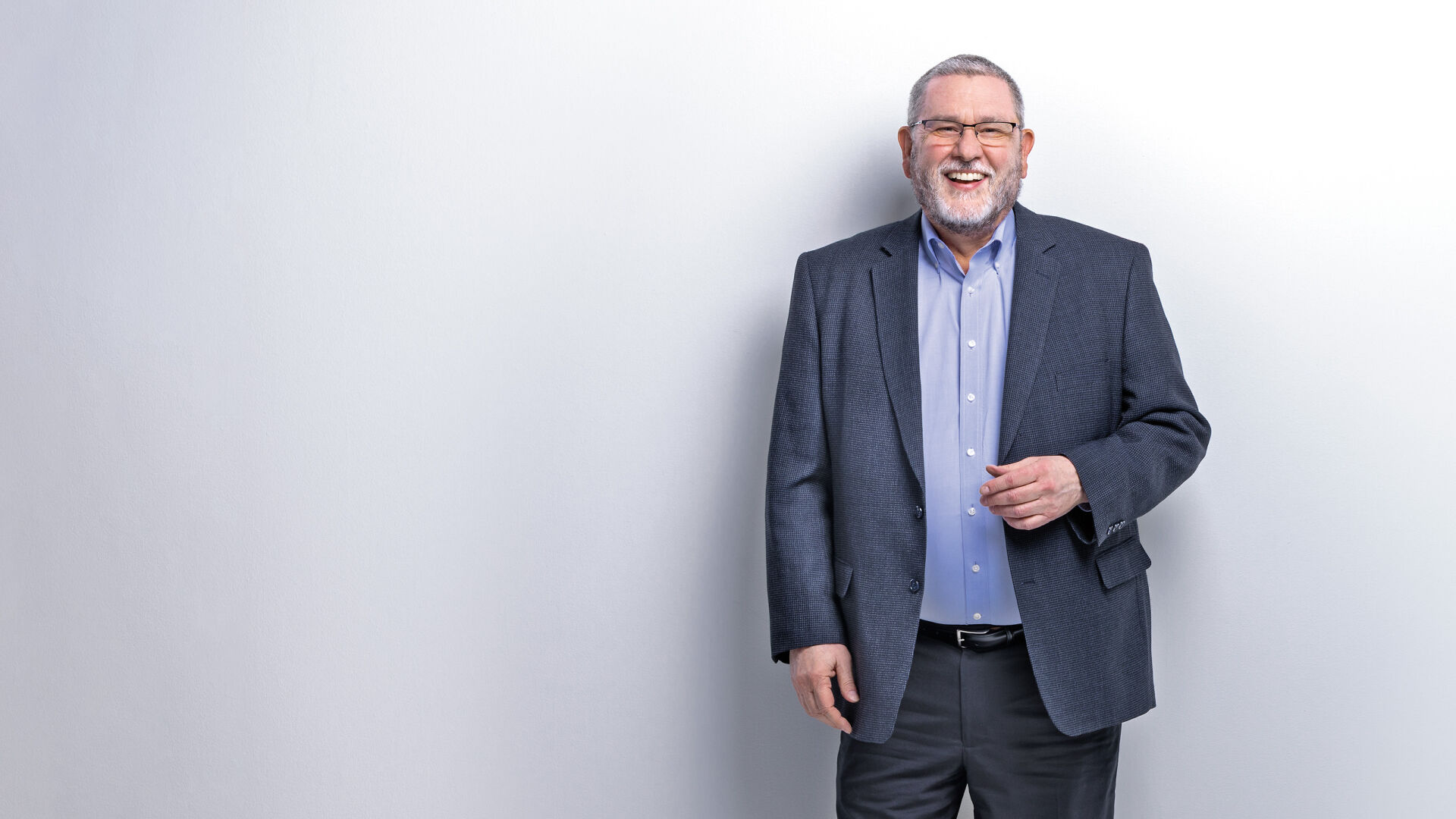

Photograph By Shane Van Boxtel/Image Studios
When Kimberly-Clark Chief Scientist Pete Dulcamara retired in 2023, he knew he wasn’t going to spend his time fishing and golfing.
“What I really wanted to do was seek my renaissance, really a rebirth,” the Maryland native says, “and it was all around this personal mission to help create businesses that improve people’s lives.”
The chemical engineer today is an advisor, consultant and author doing just that.
Insight caught up with Dulcamara to discuss his work and new book, “High-Tech Heroes,” which turns the spotlight onto Generation Z — a group Dulcamara believes is uniquely positioned to lead humanity forward.
Insight: You experienced something pretty profound, at the Detroit airport of all places, that really spurred your personal mission. Can you talk about that?
Dulcamara: My wife and I were having difficulty having children. I was working for Dow Chemical at the time in Midland, Michigan, and around Christmas I was coming back from a business trip and my flight was canceled. I got stuck in Detroit, so I had to go to this Hilton. On my way, I could hear somebody playing a saxophone.
I saw it was this African American guy, and as I put a couple bucks in his cup, he looked at me with the most compassionate eyes I’d ever seen and he said, “May you have your baby.” Well. My wife and I visited my parents for Christmas and she was feeling sick, so we went to the doctor, where we found out she was pregnant with our daughter. That was a really huge event for me personally. I spent that holiday break asking myself what did I want to accomplish in life and what do I want my legacy to be? I came up with this personal mission to help raise children that live a life fulfilled, and to help create businesses that improve people’s lives. That was in 1997, and it’s still my mission today. It’s the reason I left Dow Chemical to come to Kimberly-Clark. It’s the reason I left Kimberly-Clark to form my own LLC, and it’s the reason I wrote this book “High-Tech Heroes.” What I really want to talk about is how we can create hope and purpose and use the technologies around us to solve the world’s biggest problems like gender equality, climate change and responsible consumption.
You’re applying your knowledge of consumer products to accomplish this through an approach you call “humanity-centric innovation.” Can you describe this?
Consumer-centric innovation is all about what’s needed by the customer, what’s required by the business, and what’s possible through science and technology. The intersection of those three things is how you create a consumer product. I just took that model and applied it to humanity-centric innovation — what are the needs of humanity defined by the United Nations’ 17 Sustainable Development Goals? And then what are the business models of the 21st century — things like the smartness economy of Siri and Alexa, or the crowd economy of Airbnb and Uber, or the data economy of Google and Facebook. And then what are the exponential technologies — artificial intelligence, robotics, blockchain, genomic sequencing. How do we take the intersection of those three things to solve a problem like climate change? Maybe it’s using regenerative agriculture to sequester CO2 in the soil and the root system. Maybe it’s coming up with artificial photosynthesis to create carbohydrates that we can use for fuel instead of pulling hydrocarbons out of the ground using petroleum. I want to encourage the next generation rather than worrying to plan, take action and find purpose in their life.
In your book you say Gen Z is “our last and best chance to save the planet.” What makes you believe that?
They’re digital natives. They were born with digital devices. Gen Z isn’t afraid of exponential technologies. They’re engaging with AI and robotics and blockchain, and using tools like Discord and TikTok. They get things like self driving cars and gamification. There’s a real opportunity here for Gen Z, because they’re the leaders of the future, they’re going to be the politicians, the CEOs, the business leaders. I’d like to equip them with humanity-centric innovation. Instead of a consumer-centric mindset of creating products for just profit, let’s create products with purpose as well as profit. In the next decade or two, we could be at a point of no return as it relates to climate change and microplastics. Ninety-nine percent of all species on the planet that have ever lived are now extinct. Extinction is the rule; survival is the exception. If Gen Z can find purpose and utilize the tools that they’ve been living with their whole life and apply it to those things that matter most, our whole species will be thankful. Are people 100 years from now going to look back and see us creating the next Dark Ages or the next Renaissance? The choice is up to Gen Z.
How can older generations mentor this new generation when they are facing such a different world than the one they grew up in?
The key is to focus on human values. When artificial intelligence exceeds human intelligence, which it will, we’re going to find out that EQ is more important than IQ. And when I talk about EQ, it’s not just the emotional quotient — it’s empathetic, it’s ethical, it’s entrepreneurial, it’s envisioning. It’s all the things that make us human. A lot of the technical skills that my generation thought were important are going to be done by AI. What we need to teach people is how to communicate with each other, how to connect with each other, how to build trust with each other, how to have a conversation with each other. Those things that make us human are going to become more important than ever. As we move from IQ to EQ, the next thing we need to move to is what I call AQ, which is the adaptive quotient. We really are an adaptive species, and we’re going to find that over the next 10 to 20 years, our ability to adapt to new situations and to be resilient is going to be a critical skill.
What advice would you give business leaders in Northeast Wisconsin about creating more sustainable businesses?
Think about sustainability as something that’s free. Right now, we think sustainability costs money. But think about running your business with less water, with less energy, with less raw materials, with less waste. Business leaders should think about using sustainability as a way to create competitive advantage. Focus on using exponential technologies and new business models to solve the world’s biggest problems in an economically viable way. When you do that, you keep your license to operate, you do what’s right for the next generation and you create a profit based on purpose.

