

More than five years after a study by St. Norbert College and the Greater Green Bay Chamber identified transportation and logistics as the region’s top industry for job growth, Greater Green Bay has positioned itself as a hub for innovation and thought leadership in transportation, logistics and supply chain.
Just in the last six months, the industry has made major headlines. In May, TitletownTech announced investment in Wisconsin-based supply chain company Renaissant, which provides a technology and data solution for the flow of trucks and trailers in and out of warehouse and distribution centers.
Also in May, U.S. Secretary of Transportation Pete Buttigieg visited Green Bay to celebrate a $10.1 million grant that will create a new state-of-the-art port facility. While there, he also met with truckers to discuss supply chain issues and lauded the region’s overall strength in transportation, transportation infrastructure and logistics.
There are job opportunities, but this is not just a job opportunity — it’s a career opportunity.
— Kelly Armstrong, vice president, Greater Green Bay Chamber
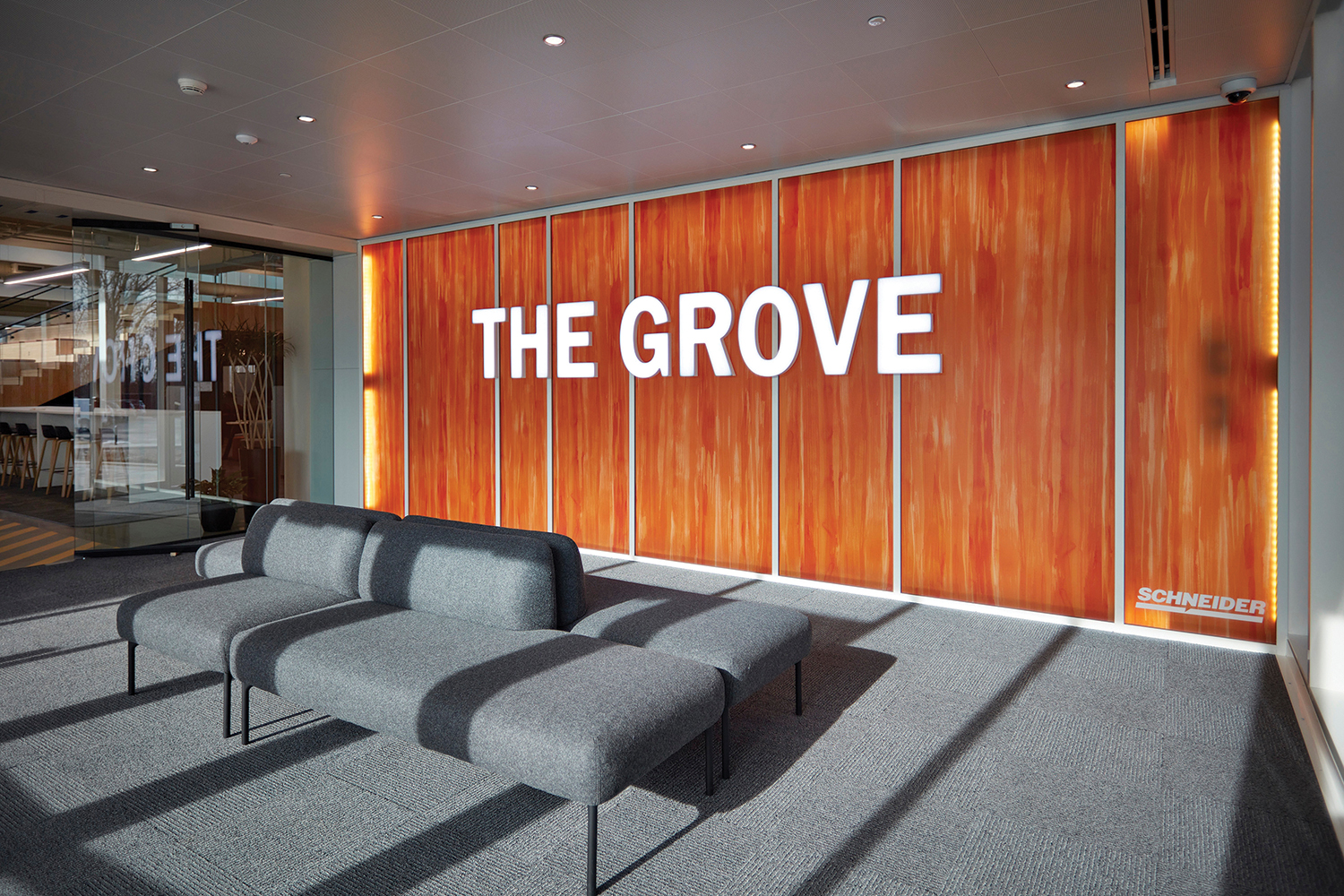
Then, just weeks ago, Ashwaubenon-based Schneider National, Inc. — the nation’s 16th-largest logistics company — announced the acquisition of Massachusetts-based M&M Transport Services, its latest since acquiring Midwest Logistic Systems a year earlier. Schneider had kicked off the summer by opening its highly-anticipated 20,000-square-foot innovation center, The Grove.

“The Grove will play a crucial role in building the future,” Schneider Executive Vice President and Chief Innovation and Technology Officer Shaleen Devgun said in a company statement. “Our goal in opening The Grove is to provide access to state-of-the-art tools and spaces that spark creativity, fulfill our promise to always deliver and always be ahead, and lead to decades of innovative ideas and solutions across the industries we serve.”
And while Schneider is the biggest player in the region, it’s far from the only one. There are more than 642 transportation and logistics companies located in and around Green Bay, representing more than 11,000 jobs.
For the chamber’s Kelly Armstrong, vice president of economic development, it’s a source of pride to house the nation’s 18th-largest transportation and logistics industry cluster, with its ever-growing portfolio of companies and resources. It’s also a top vehicle for economic development.

Industry clusters, Armstrong says, work the same way everywhere: Executives communicate regularly with one another and develop into thought leaders for their industries, which in turn attracts global attention. An employee can spend their entire career in one spot, from entry level to executive, with the opportunity for movement between competitive companies being seen as an asset, not a liability. The strong cycle of talent attraction and development that goes along with the cluster then also drives startup activity, with knowledgeable leaders sharing both their challenges and ideas.
“Why would you want to come here? There are job opportunities, but this is not just a job opportunity — it’s a career opportunity,” Armstrong says.
‘Best minds in the country’
Minnesota native Todd Ericksrud launched his career with Schneider and eventually found his way to Green Bay; the industry cluster, he says, has been a major reason he’s stayed. In 2014, Ericksrud founded Matchback Systems — a logistics company working to increase efficiency and sustainability in the use and management of shipping containers. As a Schneider alum who had become well connected in the industry, Ericksrud was confident launching the business because he understood the problem his company was solving from many angles.
I think some of the best supply chain minds in the country are in Green Bay.
— Todd Ericksrud, founder, Matchback Systems
“I think some of the best supply chain minds in the country are in Green Bay,” he says. “And when you start getting a lot of concentration and density around a specific industry, it’s just natural that you’re going to start to learn things.”
Matchback Systems is a small company, but it currently employs three interns, Ericksrud says, representing St. Norbert, UW Oshkosh and Milwaukee School of Engineering. He and Armstrong both say the industry cluster is beneficial not just on the company side, but from an academic and higher education perspective.
Ericksrud points specifically to his company’s partnership with Northeast Wisconsin Technical College, which has worked to offer programs that cater directly to his and his colleagues’ hiring needs. And Armstrong says conversations between company and university leaders played a role in St. Norbert and UW-Green Bay adding much-needed industry data analytics programs. The chamber has been intentional about facilitating cluster conversations and marketing the cluster to promote both talent attraction and thought leadership in the community.
“[The chamber meets] with executives, and we bring the universities to the table and we’re having these conversations about what else do you need in the talent space,” Armstrong says. “How else can we put our stake in the ground? How do we shout out from the rooftops, and what else can we do to build up this entrepreneurial ecosystem?”

John McCaw was lured to his current role as vice president of sustainability at Breakthrough, a business unit of U.S. Venture, from one of the country’s most notorious industry clusters — Silicon Valley. So he speaks from experience when he talks about the value of such an ecosystem.
“There’s that magic that happens when everyone is together,” he says. “The opportunity in and around Green Bay [is exciting] — there’s a very real cluster of companies that are doing innovative things and driving real solutions around sustainable transportation. And that’s incredibly important to the economy. There’s an opportunity to effect change in not only the logistics industry, but the entire global economy.”
Ericksrud says Green Bay just “does it right.”
“When you get a bunch of good, hardworking people and fill them with supply chain and logistics knowledge and capabilities, it just makes for a great work environment,” he says. “We [Matchback Systems] are a company that works with a lot of international companies, and everybody understands Green Bay has a prominent place in the industry.”
Learn more about Greater Green Bay’s transportation and logistics industry cluster:
www.greatergbc.org/economic-development/transportation-and-logistics
Thought leadership: Fueling sustainability
The transition from fossil fuels to electric power is among the issues on which the New North’s transportation and logistics companies are poised to lead, according to officials from Greater Green Bay-based companies including Breakthrough, Paper Transport, Schneider and Contract Transport Services.
“What we’re seeing is a lot of innovation that’s going to drive long-term opportunity for more sustainable movement of goods,” says John McCaw, vice president of sustainability solutions at Breakthrough. “We’re seeing leaders in this space, from both a shipper and a carrier perspective, taking a poly fuel approach and exploring the technology available, the variety of energy types that are available, and putting them through real-world paces to get some real-world data — and it’s incredibly exciting that so much of that activity is centered around Green Bay.”
McCaw says many of Breakthrough’s clients are piloting battery electric vehicles for short-haul lanes and dray movements, and the company is working to bridge the gap and bring insights into what is still a relatively new technology for the industry.
“Diesel technology has been around for hundreds of years and has received trillions of dollars of investment,” McCaw says. “Alternative energies, from both a technology and from an infrastructure standpoint, are sort of new [and] have not had the benefit of all that knowledge and investment yet.”
This includes, he adds, helping clients understand how to leverage new tax incentives and navigate legislation around evolving emissions standards. Among the regulations currently driving the adoption of electric vehicles are California’s Advanced Clean Trucks (ACT) and Advanced Clean Fleets (ACF) rules. Numerous states have followed California’s lead, including Oregon, Washington, New Jersey, New York, Massachusetts and Vermont — with many more poised to follow.
And while such seismic shifts are never simple to navigate, there are many benefits to being ahead of the curve — from cost savings to emissions reduction and efficiencies that could lead to a competitive advantage in the near future.
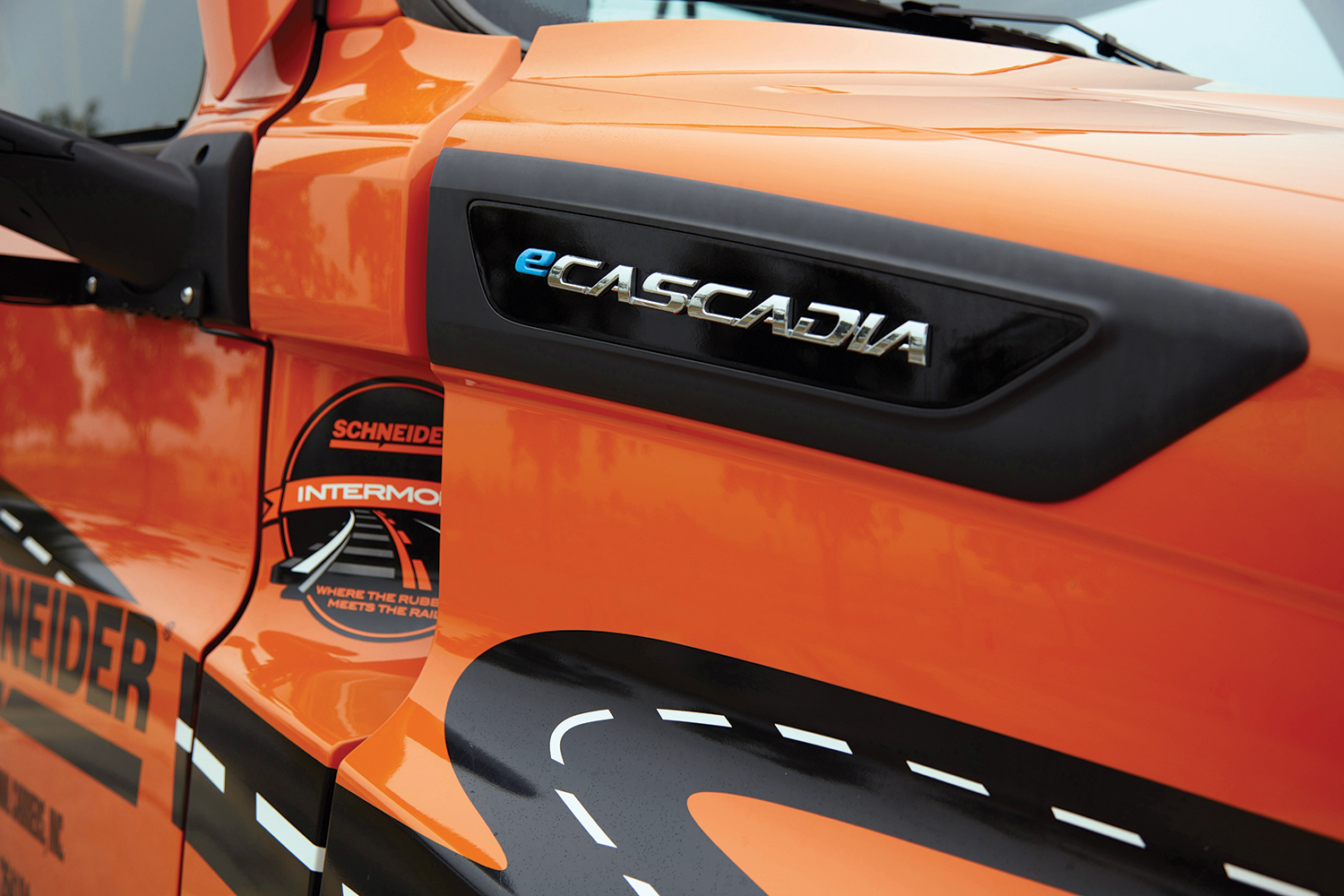
At Schneider, the addition of 92 zero-emission electric trucks to its fleet by the end of the year is expected to eliminate more than 81,000 pounds of carbon dioxide emissions per day — the equivalent of removing 2,400 gas-powered cars from the road, says Kara Leiterman, the company’s manager of media relations. It will become one of the largest zero-emission fleets in the U.S. To support the eCascadia fleet, Schneider also opened a large-scale charging depot in Southern California that will bring 32 trucks to 80% power within 90 minutes.
“We know the future of sustainable transportation includes electric,” Schneider President and CEO Mark Rourke said in a company statement announcing the completion of the California facility in June. “That is why we invested and collaborated with stakeholders along the supply chain to work together to create this infrastructure and ultimately lower carbon emissions.”
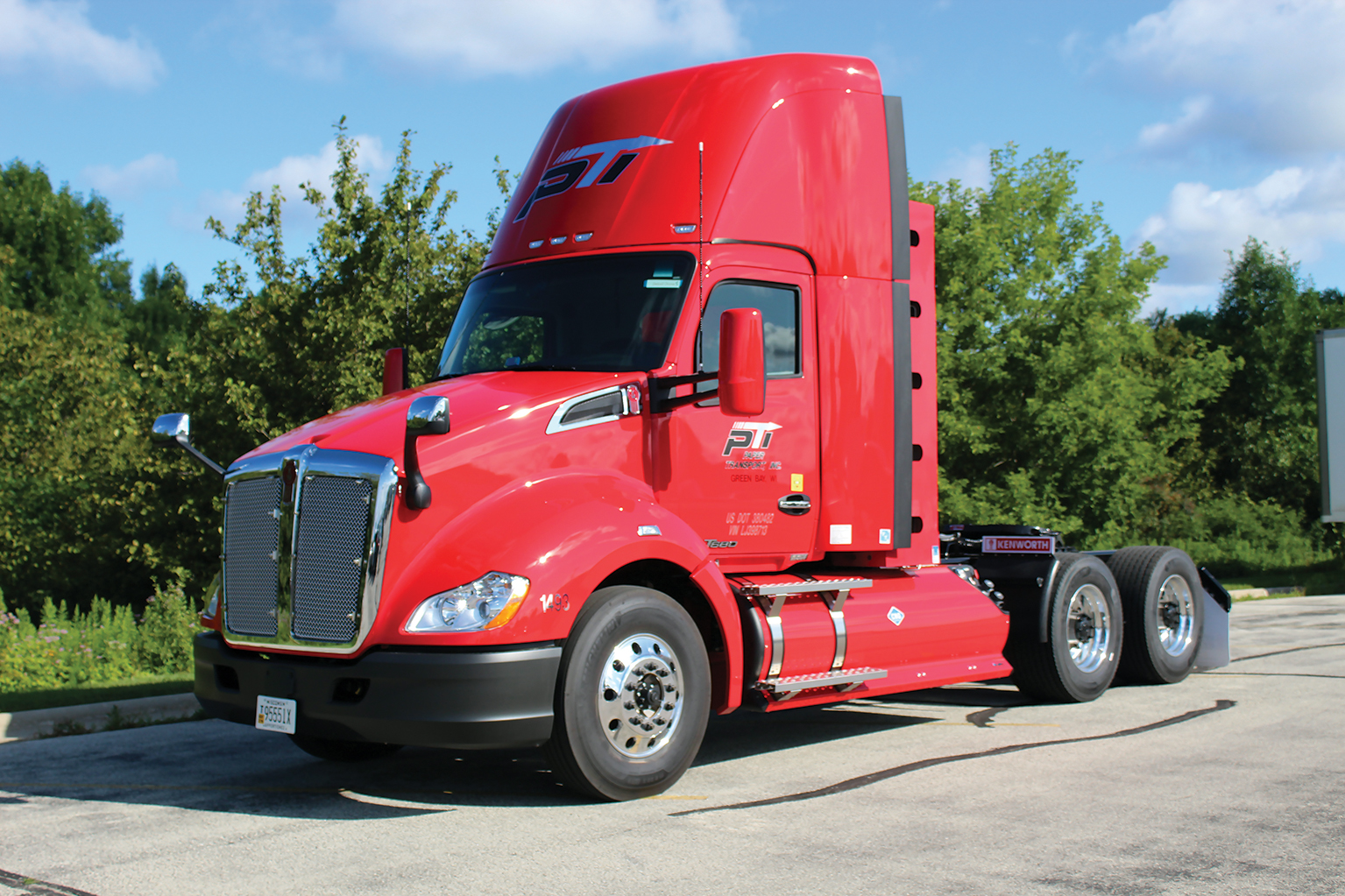
Meanwhile, Paper Transport and Contract Transport Services have made significant strides piloting renewable natural gas programs. In fact, Contract Transport Services President Curt Reitz says the company has made the transition to 100% natural gas and has its own natural gas fueling station on site.
“We believe renewable natural gas is an important piece of a low carbon future,” says Ben Schill, CEO of Paper Transport. “The carbon content of renewable natural gas is less than half of diesel or gasoline — and can be carbon negative. Today, we run over 85 tractors on the fuel. We anticipate continued growth in this space.”
— Kate Bruns