

Chris Hess’ all-time favorite band is Pearl Jam, but he’s seen Kenny Chesney more than any other artist. In August, Hess saw the Foo Fighters in the last concert at Nashville’s former Nissan Stadium.
“It was three and half hours, nonstop. It was 98 degrees outside; they took no breaks. It was amazing,” Hess says.
As a “huge live music guy,” the president and CEO of Goodwill North Central Wisconsin understands that successful performance requires every team member to be playing from the same score. At Goodwill NCW, Hess has spent the better part of a decade uniting 1,200 employees across 35 counties to do just that.
He says achieving the Menasha-based nonprofit’s mission — eliminating barriers to employment for underserved individuals — starts with culture, on which his philosophy is simple: “Culture doesn’t maintain — it grows or it dies.”
“And I’m not a ‘maintain’ kind of guy,” Hess says. “We’re constantly trying to grow our culture and really be accountable to deliver impact to people who need it the most.”
Hitting the road
When Hess took the reins at Goodwill NCW in 2018, its retail turnover rate stood at 100% — far above the national retail average of 60%, already among the highest of any industry sector.
Knowing this, Hess made an unconventional first-year CEO ask of his board. He asked to take a year off from strategic planning to zero in on the underlying cause of the high turnover rate.
The board was supportive, he says.
“We focused immediately on our culture and what we needed to do,” Hess says. “We all knew that we had this gem of an organization that had the potential to impact so many lives in the community, and we needed to get the people part right.”
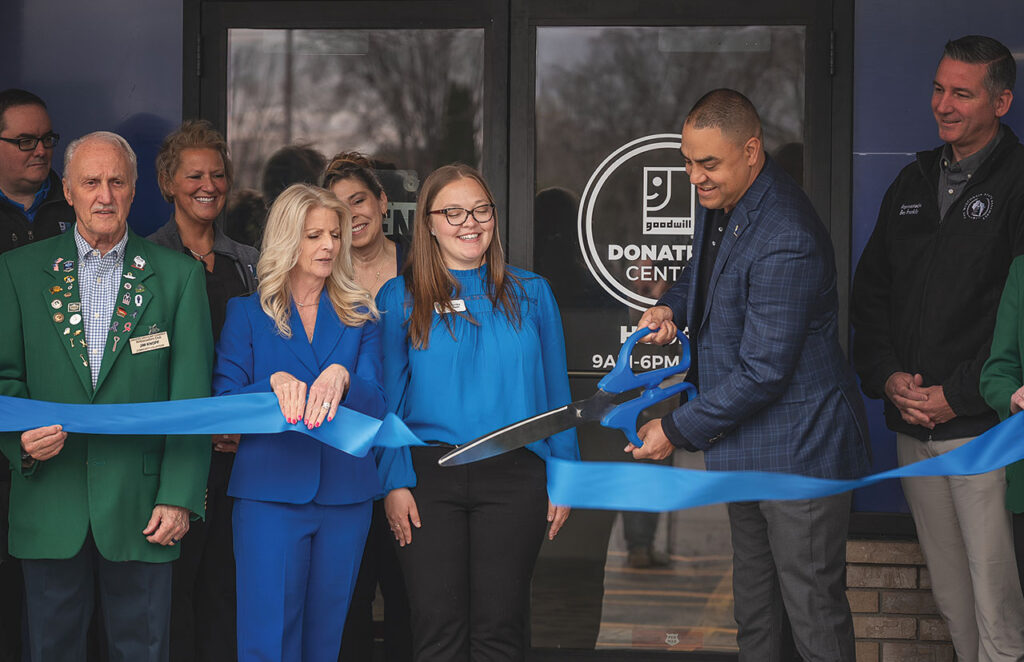
Hess and other key leaders spent that year on a “World Tour,” traveling to every Goodwill NCW store, warehouse and mission office asking employees key questions: What is Goodwill to you? What do you want it to be? How should we make decisions together as an organization?
“We were going to be different than the Goodwill culture that existed. We just didn’t really know how different, and we weren’t sure in the direction, which actually worked in our favor because the people told us where we should go,” Hess says.
The team used this feedback to create a roadmap of guiding principles and values, as well as a restated mission of “Elevating people by eliminating barriers to employment.”
This was a turning point, Hess says.
“We agreed, as 1,200 people, that we were going to make decisions using guiding principles, and that we were going to live our values every single day and every person in the organization had their fingerprints on what those values were,” he says. “That’s when things changed.”
The feedback led to other changes at Goodwill NCW, like introducing a more effective onboarding process, expanding leadership training and coaching models, and conducting a review of benefits to ensure competitiveness.
Between 2021 and 2025, organizational turnover decreased from 81% to 51%, while retail turnover showed a similar decrease, to 60.5%. In an employee engagement survey, 82% of team members said they felt engaged.
“A lot of the turnover that we experience now is turnover that we would celebrate,” Hess says. “It’s people that learn skills here, so we were the opportunity they were looking for — we said yes when others maybe said no and they were able to then move on and get their dream job in a profession of their choosing.”
Every spring, Hess continues to go on “World Tour” — complete with band-style T-shirts; every Goodwill location listed on the back as a tour stop — to all its stores, meeting team members in person.
“We’re nine years in and probably my favorite accomplishment in my career is that that thing is still alive and well,” says Hess, whose favorite part of World Tours is hearing from employees who have built job skills while gaining confidence and work experience.
On one stop, an employee shared something powerful.
“They said, ‘People like me are used to being watched. My whole life, I’ve been watched,’” Hess recalls. “‘But Goodwill was the first place where I was really seen.’”
A sharper focus
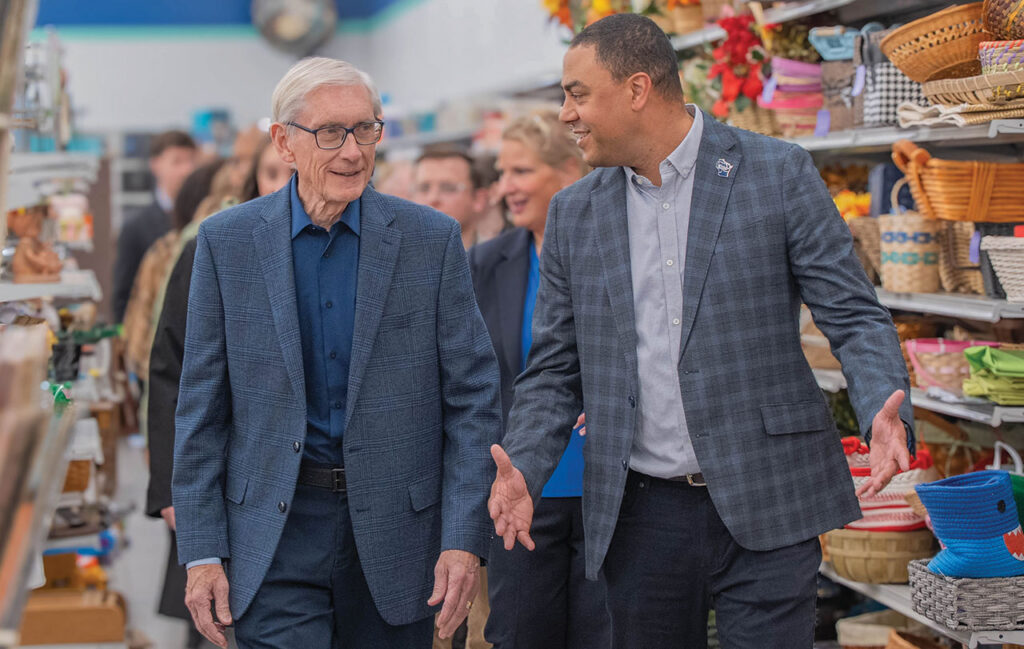
Getting Goodwill NCW’s employees aligned around a shared mission meant clarifying what the organization was best positioned to do. Before 2018, Goodwill NCW offered more than 40 programs. Today, it focuses on a few, centered on helping people build skills, sustain employment and improve financial stability.
“It wasn’t until we focused on what we were really good at and what we were meant to be — giving people that chance through the power of work — that we really started to become known for that and started to increase our mission impact because people knew who we were,” Hess says.
Goodwill NCW relies largely on revenue from its retail stores to fund its mission, with more than 90 cents of every dollar going back into mission-related work, Hess says. The organization is part of Goodwill Industries International, a network of about 150 local nonprofits across the U.S. and Canada and partnerships around the globe.
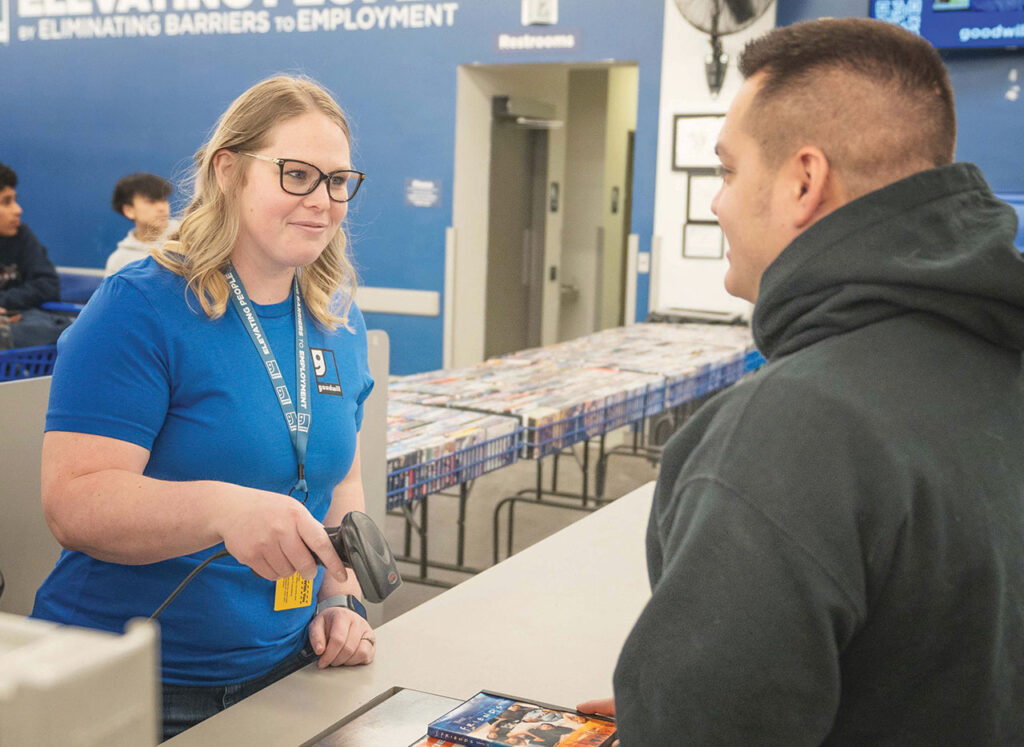
Goodwill NCW’s 28 retail stores not only generate revenue that funds workforce development programs; they also allow employees to develop job skills to build future careers.
“If you were to go into the back room of a Goodwill, it looks like light manufacturing and that is by design,” says Hess, whose previous experience includes serving as director of business development for GENCO, which was acquired and rebranded as FedEx Supply Chain. “We are teaching people push and pull inventory. We’re teaching people concepts in cellular manufacturing.”
That means employees learn how to manage inventory and move products, which are skills that can be transferred to jobs.
The retail model also depends on community participation. More than 80% of U.S. households live within 10 miles of a Goodwill location, making the organization’s name widely recognizable. But familiarity with its stores doesn’t always translate into an understanding of its broader mission.
“Most people in our community experience Goodwill from the trunk of their car — they’re either taking a donation out or putting something in that they bought in one of our stores,” says Hess. “Donations really, really matter to us. The number one thing that causes our mission to grow is our communities donating and shopping with us.”
The business behind that mission is more complex than its storefronts might suggest, says Chief Administrative Officer Anna Wilcox. Goodwill NCW manages retail operations, supply chain logistics, warehouses and workforce development programs across 35 counties and diverts an average of 35 million pounds of items from landfills each year.
Wilcox says that combination of business activities makes Goodwill NCW an important economic contributor and partner to businesses throughout the region. In 2025, Goodwill NCW supported nearly 1,700 local jobs, more than $33 million in labor income and $94 million in regional economic impact.
“What we do here is not just great stories. It’s actually impactful to the community and we have this ripple effect,” she says. “We help individuals get better, which helps the family get better, which helps our community get better and then it helps our partners thrive.”
Hess is no stranger to organizational complexity. Having worked in supply chain operations, energy and transportation, and in healthcare, he sees business discipline much the same for nonprofit and for-profit sectors.
“We have 1,200 team members, 28 store locations, 35 counties. You can’t run that … like a small nonprofit. You have to use the same business principles that you would if you were a for-profit,” Hess says. “The rigor that’s needed to run a nonprofit and a for-profit, to me, has to be the same.”
‘Holy grail of nonprofit impact’
Wilcox says there is no better example of Goodwill NCW’s outward-facing impact than Career EXCELerate Wisconsin, a career training program that was created in 2022 through a state of Wisconsin Workforce Innovation Grant. The program is funded by Goodwill and there is no cost to participants.
“When I think about Goodwill’s culture — care for people — I think this is us turning that value outward into our community,” she says. “This is an expression of our mission in our community.”
The initiative was created through a partnership between Goodwill NCW, Rawhide Youth Services and Fox Valley Technical College (FVTC) to support individuals seeking high-demand careers in retail, healthcare and the skilled trades.
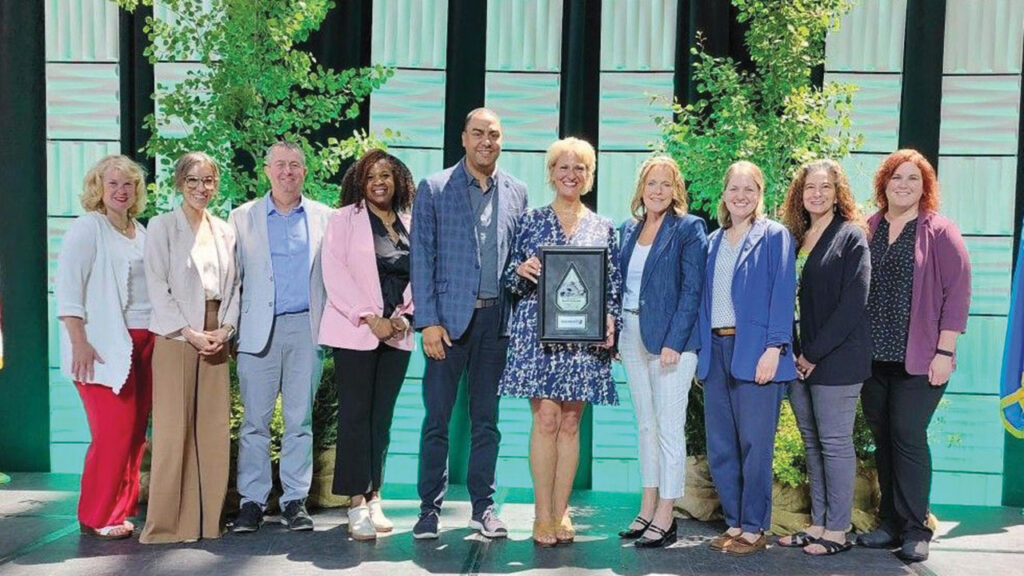
This month, Goodwill was named the recipient of the Wisconsin Technical College System Board’s Futuremaker Partner Award, in part for its work on programs like Career EXCELerate.
Chris Matheny stepped into the president role at FVTC around the same time Hess joined Goodwill NCW. The two had developed a professional relationship and personal friendship that extended well over a decade, Matheny says, so when the two organizations began talks on how to best maximize their partnership, the groundwork for innovation was there.
“It becomes really a whole lot easier to take risks when you have a trusted partner accepting and sharing that risk together. There was a really easy onramp when Chris moved into his role,” Matheny says.
Matheny says the partners have been “wildly overachieving” when it comes to Career EXCELerate, from which more than 500 participants have received a certification. As of July 2026, 71% of graduates have obtained employment or continued their education in their field of study one year after graduation, with an average post-graduation wage increase of more than $11. More than 40% were earning $0.00 an hour when they entered the program.
“And we’re doing that in under a traditional college semester in industries [where] our communities really need help,” Hess says. “That is the holy grail of nonprofit impact.”
“This is really the tip of the iceberg to which we as a community can support and make investments in institutions … that make those life-changing interventions in people’s lives when they need them,” Matheny adds. “It’s extraordinarily important.”
Career EXCELerate’s grant funding ended in June, but earlier this year Goodwill NCW announced it will sustain funding for the program while also expanding into all 35 counties it serves through in-person, online and hybrid options. Goodwill NCW now works with more than a dozen education and training partners across its region.
“I have had zero reservation about calling my [technical college] colleagues across the state and saying you need to talk to this guy from Menasha because we’ve had a really great experience,” Matheny says. “It’s not an exaggeration to say that this is absolutely a life-changing experience for the people who’ve gone through it.”
Just ask Maribel Contreras, who was honored as Career EXCELerate’s Graduate of the Year at Goodwill NCW’s annual gala Oct. 7.
As a child, Contreras moved from Mexico to California. Her childhood was shaped by abuse and instability, but school offered refuge. She had her first child as a teenager, which led to a difficult living situation.
Survival became the priority. Dreams could wait.
But Contreras kept building toward a more stable life for her and her children. With encouragement from her FVTC instructor, she enrolled in the early childhood education pathway through Career EXCELerate. After graduating, Contreras got a job at University Children’s Center as a lead teacher and was able to leave the three jobs she had been juggling.
Contreras says she was drawn to early childhood education because she wants to make a difference in the lives of young people, the way her teachers made a difference in hers.
“It’s in some shape or form healing my inner child, [providing children] the things that I wished for,” she says.
Today Contreras works as an educator within the Menasha Joint School District while working toward her associate degree in early childhood education.
The program did more than offer her a pathway to a better job, she says. It helped her think bigger and see herself differently — as someone capable, strong and with a voice all her own.
“I’m loving this new version of myself, of not just holding the title of mother or wife,” she says. “I found my passion.”
That kind of transformation, Hess says, is at the heart of Goodwill NCW’s mission.
“To see people be seen for the first time, for who they are and what they can do, it’ll change your life,” Hess says. “And that’s really what it’s all about.”
Goodwill NCW
Founded: 1971
President & CEO: Chris Hess
What it does: Uses revenue from donated goods sold in its stores to fund job training, career certifications, employment placement, coaching and financial wellness services for people facing barriers to work
Employees: 1,200
Headquarters: Menasha
Locations: 28 across 35 Northcentral, Northeastern, Central and Western Wisconsin counties
Business classification: 501(c)(3) nonprofit
Photography by Shane Van Boxtel, Image Studios