
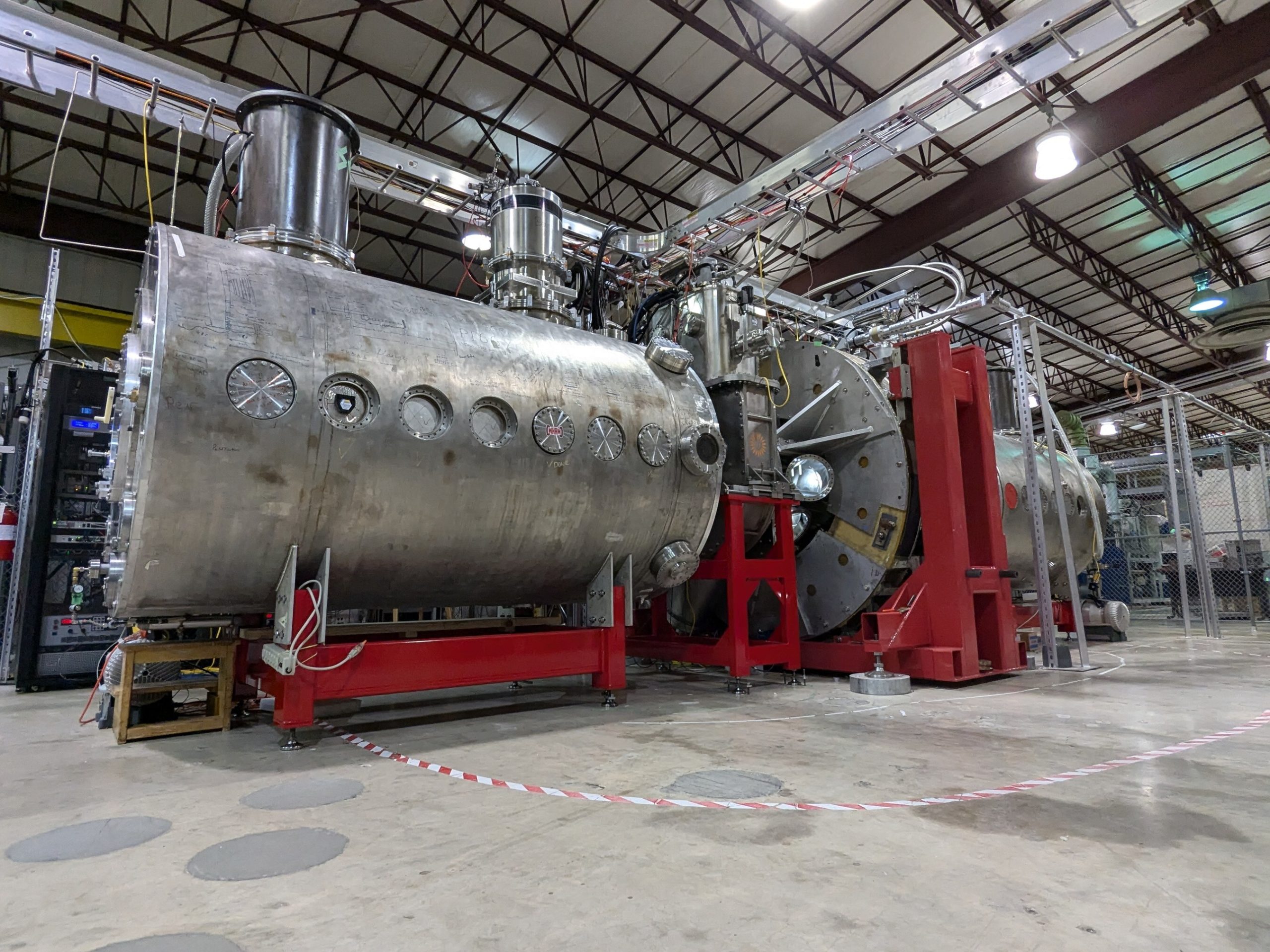

Less than a month after Madison’s Realta Fusion conducted a milestone experiment that powered a lightbulb using direct energy conversion from a fusion reaction, the company has announced a new bright spot on its horizon.
Realta has secured substantial financial incentives from the state of Wisconsin in addition to a tax increment financing loan from the city of Madison to develop the Realta Forge, a corporate headquarters and R&D facility at OM Station — the former home of Oscar Mayer on the northeast side of the city.
The redevelopment will transform over 200,000 square feet of the 2099 Roth St. property into space for offices, research and manufacturing. It is anticipated to create 600 new jobs, including technical and non-technical roles. Realta plans to break ground on the Realta Forge before the end of this year.
The Madison City Council unanimously approved $2.8 million in TIF financing June 9, pending Realta’s decision to remain in Wisconsin. Just two years ago, fellow University of Wisconsin-Madison spinout, Type One Energy, sought greener pastures in Knoxville, Tennessee, as the inaugural recipient of Tennessee’s $50 million Nuclear Energy Fund.
“This decision … opens up the TIF financing from the city of Madison, and we will have enterprise zone tax credits (from Wisconsin),” said Kieran Furlong, Realta’s CEO.
The company said it is anticipating a significant financial commitment from the Wisconsin Economic Development Corp. — namely, up to $15 million in performance-based enterprise zone tax credits.
Realta’s Furlong noted that the company will also benefit from the sales and use tax exemption bill passed by the state Legislature, which was signed in April by Gov. Tony Evers. Realta expects it to help offset the costs of projects it has planned for its new facility by roughly $37.5 million.
Among these projects will be the company’s next-generation fusion machine, called Hammir.
“All in all, we’re estimating that at this current point, it’s an incentive package that’s worth around $55 million,” said Furlong. “The state of Wisconsin and the city of Madison are stepping up and want to be a home for the future fusion industry. And this isn’t, of course, just going to benefit us.
“Things like the sales (and use) tax exemption for fusion projects are intended as a kind of welcome sign to the rest of the global fusion industry that Wisconsin would be a good place to come and build your fusion projects, and develop your technology, and manufacture your future fusion power plant components as well.”
Furlong said one of the company’s first agenda items in the new space will be testing the core subsystems for Hammir before its buildout begins.
The company uses a magnetic mirror approach to fusion — a type of magnetic confinement that, in broad terms, creates plasma and uses strong magnetic fields to contain and heat it until nuclei fuse and energy is released.
Realta’s new fusion demonstration device will be even larger than WHAM, the roughly eight-meter-long machine the company operates in partnership with UW-Madison out of its current lodgings at the Physical Sciences Lab in Stoughton.
Furlong emphasized that Realta Forge will always be an R&D facility, rather than evolving into a commercial site to produce heat and power. He expects Realta to be active in the building by the start of next year and to conduct its main R&D operations from the site “for the foreseeable future.”