

Amid all the talk of construction labor shortages and supply chain constraints, some things haven’t changed: Project owners are still demanding fast schedules, unrelenting focus on quality and strict budget discipline. These challenges — to do more in less time while keeping costs as low as possible — are spurring a new wave of creativity and innovation.
One such innovation is affecting the way foundations are designed and built for heavy industrial facilities and installations over large geographical areas. Instead of constructing foundations and pilings with millions of tons of concrete, steel helical and conventional piles are emerging as a faster alternative for installing structural supports. This method offers a new pathway for faster installation of critical foundation elements that provides strength and stability comparable to concrete, but with greater precision, speed and cost efficiency.
Helical piles advance tried-and-true method
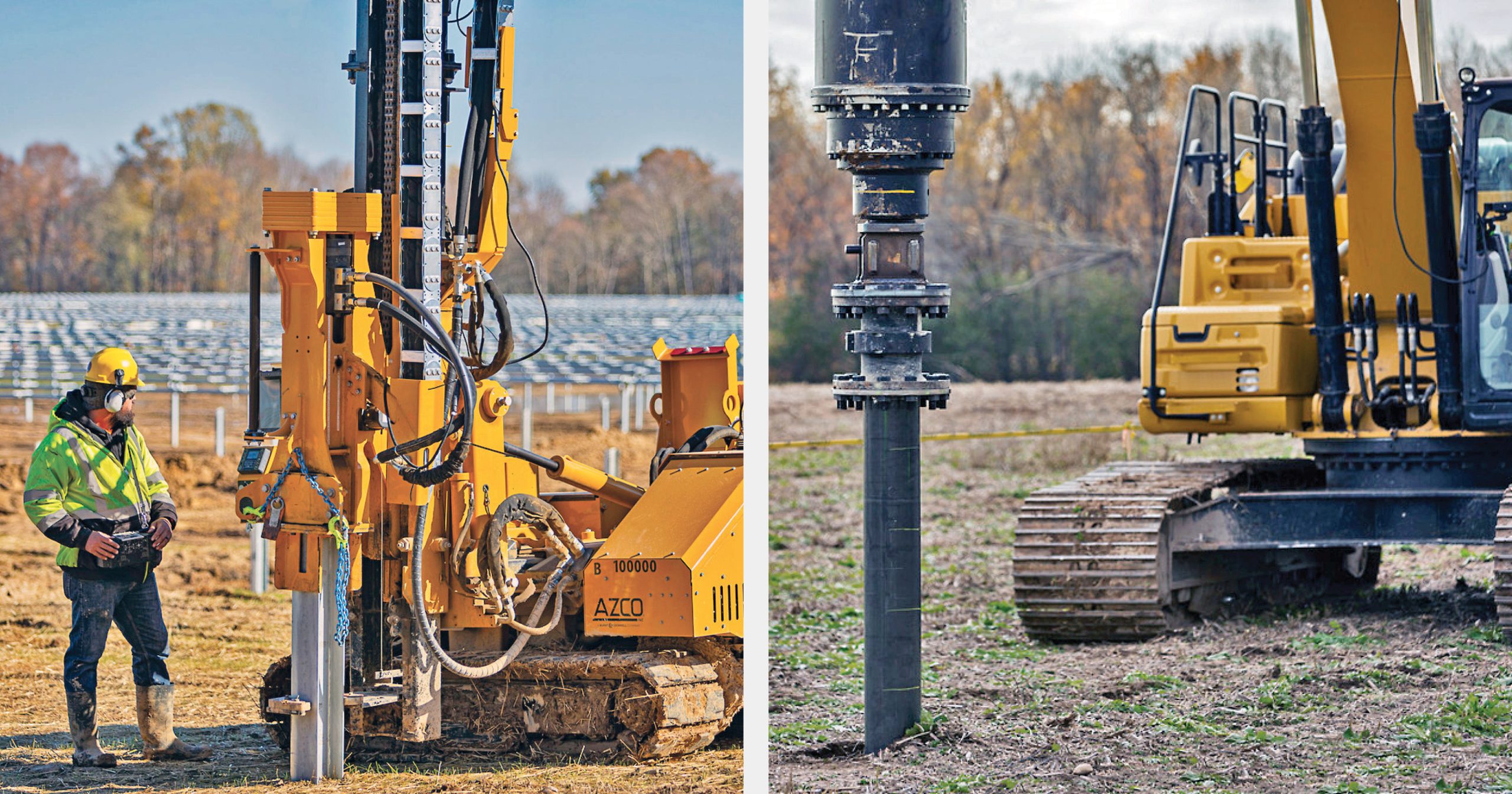
First developed about two centuries ago to stabilize lighthouses along shorelines, helical piles are gaining traction as a resilient and cost-effective choice for heavy industrial and commercial construction. Fabricated from heavy-gauge carbon steel pipe, helical piles are configured with a series of welded helix-shaped bearing plates that allow the piles to be corkscrewed into the ground with a heavy hydraulic drive capable of exerting enormous torque. The installation is a mostly spoils-free process that requires less excavation and concrete and minimizes the need for off-site trucking.
Helical piles are designed to transfer weight from the shaft to the ground. They deliver extremely high load-bearing capacity and can be installed in any weather and within most environments. Because they can be custom-built to precise specifications in a controlled prefabrication shop, such as that at AZCO, helical piles are becoming an attractive option for project owners seeking to build large facilities in poor soil conditions, challenging landscapes or low-clearance scenarios in which multiple piles must be installed each day.
Beyond tape measures and plumb lines
Conventional piles driven into the ground with high-pressure hydraulic equipment also are gaining new attention as a cost-effective method to construct stable supports for large solar and battery storage installations.
Pile drivers controlled by one or two operators within the project site are increasingly becoming the preferred technology for these installations. The units allow operators to quickly align a pile on the precise spot specified and then drive it to the exact depth needed to support large solar tracker consoles spanning several hundred feet. With a process guided by a single operator, the unit utilizes GPS data to locate the spot for each pile, along with data transmitted from engineering plans to tell the operator the precise depth to which each pile must be driven.
Computer-controlled digital feedback instantly tells the operator if the pile is installed at the correct depth and if it is even a fraction of an inch out of true vertical alignment. The process is a vast improvement over manual installations, where crews depend on survey stakes and other coordinates to visually confirm whether the pipe is vertical on all sides.
Collaborative innovation
With all the technological innovation that can be brought to bear on construction sites, one of the biggest benefits is closer collaboration and communication between engineering and construction teams.
The three elements of EPC project delivery — engineering, procurement and construction — are an ideal way to meet ever-increasing demands for faster projects, higher quality and cost control. Technology innovations that build on common-sense, proven ideas work best when leveraged with the skill and experience of craft working in the field or in prefabrication shops.
Company: AZCO INC.
Innovation: Steel helical piles
Website: www.azco-inc.com

