
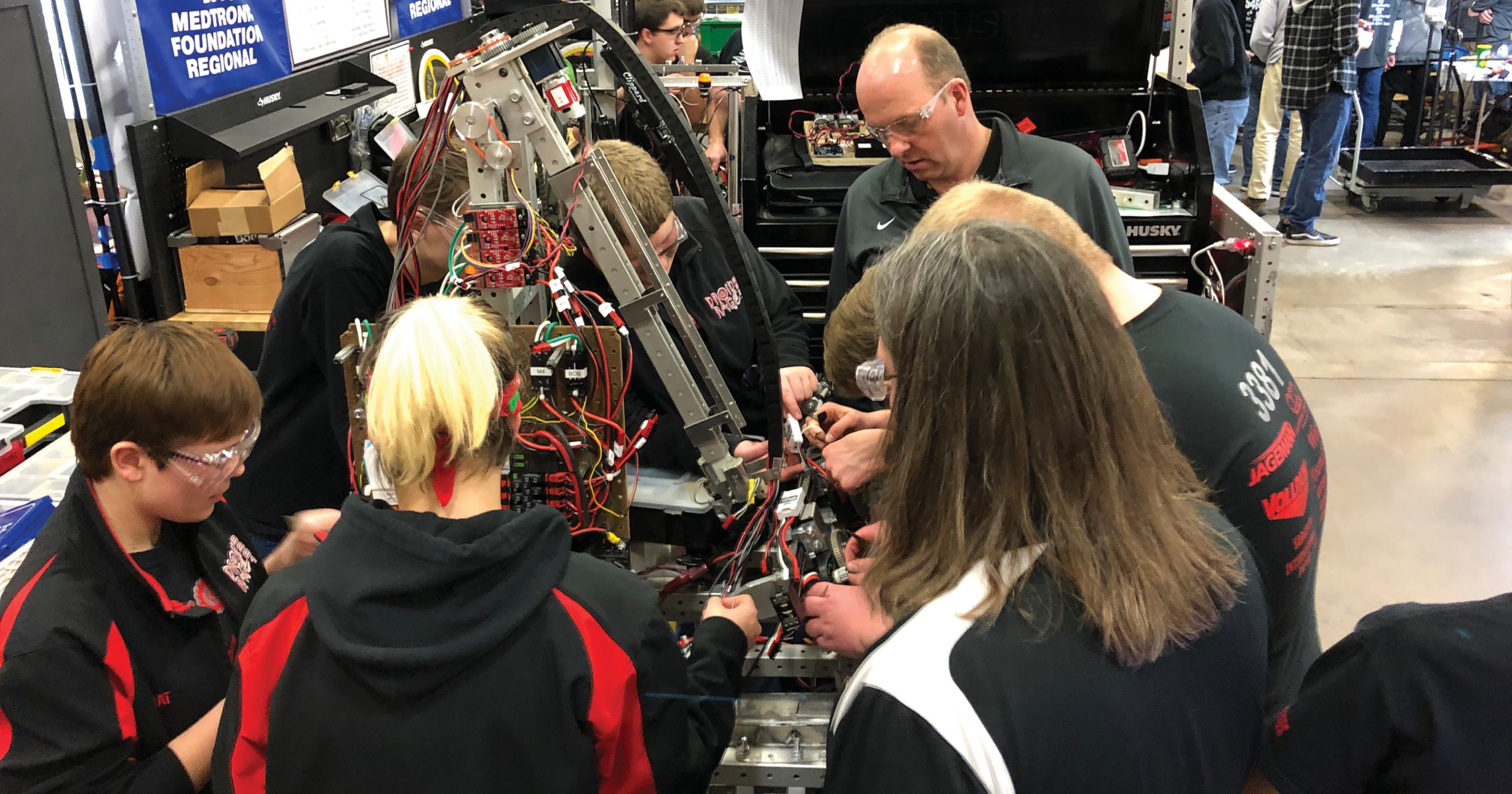
Since the organization’s inception in 2009, Lakeshore FIRST Robotics President Arrow Guetschow has devoted countless hours and seen scores of young people go through the program. For him, witnessing participants’ growth and transformation makes all the work worth it.
Guetschow has seen some remarkable success stories emerge from the program, including participants who have gone on to work for top companies around the world doing automation, engineering and machining work. It’s been equally gratifying for him to help students overcome tough circumstances, such as a young man who was at risk of failing to graduate but who later went on to a successful career in the construction industry thanks in part to the program.
“You see those kids who wouldn’t have made it but do, and then you see those kids who were already outstanding and are now with SpaceX or working for Mercedes,” he says.
For more than a decade, Guetschow and a corps of around 120 volunteers have worked with Lakeshore FIRST Robotics to ignite a passion for STEM learning and experiences within kids in kindergarten through 12th grade. The program, which became a nonprofit in 2015 and is housed in the Lakeshore Robotics & Education Center in Manitowoc, has grown in both scope and numbers throughout the years and established itself as a template for other robotics clubs in the state and beyond.
Now it’s taking its winning formula and applying it to Brown County, where the organization hopes to replicate its success. The program is starting small and focusing its efforts on De Pere as a place to establish a foothold and boost awareness.
Prior to the establishment of Brown County FIRST Robotics, the county had few robotics programs. The organization is now running programs within two elementary schools and four middle schools, and around 20 high school students are interested in forming a team. One sign of success: Two of the four middle school teams — the Duplo Dragons and the Big Figs — moved on to the sectional level of their competition.
“Rookie teams rarely move on, so this means the parents and mentors have really stepped up to teach the students, and these teams are set up for success in future years. You can teach the parents and mentors all you want, but it’s up to them to step up to lead the team, and these teams are on the right path,” says Guetschow, who works as a manufacturing engineer for Stoelting Foodservice Equipment, a division of Vollrath Co.
Within Lakeshore’s footprint, the organization has set a goal of having 10% of kids participate in the program. Leading into the pandemic, it had reached the milestone of around 5% participation, a figure that’s now slipped to 4.2%.
Guetschow says the 10% objective came from wanting to more closely mirror the percentage of kids who participate in sports or groups such as Future Farmers of America or 4-H. In Brown County, the goal is to reach a 10% participation rate by 2040.
“That seems to be the marker of a program that’s long-term sustainable. The biggest thing is that many people don’t know what a robotics program is when they hear about it,” Guetschow says of the need to overcome obstacles.
Something for everyone
FIRST (For Inspiration and Recognition of Science and Technology) is an international youth organization aimed at “inspiring young people to become science and technology leaders and innovators by engaging them in mentor-based programs that build science, engineering and technology skills.”
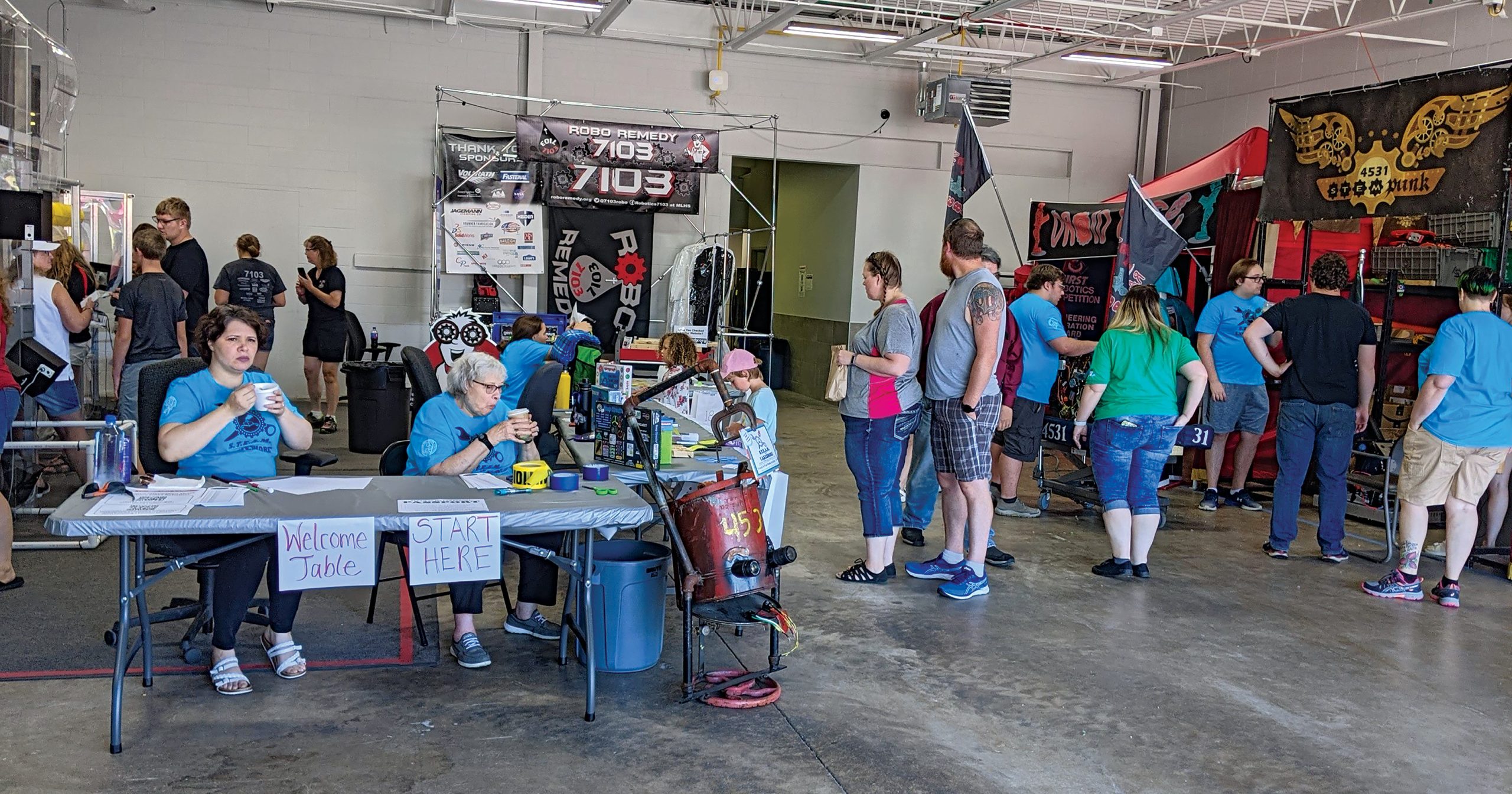
Guetschow attributes much of the success of the program to its variety of activities. The offerings range from Junior FIRST Lego League, which engages 6- through 9-year-olds in solving real-world challenges, to the FIRST Robotics Competition, in which high school students work in teams to brand, build and program robots to complete tasks against a field of competitors.
Guetschow says playing with Legos offers an ideal entry point, as the toy bricks hold universal appeal. Throughout the years, he’s learned that the FIRST Lego League program is the most likely of Lakeshore’s offerings to draw participation from girls and minority students. That’s a win, because when Lakeshore can draw in students at a younger age, they’re more likely to stick with the program throughout their time in school.
As students progress through the program, they pick up real-life skills along the way, from hard skills like computer-aided design, CNC machining, programming and automation to soft skills like communication, collaboration, teamwork and public speaking. Students develop these soft skills through coming up with marketing and branding plans, presenting to judges at competitions and advocating for their own ideas.“It’s the best-communicated idea that often ends up on the robot, so they have to work on those communication skills if they want to see their ideas represented on it,” Guetschow says.
It’s not a stretch to see the progression from tinkering with Legos to working with advanced tools like 3D printers, SolidWorks software and CNC mills, all of which are available at the Lakeshore Robotics & Education Center, Guetschow says. It’s about trying to get participants to keep increasing their skills.
“If they’ve done the Legos, this doesn’t seem intimidating,” he says.
Growth trajectory
Of course, Lakeshore benefits from having a dedicated facility, which hosts eight teams out of the building. Tom Jagemann, CEO of Jagemann Stamping Co. in Manitowoc, donated the 12,000-square-foot building and funded renovations as well as an overhaul of the HVAC system.
Jagemann got involved as a team sponsor 10 years ago and has been on the steering committee for the organization for several years. When Lakeshore created the vision of having its own space outfitted with top-notch equipment, he knew he could help.
“It didn’t take much to get me hooked. (As a manufacturing company), the thing I see that makes anything successful is you’ve got to have engineers and scientists. You have to create value,” he says. “Anything we can do to encourage our young folks to get into those fields, I view it as a huge investment in the future of our country.”
Beyond Jagemann’s gift, many other manufacturers in the region donate to the program and support teams, and Guetschow writes two to three grants per week. The group has secured funding to add bathrooms to the building and improve lighting.
As for equipment, Lakeshore was able to get a $70,000 Haas CNC mill for $31,000 and is looking to add a CNC lathe. SolidWorks CAD software is available free to all FIRST participants, and high school students can even access it from their home computers. This allows mentors to teach students using industry-standard software.
The goal is to secure a robotics building in Brown County as well. Doing so will require the support of businesses and manufacturers.
Paul Bartelt, president and CEO of Vollrath Co., says the support is well worth it for companies. After all, it’s an investment in their potential talent pipeline. He has supported Lakeshore both professionally and personally, coaching teams for his son and daughter when they were in school. He saw firsthand the outcome of kids getting into better schools and jobs through their participation with the program.
Bartelt’s son is now a student at Stanford University studying public policy, and he attributes his success in part to the experiences he gained through participating in the program.
“It’s a great conduit not only on the STEM side but also the business side and the marketing side to get kids involved and working together in a collaborative environment,” Bartelt says.
“It can be such a transformative experience on their life path.”
For now, Guetschow is also serving as president of the Brown County group. He would like to continue to see more students, volunteers and companies get involved — and eventually he’d like to hand over the leadership of the Brown County group to someone else. He’s optimistic about what’s afoot.
“We’re getting past the feasibility study. We can see people want it, and I think there are businesses interested in helping us,” he says.