

• The Northwoods
Florence, Marinette, Menominee, Oconto Counties
Tyco agrees to PFAS settlement
Tyco Fire Products in Marinette has agreed to a $750 million settlement with communities that detected perfluoroalkyl and polyfluoroalkyl substances (PFAS) in public water systems.
Tyco, a subsidiary of Johnson Controls International, manufactured foam containing PFAS at its facility in Marinette.
Tyco expects to contribute an initial $250 million on or about May 25, with the remaining $500 million to be contributed six months after preliminary court approval of the settlement.
Settlement documents do not specify which communities will receive the funds, though they do specify that the settlement excludes private water systems and those operated by the U.S. government or any state.
The settlement does not resolve any litigation regarding personal injury, real property damage and other types of actions. It also specifies that it is not an admission of guilt.
PFAS are used in the manufacture of a wide variety of products, including nonstick cookware, stain-resistant clothing, food wrappers and firefighting foam. The chemicals do not break down easily and have been found to pose potential health hazards when they accumulate.
Napoli Shkolnik law firm filed the suit that resulted in the settlement.
Keel laid for latest Constellation Class ship
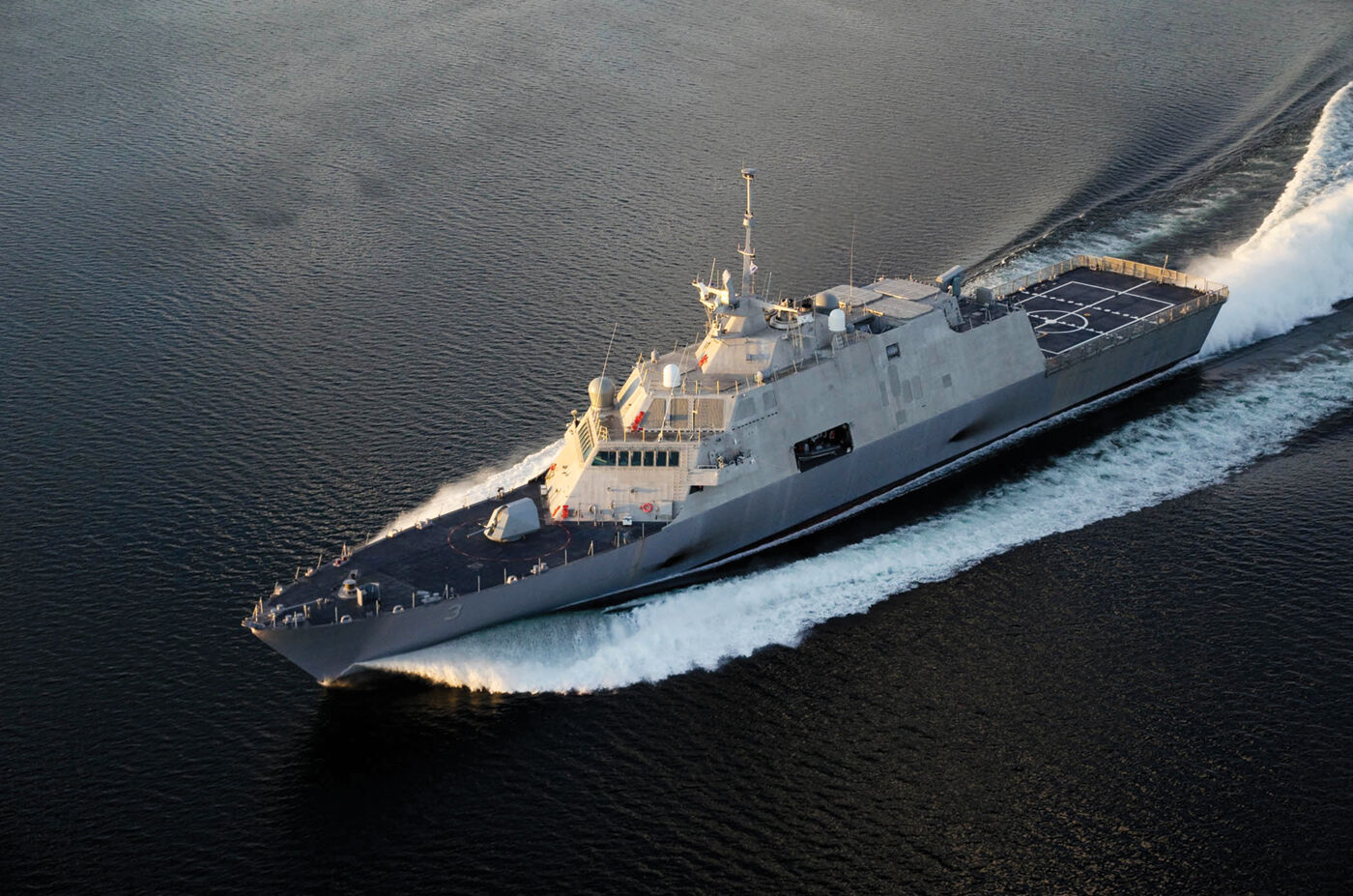
Fincantieri Marinette Marine hosted Navy and government officials to celebrate the keel laying of future USS Constellation (FFG 62).
Secretary of the Navy Carlos Del Toro and Chief of Naval Operations Adm. Lisa Franchetti participated along with Wisconsin Gov. Tony Evers and Fincantieri Marine Group CEO Marco Galbiati.
Hundreds of FMM shipbuilders gathered with guests inside the shipyard’s massive new climate-controlled Building 34, where large portions of a ship are connected and the vessel is erected. The building is part of Fincantieri’s recently completed facility. Since 2009, Fincantieri has invested more than $500 million creating one of America’s most modern shipyards.
The tradition behind the keel laying ceremony is a centuries-old ritual. The ceremony highlights the authentication of the keel, a process of tracing by welding the initials of a significant individual onto a small steel plate affixed to the ship’s keel. For the future USS Constellation, Melissa Braithwaite was named the ship’s sponsor. She is the wife of former Navy secretary Kenneth Braithwaite. Fincantieri Marinette Marine welder Jean Wagner completed the authentication process by tracing Mrs. Braithwaite’s initials onto the plate. Wagner is the first female FMM welder to earn this responsibility.
Fincantieri Marinette Marine received a contract for $795 million in April 2020 for the lead ship and nine additional vessels. If the Navy exercises all of the options, the contract is valued at more than $5.5 billion. To date, the Navy has five frigates on order with Fincantieri Marinette Marine, with five additional options remaining on the original contract.
• Interstate 41 Corridor
Brown, Calumet, Fond du Lac, Outagamie, Winnebago Counties
MPTC and Ripon College sign agreement
Moraine Park Technical College and Ripon College signed an articulation agreement allowing students pursuing associate of arts and associate of science liberal arts degrees to seamlessly transfer from Moraine Park and continue their education at Ripon College with confirmed junior status.
“Our goal is to provide an education that works best for the students we serve,” said Doug Hamm, vice president of teaching and learning at MPTC. “This agreement with Ripon College provides a wonderful opportunity for Moraine Park students to articulate to a premier institution of higher education in our district. We look forward to more collaboration with Ripon College moving forward.”
The partnership with Ripon College will affect students across Moraine Park’s 10 district counties: Dodge, Fond du Lac, Green Lake and Washington counties, as well as portions of Calumet, Columbia, Marquette, Sheboygan, Waushara and Winnebago.
Upon completion of the AA or AS degree at Moraine Park, a student can transfer a minimum of 60 credits to Ripon College. All credits earned as part of the AA or AS degree will be transferred, and credits outside those curricula will be evaluated individually.
Moraine Park began offering liberal arts degrees in 2022 as part of the University Transfer Degree program. Since then, the college has grown educational pathways for students by signing agreements with University of Wisconsin Oshkosh, University of Wisconsin-Green Bay, University of Wisconsin-Milwaukee, Lakeland University and Ripon College.
PSC funds five New North energy projects
Five energy projects in Northeast Wisconsin will receive funds from the Energy Innovation Grant Program.
The Public Service Commission of Wisconsin awarded $7.8 million to 28 projects, including projects in Marinette, Green Bay, Kaukauna and Oshkosh. There were 85 grant applications, totaling more than $34 million.
New North projects include:
Northeast Wisconsin Technical College, $250,000: A scalable solar PV system will be installed at NWTC’s Marinette campus. It will decrease electric usage by 72,000 kilowatts annually and eliminate 50 metric tons of carbon dioxide emissions. The project will involve associate degree students in the design and operation of the solar PV arrays.
WHPC-Villa West-Green Bay, LLC, $386,750: The Green Bay Affordable Housing Campus Microgrid Project seeks to be the first campus-wide microgrid for affordable housing in Wisconsin. The project creates a resiliency hub ensuring heating, cooling and medication storage are available during outages or climate emergencies.
City of Kaukauna, $1 million: Kaukauna Utilities will replace an aging HVAC system with geothermal technology to reduce the use of fossil fuels as well as add solar panel use for additional energy need offset.
City of Oshkosh, $55,476: Oshkosh will assess the city’s municipal buildings to develop a comprehensive energy roadmap.
Midwest Renewable Energy Association, $135,033: Net Zero Pathways for Schools initiative is a collaborative effort to implement and support energy efficiency planning initiatives in Wisconsin schools. These include the Mineral Point Unified School District, Dodgeville School District, Menominee Indian School District, Beloit College and the Green Bay Public School District.
• The Lakeshore
Door, Kewaunee, Manitowoc, Sheboygan Counties
Lakeshore Technical College receives grant
Nine Wisconsin technical colleges are recipients of $5.7 million in funds from the U.S. Department of Labor.
The award, part of the department’s Strengthening Community Colleges Training Grants, will span four years and aims to enhance advanced manufacturing education across the state.
Lakeshore Technical College has been allocated $397,162 primarily to fund the integration of embedded, industry-recognized credentials within advanced manufacturing programs, the development of corresponding learning materials that can save students money compared to buying textbooks, and efforts to reduce equity gaps among students in manufacturing programs. Focus will be placed on Lakeshore’s electrical maintenance, industrial maintenance and mechatronics programs.
“This grant will help Lakeshore take significant steps forward in preparing students, including those from underrepresented populations, to enter our rapidly evolving manufacturing sector. It is the largest sector in our community and employers need us to develop a skilled workforce,” said Lakeshore President Dr. Paul Carlsen. “We understand they need our graduates to be workforce-ready on day one.”
Western Technical College, La Crosse, is leading the consortium across the state. Other colleges that received funds include Moraine Park ($400,000), Gateway ($300,000), Northwood ($400,000), Chippewa Valley ($400,000), Northcentral ($400,000), Mid-State ($400,000), and Waukesha ($400,000).
This round of the Strengthening Community Colleges Training Grants provides $65 million to 16 colleges in 14 states to expand their capacity to provide training to meet the skill development needs of employers and help students obtain good jobs. These colleges will work in multiple sectors, including advanced manufacturing, healthcare, IT, and infrastructure-related sectors like construction, transportation, broadband expansion and renewable energy.
This project is 100% funded with a Strengthening Community Colleges Round 4 $5.7 million training grant awarded by the U.S. Department of Labor’s Employment and Training Administration.
Two new hotels to be built in Manitowoc
Two new hotels will be built in Manitowoc off I-43 and South 44th Street.
One of the hotels will be a Hampton by Hilton with 84 rooms, and the other will be a Marriott hotel with 78 rooms.
Construction for the Hampton will begin this spring and could be completed by fall of 2025. The Marriott hotel will be built in 2028 or 2029.
The hotels will generate room tax revenue as well as up to 16 full-time jobs and several dozen part-time jobs. The development along the interstate is expected to include a restaurant as well.
The $25 million project is being developed by Chicago-based Odyssey Hotels and will benefit from a tax incremental finance district created by the city.
City officials said proximity to I-43 and the city’s location between Green Bay and Sheboygan made the project attractive. They expect a boost to tourism and business travel as a result.
• West Central
Green Lake, Marquette, Shawano, Waupaca, Waushara Counties
Schneider Resources takes majority ownership of JR Machine
Schneider Resources Holding, a family-owned private investor, is now a majority equity member in JR Machine of Shawano.
JR Machine, named a Manufacturer of the Year in 2019, machines complex parts from nickel-based superalloys such as Inconel. These alloys are in high demand among leaders in space exploration and other emerging markets. The investment from SRH positions JR Machine to grow in tandem with its customers as these markets, including space travel, continue to evolve.
“JR Machine is ready for growth. Building parts for the most recognizable names in space exploration has allowed us to lean into Industry 4.0 and revolutionize how we work. Now, we can reach the next stage for our customers faster,” said Tim Tumanic, JR Machine founder and owner. “Schneider Resources Holding is a perfect match. We share long-held values of quality, innovation, providing good careers for our staff, and supporting our commitment to grow in the Shawano area.”
The founders and key figures of JR Machine, Tim Tumanic and Parker Tumanic, will maintain their leadership roles and ownership within the company. Additionally, Paul Knoll, a seasoned professional with extensive experience in manufacturing and engineering leadership, has joined JR Machine as chief executive officer. No other employee changes will occur at this time, though both parties expect JR Machine to hire soon.
Berlin wedding barn part of lawsuit over liquor laws
Changes to Wisconsin’s liquor licensing laws enacted last year are being challenged in court by two wedding barn owners. Farmview Event Barn in Berlin and Monarch Valley Wedding & Events in Blair filed the lawsuit against the Wisconsin Department of Revenue.
The new law requires wedding barns to get liquor licenses similar to other establishments that host events. The new law affects every level of the state’s alcohol industry, governing the licensing, producing, selling and distribution of beer, wine and liquor. It was lauded by some businesses including breweries and wineries that saw restrictions eased.
The new law requires event venues to either get a permit or license to sell or allow alcohol legally starting in 2026. Currently, wedding barns and other private event venues don’t need liquor licenses to operate, and many contract with licensed vendors to provide alcohol at events.
Under the law, wedding barn owners could either get a permit that would allow them to host events six times a year or no more than once a month — or obtain a liquor license that would allow them to sell alcohol at as many events as they wish.
The lawsuit, filed in Trempealeau County Circuit Court, alleges that the law violates equal protection guarantees and the right to earn a living under the Wisconsin Constitution by imposing an illegal, non-uniform tax.
Neither of the wedding barns that filed the lawsuit has a liquor license. They also don’t sell or provide alcohol, but both allow for those who rent the facility and their guests to bring alcohol and consume it on site.
Bars, restaurants and operators of other event facilities have argued this gives wedding barns a competitive edge.