
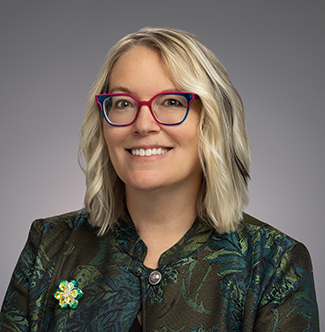


Talk to a group of professionals at an event in Northeast Wisconsin and you’re likely to find at least one “boomerang”— someone who’s left the area for a career and found themselves returning home later.
Lara Fritts, the new president and CEO of the Greater Green Bay Chamber, has had that experience herself — not once, but twice.
The first came shortly after she launched her career in Milwaukee. Her father, hoping she’d live a little closer, sent her a simple postcard about an open position in Green Bay leading a new Main Street program called On Broadway.
At just 25 years old, Fritts became the first director of the fledgling organization, launched in 1996 when then-Mayor Paul Jadin hoped to revitalize the Broadway Street corridor.

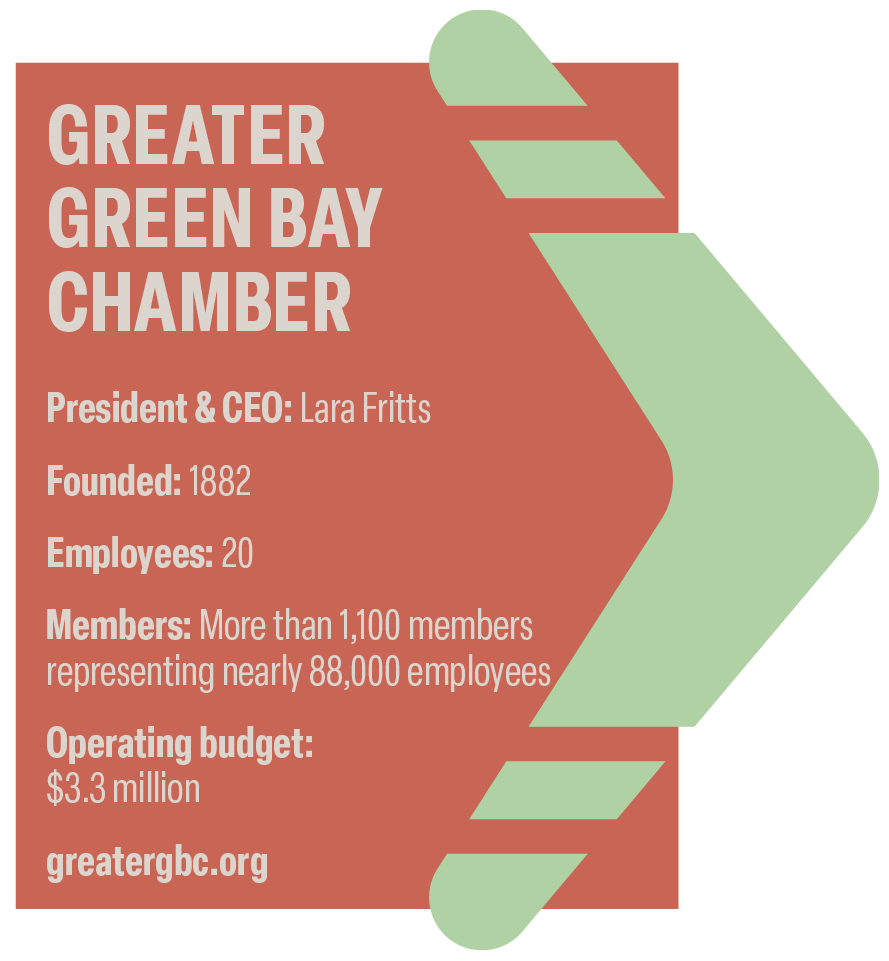
Fritts, a graduate of Green Bay Southwest and of both UW-Green Bay and UW-Milwaukee, eventually went on to a career helping communities in other parts of the country strengthen their local economies. But this past December, it was time for boomerang No. 2: The Greater Green Bay Chamber brought Fritts back to her hometown after president and CEO Laurie Radke stepped down following 14 years in the role.
“I met with all the staff, and they’re so smart and talented and just passionate about this community, and I am just so impressed with everyone,” Fritts says. “I’m so excited that we’re now building our plan for what’s next, building off the foundation and the incredible legacy that Laurie Radke has left us. We’re going to continue to uphold that legacy while leaning into our new brand.”
Hometown grown
Ryan Krumrie, an attorney with Hager, Dewick & Zuengler, S.C., is chairman of the GGBC board of directors as well as a member of the search committee that brought Fritts home.
“We were really looking for someone to continue on the great work we’re doing,” Krumrie says.
The search committee interviewed about a dozen candidates, but Fritts was the first one and really set the bar, Krumrie says.
Fritts possessed the background in economic development, talent attraction and business advocacy that the committee sought, and committee members liked her adaptivity in working with elected leaders, Krumrie says. Her ties to the Green Bay area were also a huge plus.
“The nice thing with Lara was she had been outside of the community and in a different environment,” Krumrie says. “So while she lacked a little bit of that connection with current business leaders, she would also be able to bring an outside perspective to what she’s seen in different communities, which we valued.”
And from almost day one, Fritts has been working on building those business connections, including through a series of listening sessions she held in December, January and February.
“We did geographic roundtables,” Fritts explains. “So we were in Denmark, in Wrightstown, Ledgeview, Hobart, Howard — we went all over Brown County. We then did industry specific roundtables where we wanted to hear from our key industry sectors how we can be supportive.”
Tim Daanen, president and owner of B&D Warehouse, participated in roundtables for his industry sector and for business owners. B&D has been part of the Greater Green Bay Chamber for decades, but Daanen has been somewhat of a self-described quiet member, having had the impression that the chamber was mainly focused on very small or very large businesses.
“I appreciate the fact that Lara had some listening sessions … I think that was valuable,” Daanen says. “I appreciate being asked, and so that’s why I thought I want to get involved again.”
Fritts also came to B&D for a tour of its operations.
“When you have the chamber president knowing about your business, there’s an opportunity that Lara could maybe make connections for me, or for somebody else,” says Daanen, who says Fritts suggested new potential pathways, including foreign trade zones. “I think she’s got a lot of passion for what she does.”

Building a career
Daanen and Fritts also discovered they share a connection in Junior Achievement of Wisconsin – Northeast Region, with Daanen currently teaching for the organization and Fritts having participated as a student.
Fritts can trace her career trajectory back to those Junior Achievement days at Green Bay Southwest. She became interested in the organization after two volunteers from Wisconsin Public Service spoke at her school.
“It sounded really interesting, because I always wanted to get into business in some way,” Fritts says.
It makes sense, as Fritts comes from an entrepreneurial family: On her mother’s side, a great-great grandfather emigrated from Holland and started a brickmaking business; a cousin on her dad’s side launched a successful candy operation (Fritts’ maiden name is Vande Walle).
Armed with her Junior Achievement experience, Fritts went to UW-Green Bay with ideas about becoming an accountant. She instead graduated with a degree in regional analysis with an emphasis in economic development — in the middle of a recession.
Luckily, her uncle Tim Twomey had a job waiting for her at his temporary service. During that time, Fritts had lined up another job interview in South Dakota as an entry-level planner.
“And I was told, ‘Yeah, we can’t hire you. You need a master’s degree,’” Fritts recalls.
Fritts says her uncle told her, “Well, you can work for me forever, or you can go get a master’s degree and follow your dream.” Fritts took her uncle’s advice and got accepted into graduate school at UW-Milwaukee, where she had an internship working for the Uptown Redevelopment Project.
“It was a two-person shop, so I literally became a Jill-of-all-trades and learned all the aspects of the organization. I had a wonderful mentor, John Bach, who really instilled in me how to run the organization. So between Junior Achievement, my administrative skills and my experience at Uptown, it led me to On Broadway.”
Fritts’ work getting that new organization off the ground became a hallmark for the rest of her career: Her ability to make things happen and take things to the next level attracted notice from other communities. Her career took her to Wausau, as well as to Maryland, Virginia, Washington D.C. and Utah, always in roles where she was building organizations or agencies and building the kind of connectivity that can improve communities.
Leading through connections
In the Green Bay area, Fritts is already showing that she’s great at making connections, but her former colleagues would also say she’s good at keeping them — and tapping into their expertise when it makes sense.
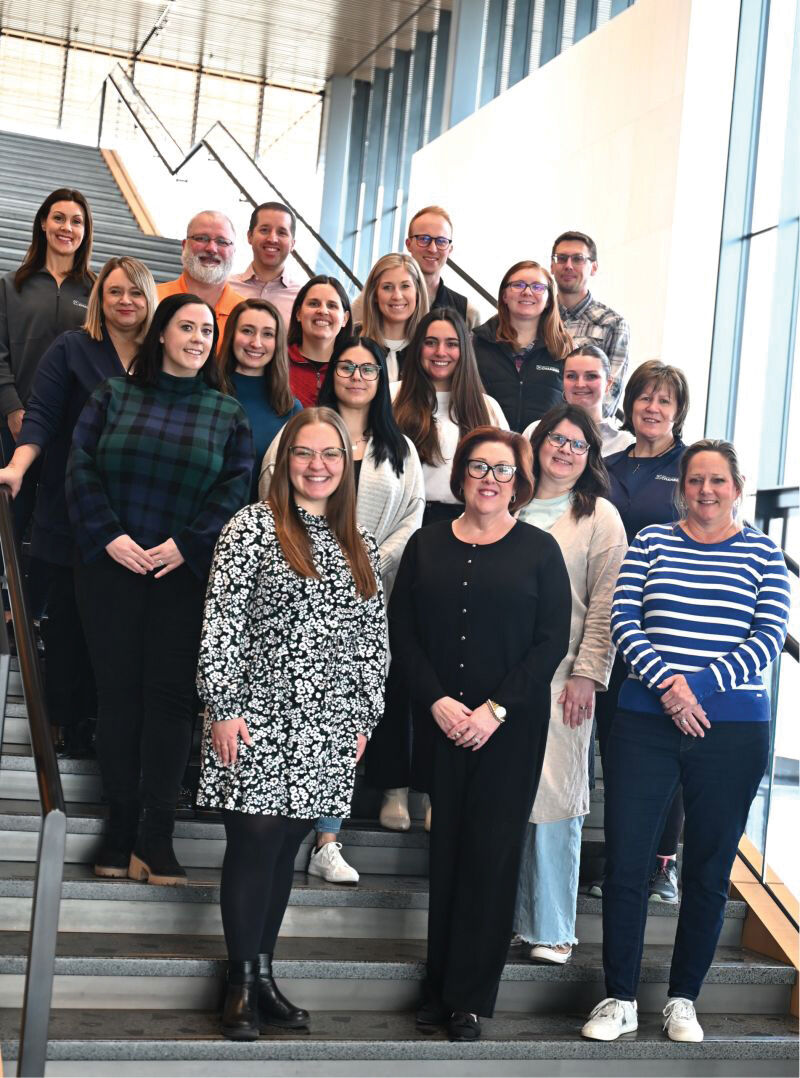
One of those connections is Ben Kolendar, chief of staff at the World Trade Center Utah, who worked with Fritts from 2016 to 2019 as deputy in a newly formed Salt Lake City department of economic development, which included the city’s redevelopment agency, business development arm and arts council.
“She trusts people to deliver. She gives them direction and just says, ‘go,’ and I give her just as much credit for being able to do that as my technical experience of being able to do it,” says Kolendar, who has stayed connected with Fritts and recently chatted with her about the potential for Brown County companies to become foreign trade zones, a designation that facilitates working with international companies. “That’s one thing that has definitely served her well … she’s just got this wide network that she could call on anytime she wants.”
“I’ve always said that I don’t have to know everything; what I do have to know is really smart, talented people,” Fritts says. “And Ben’s a great example of that.”
Jodie Bollinger, department director for the Frederick County Office of Economic Development in Frederick, Maryland, worked with Fritts for almost three years when she was the division director. Fritts created the division of economic opportunity, which had two departments, economic development and workforce services, representing “a great alignment for our business community,” Bollinger says.
Fritts also was “very heavily involved in projects that brought significant capital investment to our community,” including a $2 billion expansion of a life science company in the region.
“Lara leads with a clear vision in mind,” Bollinger says. “She focuses on results and, most importantly, she empowers her team.”
Cole Buergi, vice president of business development at Kane Communications Group, brings the perspective of having worked with Fritts decades ago at On Broadway and again today as a member of the chamber’s economic development board.
“I think she has a natural ability to see the future and share with people what things could look like, and then help them put the puzzle pieces in place to get to that point,” Buergi says.
Buergi says he sees Fritts taking the right steps by getting input from the business community to understand the lay of the land, then taking on the challenges that they are facing.
“I think she’s the right person at the right time,” he says. “There’s a bright future for the greater Green Bay area and the chamber.”
A vision moving forward
Under Radke’s leadership, the Greater Green Bay Chamber launched a rebrand process that was shaped by community focus groups and surveys. The new “Greater For You” brand was announced in July, an effort partially to ensure the chamber’s identity was inclusive of communities outside of Green Bay as well as to better convey the breadth of services and programs the chamber offers.
Through the process of listening to members during the recent roundtables, Fritts discovered that people weren’t necessarily aware of the breadth of things the chamber does — things like the Startup Hub, the Urban Hub and the longstanding Golden Apple Awards, which celebrate educators. People love that event but didn’t necessarily know the chamber was connected with it. The rebrand now more prominently connects the Greater Green Bay Chamber’s name with those offerings.
The rebrand was completed with the help of O’Connor Connective, which collected data from GGBC members to understand what was important to them — resulting in the rebrand’s three pillars: growth, talent and impact. When Fritts arrived, she also wanted to hear from businesses firsthand, which is why she launched the listening sessions.
“The first thing that we heard loud and clear was they wanted us to enhance our work around talent attraction, that even though we have amazing colleges and universities here, we need more people to fill the roles that we have available,” she says. “So how do we get people to realize that Green Bay is an amazing place to live, work and have great employment? So that’s something we’re going to lean into.”
Talent is a pressing issue, with baby boomers retiring and the number of residents in Brown County 55 and older growing from 41,494 to 80,987 between 2000 and 2023, according to a Wisconsin Department of Workforce Development report. The county also has experienced a decline in the number of people working or looking for work, which dropped 10.8% during the same period.
Fritts also learned that busy business leaders want more educational programming, and they want the chamber to enhance economic development efforts. Fritts says there are a number of ways to do that, including by continuing to build partnerships with New North, Inc. and the Wisconsin Economic Development Corporation.
“I look at both of those as our national/international sales team,” she says. “Our job at the chamber is to be a capture manager. They’re out there doing the business development; we need to capture it here in Brown County.”
Being a boomerang
The community has changed in many ways since Fritts last lived here: So many more amenities and fun things to do, for one, and also a greater diversification of industry. The greater Green Bay area has almost 8,000 businesses now.
“We were so paper-heavy for so long, and now we have tech companies. And you look at TitletownTech and the amazing innovation that’s happening there, [it’s] quite incredible,” Fritts says. “And I think what’s happened downtown both in the On Broadway district and the central business district is really incredible, from the riverwalk to all the cool stores and restaurants. It’s been awesome to see the change.”
One of the questions the committee asked Fritts was why she wanted the job when she seemed happy on the East Coast.
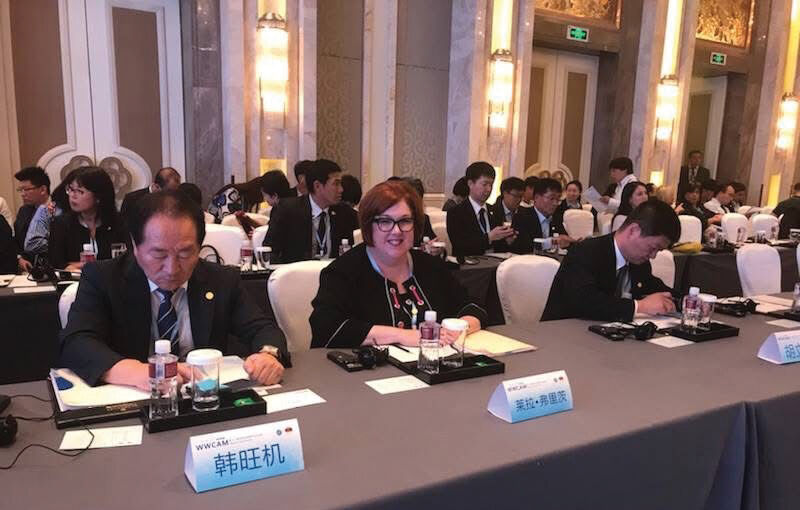
“And I was very candid. This job matters to me. I grew up here. I’m a product of the Green Bay public schools, and of UWGB,” says Fritts, who can also draw on her national experiences and add that perspective to the table. “How many people get that opportunity?”
“It’s incredible to be home,” she says. “There’s something familiar, yet it’s changed. And that’s been really exciting.”
The biggest differentiator between other places and here, she says, is the willingness of people to step in and help. She cites the example of a recent snowstorm during which her husband was clearing their drive — out East, you’d kind of be on your own. But here, a neighbor with better equipment stopped to clear it for him in a much shorter amount of time: “People step in and help when they see somebody in need. I love that. I love that so much about this area.”
Greater Green Bay is positioned well because of its robust business landscape, a good transportation system, abundant educational opportunities and its relative affordability compared to larger metros, Fritts says, but still she knows talent attraction is one of the challenges on the minds of many business leaders. One of the chamber’s focuses is learning why young professionals want to leave.
To help showcase the county, the chamber is working on refreshing its “Your Move Green Bay” website.
“People want to live in cool places,” Fritts says. “They also want to stay in places where they feel a connection to community. And so how can we make new and returning residents feel welcome?”
Fritts has settled into her new home in Hobart and loves to spend free time with her husband, Mike.
“He has supported my career in such an incredible way. He retired from the federal government and really has followed my career around,” she says. In coming home to the Greater Green Bay area, Fritts also can be closer to her friends and family, including her 85-year-old mother.
At the chamber, Fritts is now working with her team internally on a new work plan that will formally define the chamber’s vision, goals, objectives and tactics for getting there. The work plan ties into the work already done by O’Connor Connective on the rebrand, as well as the chamber’s strategic plan.
Her goal also isn’t to reinvent the chamber but rather to ensure its members and the wider community understand all it has to offer.
The Midwest is filled with humble people, Fritts says, and as such, organizations don’t always shout about how fabulous they are.
“And yet, the chamber is really fabulous,” she says, “and so part of telling our story is shouting it a little bit louder.”

