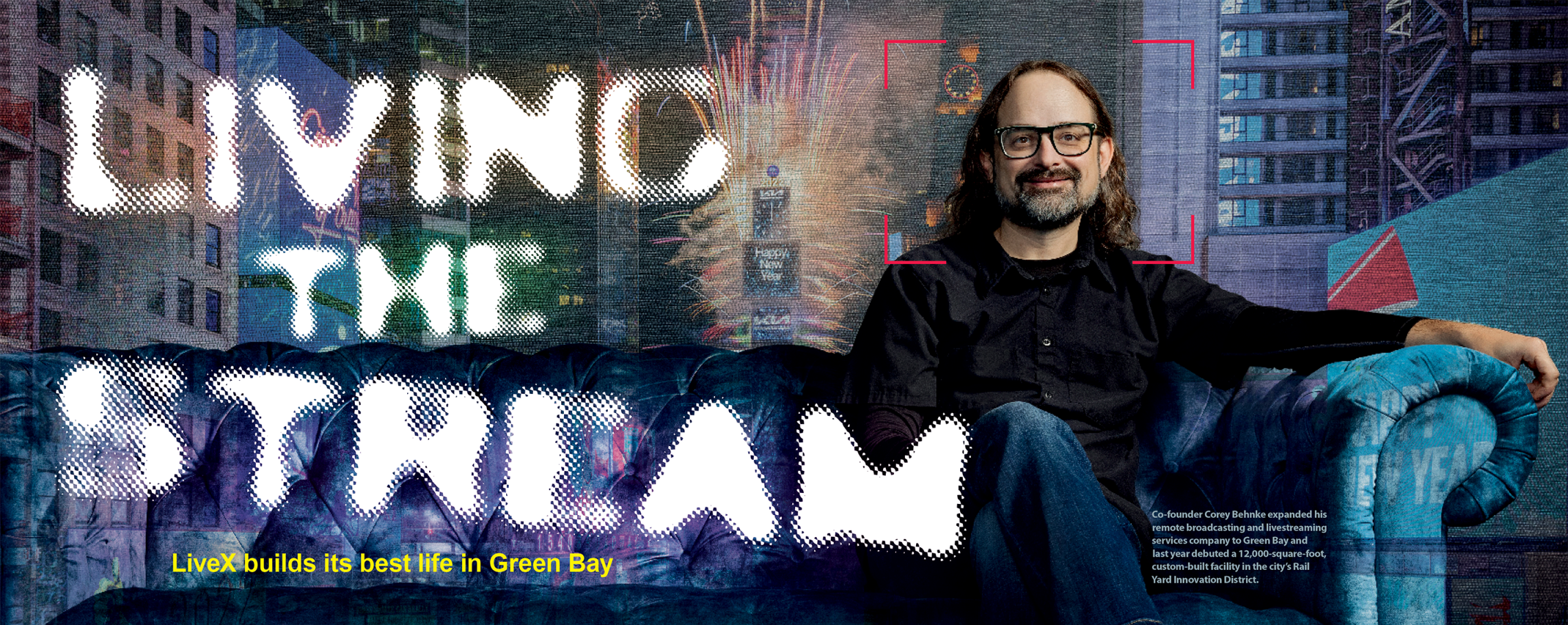

PHOTOGRAPH BY SHANE VAN BOXTEL, IMAGE STUDIOS
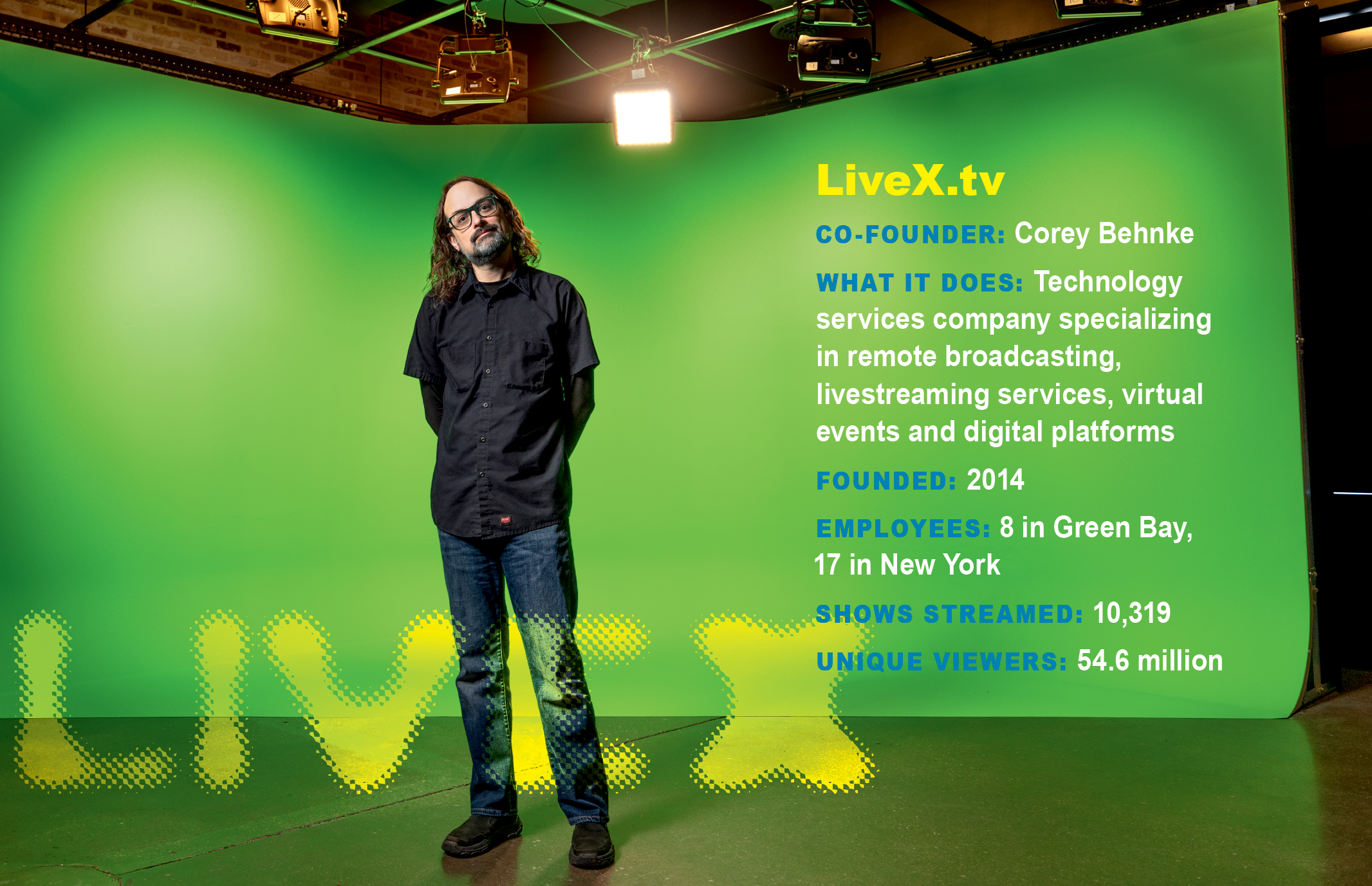
LiveX co-founder Corey Behnke believes in the power of “lifestyle savings.”
“Lifestyle savings to me is the idea that I can do something at a very high level, but also live a ‘normal’ life,” says Behnke, who founded his livestreaming services and technology company in New York City in 2014.
The concept of lifestyle savings was a motivating factor in Behnke’s decision to expand LiveX with a second location in his hometown of Green Bay — where real estate and talent are affordable — rather than in New York.
Today Behnke operates both LiveX locations from his full-time home in Titletown, but his life is hardly normal.
From producing the first-ever live remote roll call during the 2020 Democratic National Convention to launching the webcast of New York City’s Times Square ball drop on New Year’s Eve, LiveX works behind the scenes to bring some of the country’s biggest live events to millions of viewers across the globe — all from its newly-minted office in Green Bay.
“When you tell people that, for the last two years, four operators in Green Bay have been responsible for about 7 million viewers seeing that [New Year’s Eve] feed, it blows your mind a little bit,” Behnke says.
Midwest is best
Behnke had been living in New York for 20 years when the COVID-19 pandemic hit and suddenly the open plains of the Midwest became more attractive to many city dwellers living in tight quarters. But Behnke had his sights set specifically on Green Bay well before 2020.
Behnke also runs one of the world’s largest Green Bay Packers fan websites, Cheesehead TV, which gets over 1 million visitors a month during the regular season. Behnke had long dreamed of owning a home near Lambeau Field and in 2016 his dream became reality when he purchased a property on Shadow Lane.
The pandemic may have closed some doors for LiveX with its core business in events coverage (“We had $400,000 of signed contracts disappear in a week,” Behnke says), but it opened others.
LiveX, which specializes in full-service broadcast design and production, shifted to working with worldwide clients to meet the new socially-distant demands of remote broadcasting. For example, the company assisted ABC television in the remote production of its daily talk show, The Tamron Hall Show, with the help of home studio kits. LiveX’s New York studio acted as the master control room, bringing in remote daily guests, switching the show and mixing audio.
“February and March 2020 were really heady [times],” Behnke says. “ABC coming to us asking for help was pretty amazing.”
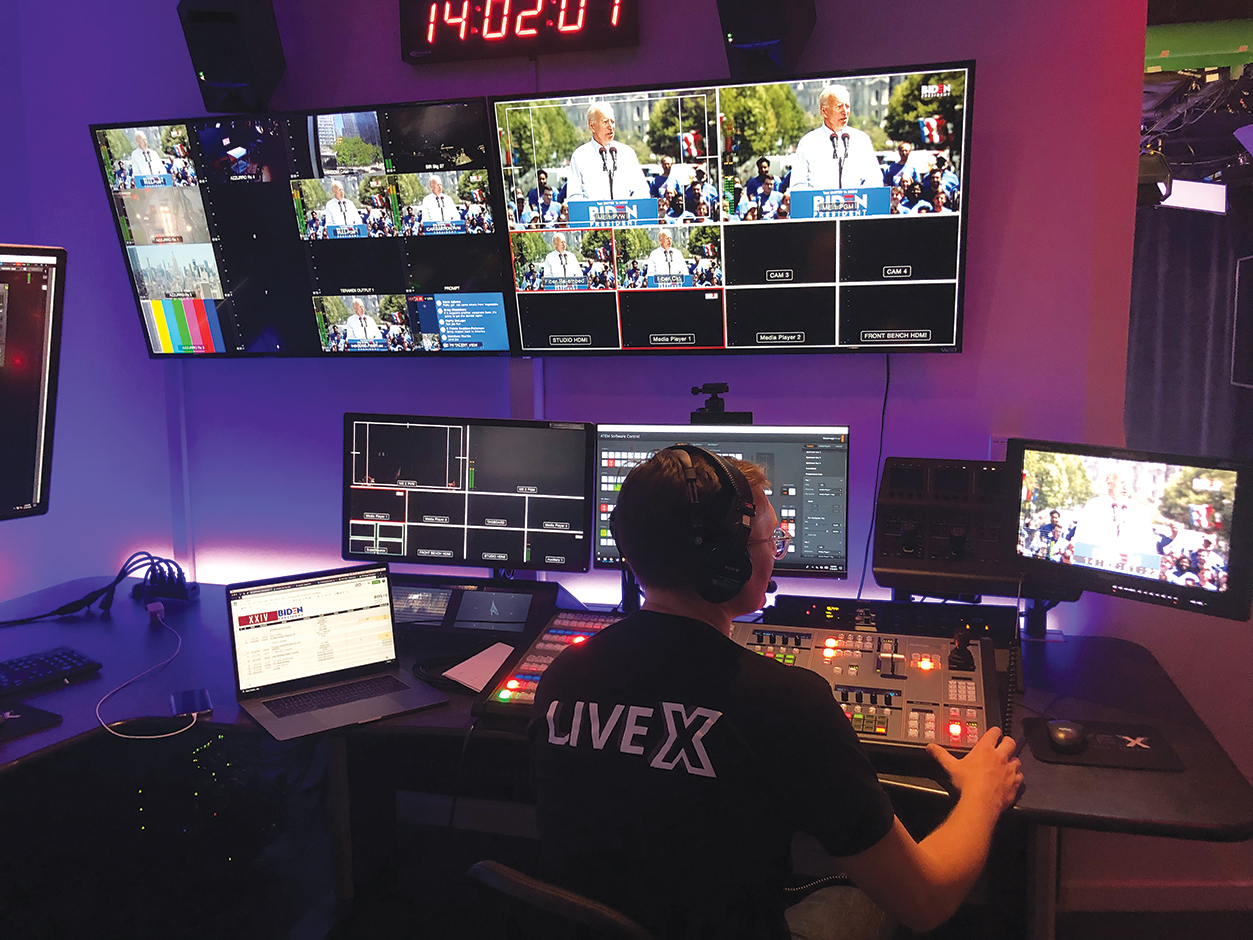
One of the most memorable experiences for Behnke was producing the first live remote roll call during the 2020 Democratic National Convention. LiveX produced the roll call with voices from 57 U.S. states and territories, from Hawaii to Maine, with the help of remote kits that were shipped to participants so they could record their nominating votes from where they were.
“That’s one of those experiences,” Behnke says, “that’s the biggest of my life, to be honest with you. While I knew how we were going to do it, we had to teach everyone else how to do it. We were literally running tech support for [President Biden’s] grandchildren, trying to tell them how to get on the video wall behind them.”
With remote broadcasting making up a larger piece of the LiveX pie than ever before, the idea of expanding the business to Green Bay with a devoted remote broadcast facility suddenly seemed like a viable option.
In September 2020, Behnke signed a one-year lease on a 1,500-square-foot space in the Broadway District so he could test operations in Green Bay. Behnke was looking for his business’s top three needs — internet, infrastructure and talent. Not only did he find them all in Green Bay, but he found them for much less than in New York. Case in point: The same fiber internet that runs $1,800 a month in New York is $400 in Green Bay.
“I realized that if remote broadcast was going to be a significant part of our business, there’s zero reason to do it anywhere where real estate costs a lot of money because in theory you can do it anywhere,” he says. “And if you’re going to do it anywhere, shouldn’t you do it in a place that [offers] lifestyle savings?”
So that’s what he did. In 2022, LiveX officially opened a new custom-built facility on a 10-year lease in Green Bay’s Rail Yard Innovation District — a 22-acre development in the city’s Broadway neighborhood.
“The reality is, in the city of Green Bay and even Northeast Wisconsin as a region, there’s a lot of competition for companies of this magnitude,” says Brian Johnson, executive director of On Broadway, Inc. “This is the type of company that could have landed in any number of locations, so for them to choose the Broadway District, we see that as a sign of good things that are attracting other businesses to the area.”
The $2 million, 12,000-square-foot expansion takes up the entire third floor of the Titletown Brewing Co. building and features four remote master control rooms, a full master control room and a full-service broadcast studio with a working studio kitchen. LiveX celebrated last September with a grand opening to showcase its new state-of-the-art facility.
“When you walk through Corey’s space, it’s really something to be admired,” Johnson says. “He’s making an investment that is really important, because it sends the signal that he’s committed to this area and its long-term success. He’s putting his money where his mouth is with a space that kind of elevates the bar.”
3, 2, 1 . . .
These days Behnke spends most of his time behind the scenes, but his career began on the stage. He attended North Carolina School of the Arts for acting and performed in off-Broadway shows, gradually falling deeper in love with the craft of live stage productions. He began picking up production assistant jobs with live event broadcasts, which he saw as a natural extension of theater. One of his first was for Times Square New Year’s Eve in 2002.
The experience would have a greater impact on Behnke’s career trajectory than even he knew at the time.
“The first time I walked into a broadcast truck, it immediately felt like that’s where my home was. I don’t know how else to explain it,” Behnke says. “It’s like you get introduced to something for the first time in your life and you realize that’s what you’ve been missing out on. That changed my life.”
Behnke quickly worked his way up from production assistant to running the official webcast for the Times Square New Year’s Eve event that includes the lighting and raising of the New Year’s Eve Ball, hourly countdowns, live musical and cultural performances and the pushing of the Waterford Crystal button that signals the ball drop at midnight. Typically about 1 billion people watch the ceremony each year — about 7 million of whom have done so through the LiveX webcast.
“Corey, you know, he’s just a dynamo,” says Jeff Straus, president of Countdown Entertainment, which partners with the Times Square Alliance to produce the Times Square New Year’s Eve event. “Not only is he a great worker, but he’s full of ideas. He quickly rises to the top because he takes on more responsibility.
“He’s not only a producer; now he’s like our technology advisor for the entire show,” Straus continues. “If I have a question or issue, he’s the first person I call.”
Behnke has been partnering with Countdown Entertainment in the production of Times Square New Year’s Eve for nearly 20 years. Straus remembers Behnke approaching him in 2008 with an idea to create a webcast of the ceremony.
“The first year I said, ‘I’m not ready for this, no.’ But he kept pushing. When Corey sees something, he goes after it,” Straus says. “We had our first webcast in 2009-2010, and Corey made it happen.”
The webcast allows digital media outlets, bloggers and webmasters to embed the video to their own websites and social media channels, as well as create programming tailored to their specific audiences.
“It’s the future of what we are doing,” Straus says. “Corey, to his credit, saw this all the way back in 2008 when he started pushing me in that direction — so we were way ahead of a lot of folks. At Times Square we are filled to the brim — we can’t have any more people in Times Square — so we really see our reach being people who watch online. And it’s Corey’s webcast that gets it out all over the world.”
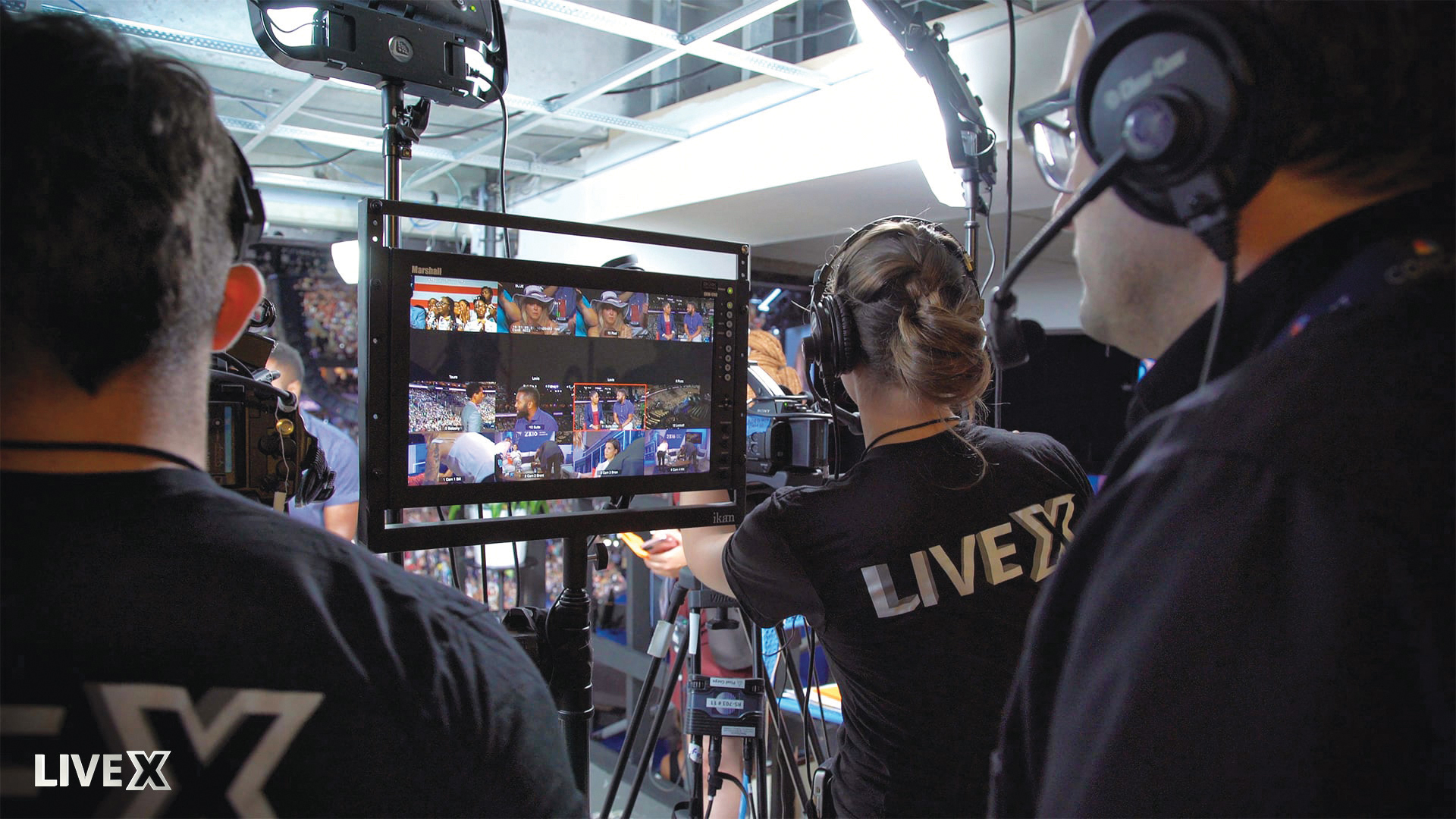
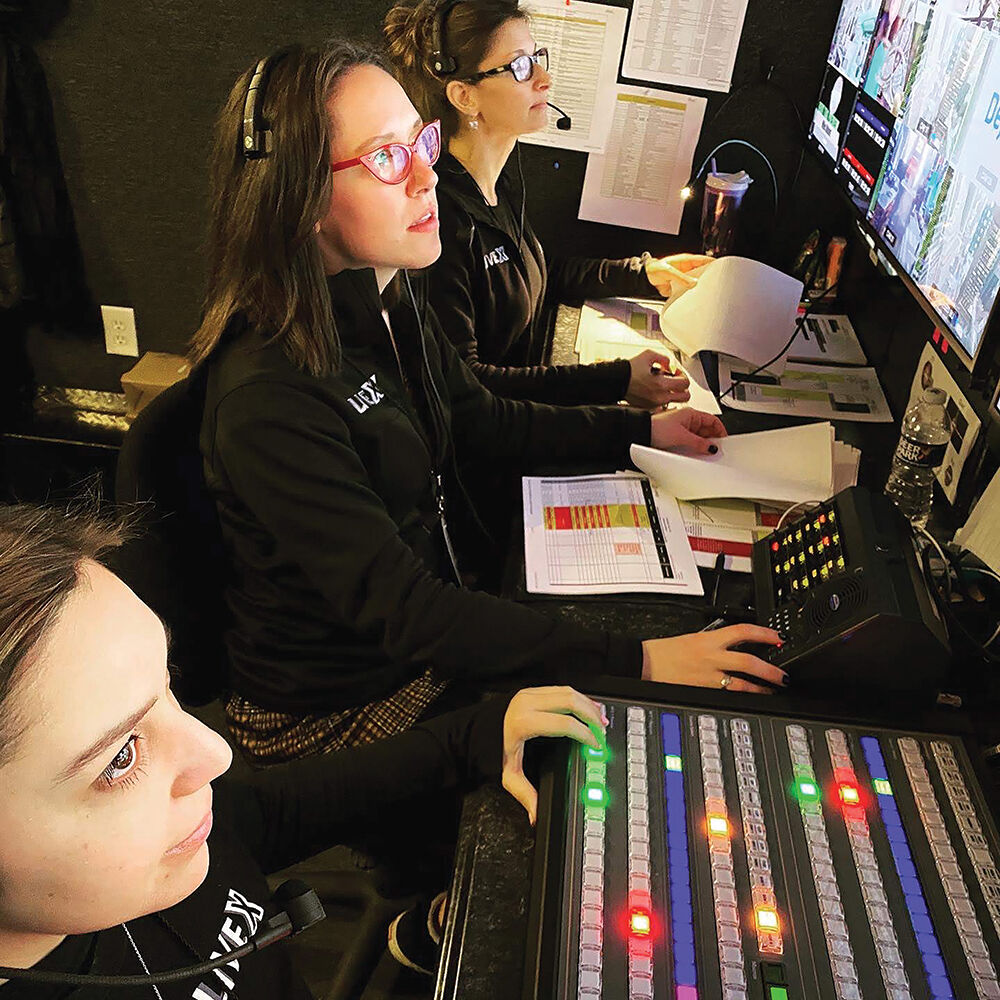
For the last two years, LiveX’s Green Bay team has been responsible for encoding services that make the Times Square feed accessible to nearly 7 million people in more than 200 countries on 20 different platforms.
“There’s a certain ‘wow’ factor to what they do,” Johnson says. “The fact that the New Year’s Eve Times Square ball drop is live cast out of Green Bay, Wisconsin… As someone who lives here, it’s fun to tell that story. It gives us a way to open a door to talk about the community we are from.”
Room to grow
LiveX has grown into an $8 million company in its first eight years, and it’s just starting to stretch its legs in Green Bay. And to support its growth, Behnke plans to hire 24 to 30 new employees over the next three years.
In 2021 the City of Green Bay named LiveX its “Small Business of the Year” — the first business to ever receive the designation. Mayor Eric Genrich presented the award during his 2021 State of the City address.
“I wanted to recognize LiveX obviously for the great work they do, but also for what they indicate as a business,” he said. “To have a business co-located with headquarters in Green Bay and New York I think points to a future that’s possible here in the age of remote work.”
Behnke saw the possibilities when he opened his Green Bay location and now says remote production currently makes up about 20% of LiveX’s business, up from about 10% in 2019. Livestreaming services make up the majority at 40%. System integration, like when LiveX built the first studio for Cheddar TV on the floor of the New York Stock Exchange, makes up another 20%. Experiential services like projection mapping, immersive environments and lighting design make up a small portion.
Product currently makes up 20%, but this is an area of growth for Behnke, who would eventually like this segment to be the company’s largest.
One of LiveX’s current products is Rivet, a remote contribution broadcasting app used by about 300 clients to help them bring in remote guests to their live and on-demand shows. Another is Virtual Video Control Room, a cloud-based control room that allows LiveX staff to access productions virtually from anywhere in the world. This product is vital to the Times Square New Year’s Eve production. From the LiveX mobile unit in Times Square to its New York studio to the remote control room in Green Bay, the entire LiveX team connects through Virtual Video Control Room and is able to work together as though it was sharing a single set.
“One day, product will be 51% of the business and I’ll be very happy,” Behnke says. “That’s the most sustainable and it takes the seasonality out of the business, which is probably my biggest stress factor.”
In addition to further product development, Behnke sees LiveX growing into more high-end remote production and cloud production, even though the latter has the potential to null and void his current business.
But there’s humor, and necessity, in it, he says.
“What’s hilarious is I’ve built four remote master control rooms in Green Bay, we have one in New York, and our cloud business basically tries to destroy all of that,” Behnke says. “But what I’ve learned is you have to be in the business you’re in and the business you’re going to be in at the same time. If you’re not disrupting yourself, you’re not doing it right.”