
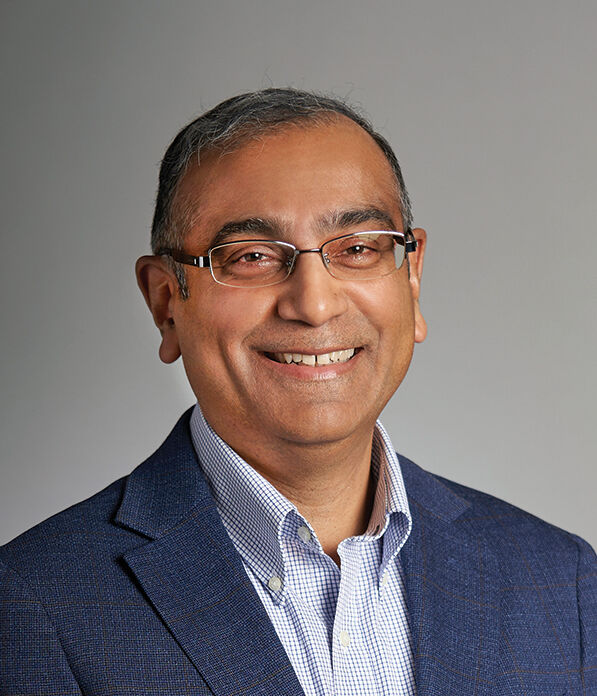

Get to know: Chris Baichoo
This month Tim Wiora officially retires after seven years as CEO of WMEP Manufacturing Solutions, the Madison-based nonprofit consultancy aimed at helping small and midsized manufacturers. Since January, the organization has been led by Chris Baichoo, an experienced leader who has worked in the U.S., Canada and Asia. Baichoo recently sat down with IOM to share the current view from his chair as WMEP’s new leader. Read the full interview at insightonmfg.com.
IOM: Tell us more about your background.
Baichoo: I’ve got a pretty interesting background; I’m originally from Guyana, South America and when I was about 8 years old I came over to the U.S. with my family. My dad worked on his master’s degree, we lived in California for a couple years, then we came back home to South America and it was a really good opportunity for me. I always had a passion for understanding how things worked, and early on I figured out I wanted to be an engineer. So I came back over to the States in ’84 and went to school in Missouri to get my mechanical engineering degree. I put myself through school by working in the summers. I’d refurbish cars and stuff like that — it pretty much paid for my education through working summers.
What sparked your interest in manufacturing?
When I was doing my engineering degree I was in Hannibal, Missouri and I got a job at a small, family-owned manufacturing facility making industrial heaters. I ended up staying with them for 30 years, until I was about 50 years old. I started working on the shop floor and worked my way through various functional positions — marketing, engineering, R&D…
What attracted you to the opportunity to work with Wisconsin manufacturers specifically?
Manufacturing as a percentage of our economy is very high compared to other states, and we really have a thriving community of entrepreneurs who are looking at how do they use the ideas that they have. I’ve worked all over the world, and [here] we have a network of people that are so willing to help each other out and who go out and make an effort to contribute to the local community. I find that really unique, and I love that atmosphere of collaboration.
Manufacturing in the U.S. has gone through such a transition. It was great, it bottomed out, and now we’re in this resurgence. It’s just a really great opportunity in this role that I’m in at WMEP to help our local manufacturers grow, increase their profitability, hire more people and really help to create more thriving communities where they are. I’m really excited to be in this position to use my skills and pay it forward to the local community.
What have you learned from Tim over these last few months?
I’ve spent my entire career in for-profit, so taking over a nonprofit where we’re mission based, it takes a little bit of a different mindset. There’s a real team aspect to the work we do. The networking you need to do is a lot different and I think managing the stakeholders is one of the key things he’s helped me understand.
What’s the most unique challenge of your role?
One of the things I work on is that we really have to understand what the issues are from our clients, and it’s constantly changing. I’ve never seen the rate of change of issues that we’re seeing right now, so one of the things we’re working on is getting with manufacturers to understand their needs.
What are the biggest issues you will be working on in your role?
Three of the biggest issues I see are labor availability, margin compression and growth. Three or four months ago, if you asked [my answer would be] different. This is why we have to really keep understanding what are the top of mind challenges and how do we point people in the right direction and deploy our services to help address those needs right now.
With labor availability, there’s a couple of things. At Manufacturing Matters John Koskinen gave a talk about what’s going on in Wisconsin. One of the things he mentioned is there’s 74,000 people right now looking for jobs in Wisconsin. If each one of those people was able to find a job, we’d still be short 150,000 people. That’s sobering. So one of the things we’re doing is trying to figure out how do we help manufacturers with this problem. And there’s a couple of things. We’re focusing a lot on automation; if we look at the hits on our website, automation is the top thing people are looking for. The other thing is upskilling. Once you put automation in, how are you looking at people who are doing menial tasks to upskill them? Then I think the last thing is operational excellence. How do you look at your manufacturing cells and figure out how to improve productivity so you can take those people that you free up and use them in other areas so you can get the product out the door?
The next thing that’s happened that a lot of people are dealing with is margin compression. Labor costs have gone up. Material costs have gone up. Operational excellence drives labor efficiency. The other thing we call “doing more with less.” It’s how do you use less electricity? How do you use less water? How do you reduce the scrap that you generate to really be efficient on the input materials, not only labor but materials to help manage your margin compression. And also how are you designing your products so they use less materials and less labor?
The third challenge that’s coming up, I think, is that growth is slowing down. In 2021-2022 there was this huge backlog that was created when we couldn’t find enough labor. A lot of companies have burnt through that backlog now and they’re now looking at “how do I grow my business.”
A lot of it comes back down to what’s your strategy, being more pointed in terms of how do you identify your ideal customers. So we [help clients with] growth strategy to help make sure companies are really focused on the right customers, understand their value proposition, and they can really go out and find the right customers. The other piece of it is looking beyond our borders: exporting. We actually had a full session for ExporTech that really helped coach companies in terms of what competencies they can build internally, which counties they should evaluate to pursue, and how [can they be] aware of all the things that WEDC has to help them fund investments for three or four years; there’s tons of money available to help them with their exporting journey.
What does the future look like for WMEP?
We still have a lot of opportunity to grow our brand. One of our goals is to be the go-to provider of consulting services. When you say the word consulting, people have the view that you’re just there to take money out of my pocket continuously. What I’ve learned is we’re more of a coach. We want to take people from stage number 2 to stage number 4 and coach them and then we leave and we find somebody else to coach. I think that’s an important distinction that I realized of what we do, and that’s kind of what we want to make sure people understand. We’re here; we have these resources; how do we help you be successful? And that’s our mission. That’s how we get measured by the MEP network.
— Kate Bruns
Charting a new course
Lakeshore Technical College has announced plans to partner with the Cedar Grove-Belgium School District and industry employers to develop an advanced manufacturing technology charter school — the first of its kind in the state. The program is being funded by a $650,000 grant from the National Science Foundation and hopes to address the continuing labor shortage in the manufacturing sector. “This grant will have a significant impact on the community,” said Lakeshore President Paul Carlsen. “It will provide students the opportunity to embark on a fast-track trajectory for education that will prepare them to graduate as workforce-ready advanced manufacturing technicians and be ready for additional industry-focused college coursework.”
Fired up
For the 15th year, students got summer off to a sizzling start by competing in Envision Greater Fond du Lac’s Project G.R.I.L.L. — a program aimed at inspiring students to pursue manufacturing careers. G.R.I.L.L. stands for Growing Readiness in Learning and Leading. “Project G.R.I.L.L. teaches students all the steps of taking an idea from concept through production with the end result being a fully functional grill,” explains Envision’s website. “The design process and fabrication of these complex grills takes an entire school year during which each student group is mentored by both their technical educational teacher and a manufacturing partner.” A total of 77 students from seven Fond du Lac-area schools participated this year, with a team from Lomira High School taking home first place for a milk-truck-shaped grill made in conjunction with industry partner Wabash National.
Women in forest products
Last month, the Wisconsin Paper Council launched its Women in Forest Products scholarship program, established with an initial gift of $20,000 from Ahlstrom. The goal of the scholarship is to provide financial support to a female graduating senior who is pursuing a career in the forestry products or related field, as well as to develop women in the field as future leaders. “Ahlstrom recognizes the need to have more women in the paper industry and this scholarship is designed to encourage high school young women to enter different fields in the paper and forest products industries, and to encourage women leaders already in the field to grow their leadership skills through education,” said Addie Teeters, head of marketing communications and public affairs for Ahlstrom.