


It’s no secret: There are more open jobs than workers in the U.S., and the problem is only expected to worsen as tiny Generation Alpha enters the workforce. Gen Alpha, defined as individuals born between 2010‑2024, totals only 38.5 million Americans. Contrast that with more than 75 million Baby Boomers (1946-1964), 65 million Gen Xers (1965‑1980) and 72 million Millennials (1981-1996), and there’s no doubt the talent pool is shrinking.
Some argue that artificial intelligence will be the answer to addressing talent shortages. But the World Economic Forum projects that while AI may displace about 92 million global jobs by 2030, it is also expected to create 170 million new jobs — representing a net gain of 78 million “help wanted” ads.
And while nothing much can be done about the people shortage, manufacturers are looking to quality over quantity, and eyeing talent from within. In Northeast Wisconsin, higher education institutions, nonprofit organizations and companies like Microsoft are working to increase access to upskilling, better and faster, as the pace of technology growth continues to demand it.
“It’s going to become more and more important as jobs change faster and faster,” says Vickie Patterson, executive director of the Bay Area Workforce Development Board. “You’re not going to be able to go to a two-year program to keep up. At some point upskilling just becomes more and more important, and companies are looking at it differently.”
Making good hires, nurturing talent and supporting growth are not just necessities in the talent crunch, but they also make good business sense. Studies by the New York-based consultancy ILX Group have shown that upskilling is 70-92% more cost effective than hiring a new employee, especially for technical manufacturing roles.
The Wisconsin Department of Workforce Development launched its Fast Forward grant program in 2013 to help employers defray the costs of upskilling, Patterson says. In 2025, nearly half the state’s grant awards went to support manufacturing, including $128,018 to upskill 111 incumbent workers at Diversified Woodcrafts LLC in Oconto County.
The Northeast Wisconsin Manufacturing Alliance (NEWMA) launched its own upskilling program, a partnership with Microsoft TechSpark and Goodwill NCW, in 2020. The training and certification offered is free to NEWMA members and to date has served more than 1,500 workers in Northeast Wisconsin, with current offerings in the areas of data analytics, generative AI, project management and digital literacy.
NEWMA’s training supports manufacturing employees of all types, says Microsoft’s Michelle Schuler, manager of TechSpark Wisconsin.
“No matter who you’re talking to, whether you’re talking to the unemployed or underemployed, whether you’re talking about a president, CTO or CIO of a company, everybody is talking about learning something new,” Schuler says. “There is no better time than now to talk about talent.”
NEWMA’s 2026 Manufacturing Vitality Index, published last month, found that CNC machining, welding, industrial maintenance and communication skills remain most in demand at Northeast Wisconsin manufacturing workplaces, as they have for several years. But for Schuler and Microsoft, it’s all about the pedal-to-the-metal that is technology adoption.
“I don’t even think AI is the initial topic; it’s what problems are you trying to solve and how do you leverage technology to do that?” she says. “[AI] is not going away, and it’s also changing how we work and think about work.”
Worth the investment
Patterson, who notes that AI training has been a popular option in the past year, says there are many flexible options for incumbent worker training, including courses through gener8tor and NEWMA. In addition, the Bay Area Workforce Development Board is currently accepting applications for its Spring 2026 Incumbent Worker Training grant program. Patterson says time and paperwork are typically the most common barriers to employers moving forward with upskilling — sometimes also financial cost.
“Our Incumbent Worker Training offers to pay for a portion of it based on company size, so some smaller and mid-sized companies have a harder time doing that,” she says.
But resources can be pooled between companies to support upskilling, experts say. About a decade ago, 11 companies came to Fox Valley Technical College with training needs in industrial maintenance. The college sought to offer a workable solution.
“Not one of those companies had the money to invest to put on a single training event for their employees,” says Chris Dragosh, FVTC’s dean of agriculture, manufacturing and engineering technologies. “We provided a single day model, once a week for eight hours, and that cost was split across all 11 companies.”
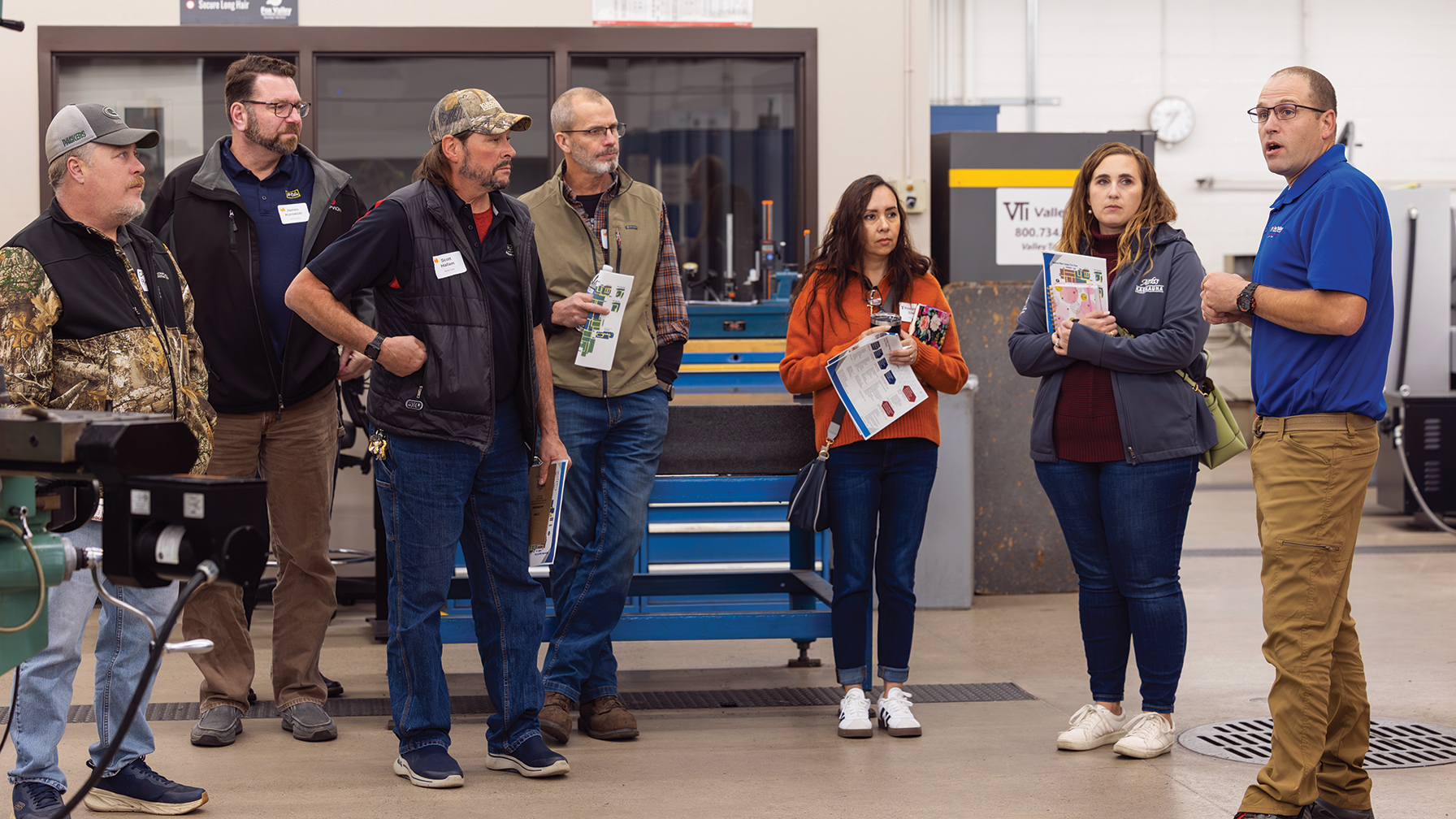
The rest is history. Dragosh says FVTC has been offering industrial maintenance upskilling for more than a decade now, with 31 companies participating in that program alone. Speaking at a special employer engagement event at the college in November, Dragosh outlined FVTC’s current menu of offerings and customized training opportunities, which includes welding, automation, machining, safety engineering and quality engineering.
At the event, a panel of industry representatives spoke about their challenges and successes in upskilling. Justin Eslinger of Amcor, who participated in FVTC’s first‑ever industrial maintenance training cohort, was among the panelists. Eslinger shared with attendees that, since 2015, more than half of Amcor’s maintenance department has participated in the program.
“We actually have people transferring into our plants to try to get the opportunity to get into the program,” he said, adding that Amcor has been able to use the training to get employees versed in electromechanical maintenance, which has increased productivity at the company because jobs can now be handled by one technician that used to require two.
Brian Kaminske of Waupaca Foundry said his company has also sent more than 100 employees through the electromechanical program, and Tim Kinney of Miller Electric Manufacturing said his company has utilized FVTC’s programs primarily in the safety area, training more than 100 first responders. Justin Danko of Oshkosh Defense said his company has benefitted from FVTC’s four-week welding training.
“This summer, we actually had 32 volunteers … who went from never welding to now they’re welding at our facility in Oshkosh,” Danko said.
And while a fresh crop of green welders may present concerns about quality, Danko added, there have also been a lot of positives to integrating new workers with an experienced force.
“We’ve had them question, in a good way, some of the processes and things that older welders have been doing the same for 30 years,” he said. “When we get some fresh people in there asking questions, we’ve actually found a few quality improvements and other things that we can do based on getting those new faces in there.”
Overcoming obstacles
Perhaps it goes without saying, but for every worker who is upskilled and placed in a new role, a job opening is left in their wake. Backfilling positions is almost as big of a challenge as identifying the right workers for upskilling.
It’s simply a numbers game, Kaminske says.
“We just don’t have the unlimited people supply,” he says. “You go back a lot of years, we had what seemed like unlimited applications and resumes. So you upskill somebody, put someone else in, and move on. Now it’s getting more and more difficult just to fill the basic jobs.”
When it comes to identifying people for upskilling and backfilling, Patterson says, it pays to think outside the box. She points to a recent example in which she was able to identify bartenders as being good candidates to upskill into positions as 911 operators because of their demonstrated listening and de-escalation skills.
Dragosh recommends offering multilingual training as well, so as not to leave a pool of qualified workers behind. For example, Kaminske estimates that about 20% of Waupaca Foundry’s workers speak Spanish.
In addition to the challenge of backfilling positions, there’s also the numbers issue created when you take workers off the line for training.
“At one point, we had 32 people doing a four-week consecutive class where they’re going every single day for every hour of their shift,” Danko says. “So it’s pulling 32 people out of our assembly facility, trying to figure out how we can adapt to that in our schedule.”
And then there’s the concern a company will invest in upskilling a worker only to have them leave for another opportunity, which was raised at the FVTC panel discussion.
“I think a lot of employers can really say retention is tough, right? And getting tougher and tougher,” Kaminske told the audience. “I’m a firm believer that the more paths you can provide in your organization, the better chance you have of those people staying with your organization and pursuing those paths.
“I wish I could sit and report that it’s perfect, but overall I would say we have 80%, 90% retention. There’s definitely that risk, but we always feel there’s a bigger risk in not upskilling your workforce.”