
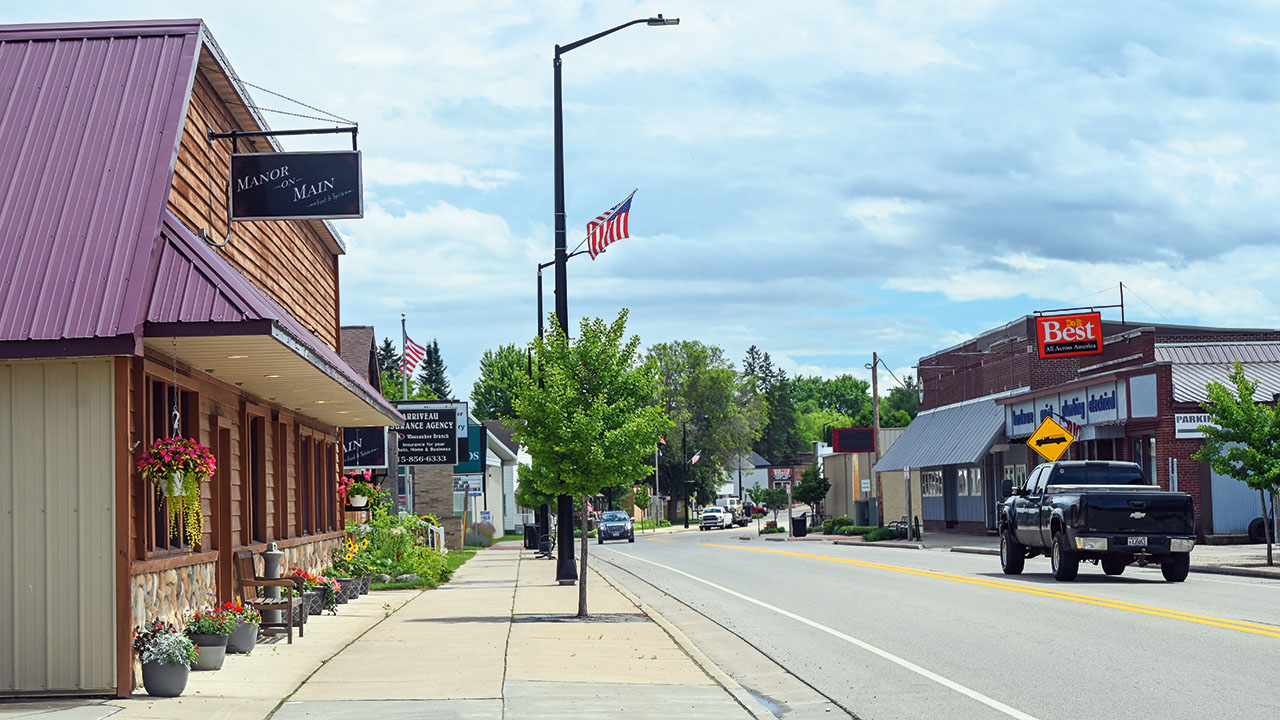

Communities throughout Marinette County are working to create the housing and infrastructure needed to support a growing workforce while repurposing properties that could help fuel future investment.
The city of Marinette is using Tax Incremental Districts (TIDs) to drive development, says Jan Kust, mayor’s assistant and community development specialist for the city of Marinette.
Kust says the city has created seven new TIDs over the last several years, “which maybe for a large city is not a huge thing, but for a small city like Marinette, it’s gigantic.”
The latest, TID No. 20, was created Aug. 17 and lays the groundwork for future downtown redevelopment. It encompasses roughly six acres including Marinette’s city hall and police station, which the city plans to relocate to the former Army National Guard Armory next summer.
The $10 million relocation project will create a mixed‑use redevelopment opportunity downtown.
“It’s business, it’s housing, it’s everything that the downtown needs,” Kust says.
Another successful TID has been TID No. 13, a 33‑acre rehabilitation and conservation district created in 2016 to provide development incentives at Marinette’s Pine Tree Mall. Kust says the city has worked with property owner Ned Brinkman of Midland Management to revive the once‑struggling mall with the addition of national retailers such as Ashley Furniture opening in November and Hobby Lobby opening in February.
“By that time, we will have all the room in our almost extinct mall up and running and fully functioning,” Kust says. “I’m very proud of the teamwork that we’ve done with our developers in the area.”
Focus on housing
Marinette County, Wisconsin’s third largest county by land mass, continues to face a housing shortage, says Marinette County Development and Tourism Director Autumn Timblin. Demand is being driven in part by major employers like Fincantieri Marinette Marine that bring contractors and new workers to the area.
“We have a lot of people traveling from outside of our area to come into our community to work,” Timblin says.
Timblin notes that a lack of smaller single‑family homes and multifamily units limits opportunities for older residents to downsize and for younger families to access starter homes. Rising prices, a shortage of affordable options and aging housing stock are contributing factors.
“In a lot of our rural communities we’re also starting to see a lot of second homes or rental properties, which for tourism is a fantastic thing. But on the flip side of that, the housing stock takes a hit,” Timblin says.
In the city of Marinette, Kust points to two recent successes: The Reserve, a 108‑unit apartment complex developed by Midwest Expansion that was completed in 2025, and the redevelopment of the former Bay Area Hospital site, led by Tycore Built, into the Shipyard Estates development that includes 174 apartment units and 22 new homes.
Outside of Marinette, two communities’ housing efforts have gotten recent boosts through grant funding. In 2024, the village of Wausaukee and the city of Peshtigo received planning assistance and access grants through WEDC’s first Thrive Rural Wisconsin cohort, which the communities are using to advance workforce housing projects.
Timblin says both communities have conducted community listening sessions, identified properties and had site plans developed by Green Bay‑based Cedar Corporation.
Wausaukee obtained an additional $1.6 million federal HUD grant to assist with an estimated $2.4 million in infrastructure costs at its development — High School Hill workforce housing. The proposed plan would allow for a total of 87 housing units — single family homes, duplexes, triplexes and townhomes — within 48 separate lots.
While Peshtigo is in the process of applying for additional funding to move its development into the next phase, Wausaukee is actively pursuing developers, Timblin says.
“It’s a hard push in rural communities to find [developers] who will come in and take a stab at housing development,” Timblin says. “The village of Wausaukee has a very small population, so it’s a lift to be able to get developers to see the need in the area.”
PFAS funding
In September, Wisconsin’s Joint Committee on Finance approved the release of approximately $10 million from the state’s PFAS Trust Fund to address drinking water contamination linked to Tyco Fire Products LP’s Fire Technology Center in Marinette. The funds, provided by Tyco as part of a June settlement, will be used by the Wisconsin DNR to provide safe drinking water to Marinette and Peshtigo residents affected by the contamination, including testing and replacing contaminated wells and installing water treatment systems.
Childcare expansion
Shine Bright on Main childcare center plans to expand its 2,000‑square‑foot facility in Coleman. The $300,000 expansion is supported by a $147,300 Wisconsin Economic Development Corp. grant that will increase the center’s licensed capacity from eight children to 47 and will add after‑school care. The project is expected to be completed by the end of 2027 and will add seven to eight staff positions.
UWGB‑Marinette campus
The Marinette County Board has given a special committee nine months to explore new uses for the former University of Wisconsin‑Green Bay, Marinette campus which ended in‑person classes in 2024. Private investors have shown interest in two parcels, says board chair John Guarisco. The county board voted not to retain ownership of the campus once a future use is established. “We don’t want to be landlords,” Guarisco says. “In a perfect world whoever the suitor is would use the buildings, and we would use the money to repurpose it and take the burden off Marinette County taxpayers.”