
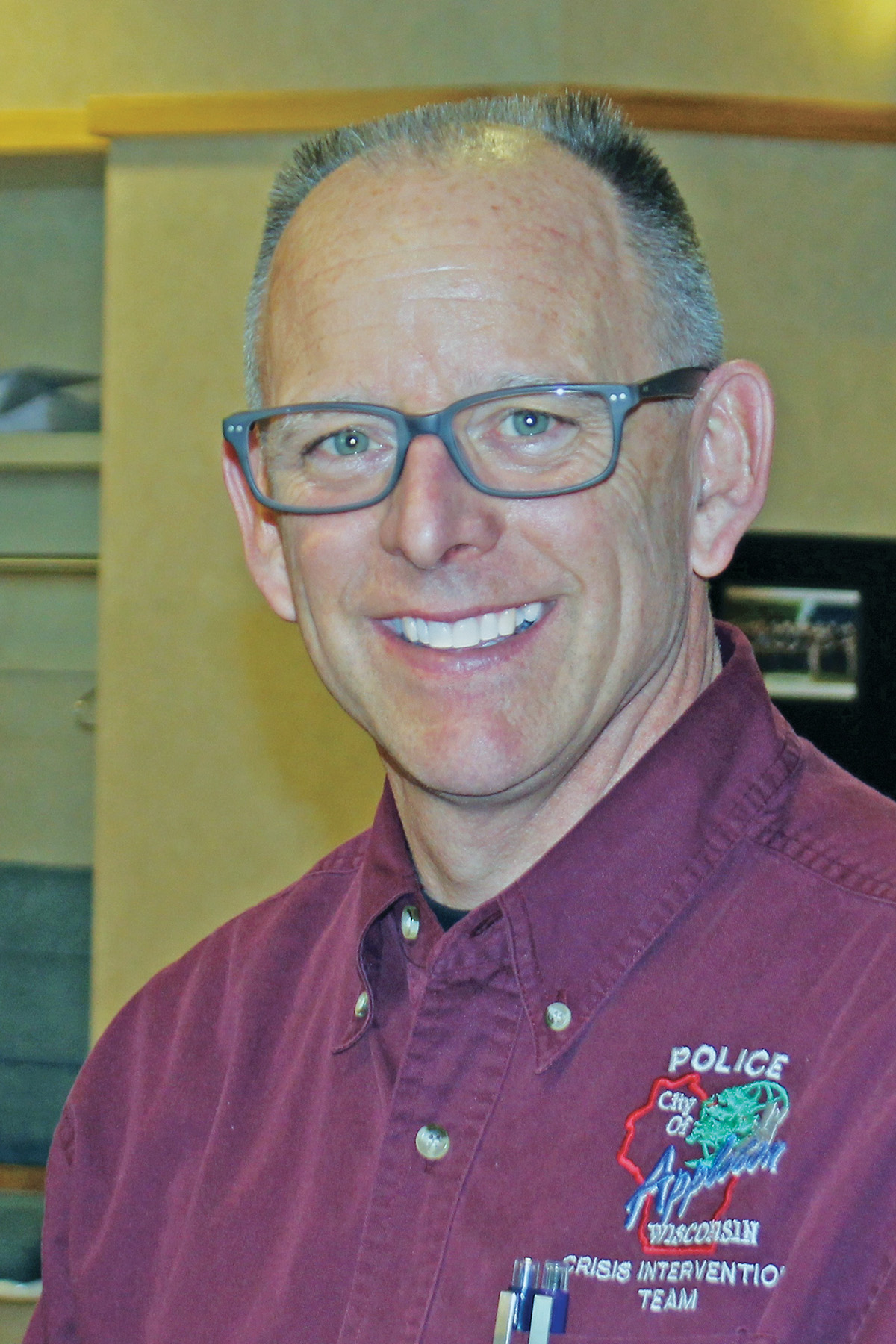

When John Wallschlaeger decided to become a police officer after a 20-year career in the automobile industry, he was surprised to see the disconnect between law enforcement and mental health care.
“Coming out of the private sector going into law enforcement, it seemed like health care didn’t interact with crisis services very well. It seemed to me that it should be easier to get mental health help,” he says.
That observation led to a dedication to fostering healthier, more productive interactions between law enforcement and individuals with mental health struggles. In 2004, Wallschlaeger traveled to Ohio to receive Crisis Intervention Team training. CIT promotes safe and humane responses to those experiencing mental health crises. Later in 2004, Wallschlaeger helped bring the first CIT class to Wisconsin.
Within law enforcement, crisis interactions make up about 20% of a typical agency’s time, Wallschlaeger says. In the past, officers often would wind up taking people to jail because they didn’t know what else to do with them, he says.
CIT training teaches officers to de-escalate crises. That begins with recognizing that police officers instill fear in a lot of people and taking steps to minimize that. For example, an officer might sit down next to someone who’s struggling and have a conversation versus standing over them.
Through CIT work, individuals can get connected to better care, Wallschlaeger says. “Maybe we can help them get those better days. And if they have those better days, then they’re not going to be a call for service.”
Now retired from police work, Wallschlaeger serves on the CIT International board and does consulting work, including through the National Criminal Justice Training Center at Fox Valley Technical College. He continues to be a champion for mental health care — including working closely with Samaritan Counseling Center, which is set to open a new, expanded facility in Menasha this summer.
“The generosity of the Fox Cities has made [the expansion] possible. We’ve all seen the impact of the stress of the pandemic,” he says.
— Jessica Thiel
The future is now
Volatus Infrastructure, LLC, in partnership with Wittman Regional Airport and Greater Oshkosh Economic Development Corp., announced plans for a permanent electric Vehicle Takeoff and Landing (eVTOL) vertiport. The vertiport, which is a location designed to support eVTOL aircraft, is being built at Wittman Regional Airport and will include a terminal with amenities, a landing pad and a vehicle-agnostic charging station. It’s expected to be completed in the coming months.
Medical research boost
A new research collaboration between the University of Wisconsin-Oshkosh and the California-based biotech company Fauna Bio seeks to translate disease resistance strategies found in the animal kingdom into new treatments for human disease. Fauna Bio has provided a $500,000 sponsorship that increases UWO’s capacity for biomedical collaborations and helps establish the university as a destination for researchers looking to study emerging animal models.
Help for the helpers
United Way of Wisconsin will receive $1.12 million in U.S. Senate-directed funding through the passage of the Federal Omnibus Bill. The funds will support efforts to reconfigure the existing 211 statewide referral infrastructure, managed by United Way with statewide and local partners, as an information exchange system to maximize social and mental health care coordination and referrals across Wisconsin. 211 provides confidential, judgment-free, round-the-clock interactions with trained specialists who can help people find resources available in their communities. 211 Wisconsin has fielded 350,000 requests over the past year.