
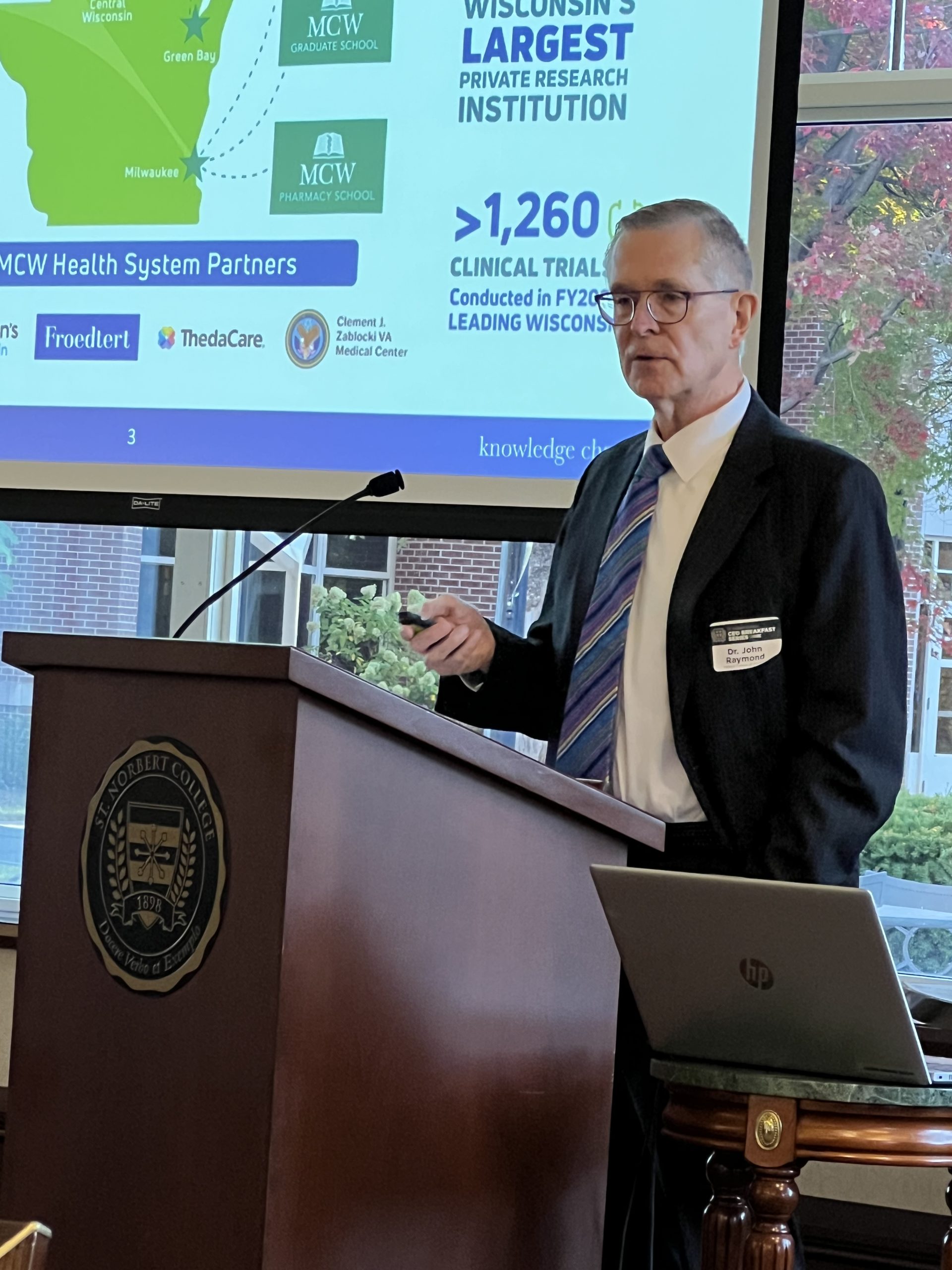
Students graduating from the Medical College of Wisconsin’s campuses in De Pere/Green Bay and Wausau are helping to address rural health care disparity in the state, says Dr. John Raymond, president and CEO of the Medical College of Wisconsin.
Raymond was the first speaker of St. Norbert College’s 2025-2026 CEO Breakfast Series, which kicked off Thursday morning on the campus.
At the breakfast, Raymond spoke about the Medical College of Wisconsin’s role as an economic engine in the state and gave an overview of the impact of the college’s expansion from Milwaukee to De Pere/Green Bay and Wausau on addressing health care gaps in underserved and rural populations.
“We needed to address not just the health care workforce shortage with the maldistribution in the northern part of the state, not just the primary care, but of specialties,” Raymond says.
The disparity is expected to grow as both the patient and health care worker population continues to age. “So you’re seeing that we’re going to have a tsunami of chronic age-related health conditions to deal with, and that that is primarily manifesting itself in the northern part of the state,” Raymond says.
With rising student debt, the regional campus programs become even more important, Raymond says. “Students know that if you practice in an under-resourced and underserved area, you’re not going to make as much money … by having a three-year option, you’re reducing their debt burden and preserving their choices.”
The MCW Board approved the regional campus concept in 2012, and the program now has a track record of success. “The graduates have a 100% placement rate in residency programs, many of them who choose to leave for the residency place at the top programs in the country,” Raymond says. “And what’s beautiful is many of them have decided, after they do these world-class residencies, to come back and practice here.”
For example, more than half of the students who graduated from the campus have decided to practice in Wisconsin’s northwoods. There have been 184 graduates from MCW-Green Bay and 113 from MCW-Central Wisconsin. Sixty percent of MCW graduates overall stay to practice in Wisconsin.
Raymond displayed county maps demonstrating that northern counties and urban areas of Madison and Milwaukee “bear the disproportionate burden of health care worker shortages,” in mental health, primary care, specialty care, dental health and OB-GYN care.
“There are regions in the state that do not have a single OB-GYN provider, not a doctor, not an APN (advanced practice nurse) … It’s not right that a woman might have to drive 90 minutes or two hours to get obstetrical care,” Raymond says. Twenty counties lack any OB-GYN providers, and earlier this year, ThedaCare announced it was closing its Waupaca labor unit.
The state is facing a similar concern with psychiatry, though the industry is making inroads with telepsychiatry, and MCW has two new rural mental health residencies — the first two psychiatric residencies in the country to be based in rural areas.
“Just by opening those two programs, we increase the number of psychiatric graduates in Wisconsin by 70 percent,” Raymond says. “We’re also fighting to expand the scope of practice of non-physician providers.”
Shortages have reached nurses, respiratory therapists, and support staff for cleaning rooms and serving food to patients. “So we need to really address the entire spectrum of the health care workforce shortage,” he says.
There have been additional setbacks in the state, such as HSHS Prevea system closing their hospitals in western Wisconsin in 2024, creating a crisis for mental health care and emergency room services, Raymond says. But health care systems are also stepping in to fill the gap, ramping up telemedicine and using AI to help manage and identify high-risk patients.
“The Wisconsin legislature has dedicated real dollars to addressing that crisis in western Wisconsin, and people are banding together,” he says. And a new Wisconsin High Value Network led by Cibolo Health is allowing small hospitals and clinic networks in the region to share contracts and support functions. Chippewa Valley Cooperative Hospital is beginning to offer care this fall, helping to fill the void from HSHS leaving, Raymond says.
Raymond also spoke about:
-
A new $5 million CDC grant secured by Dr. Anna Palatnik, professor of obstetrics and gynecology, to address health disparities in perinatal and prenatal care primarily in African American women in the central city area of Milwaukee. “There’s a lot of anti-DEI rhetoric and a push from the federal government to make caring about people of color not something worthwhile,” Raymond says. “We’re leaning into health disparities.”
-
MCW’s renovation of the former Gimbel’s/Shuster’s department store building on Martin Luther King Jr. Drive, now offering community space, a healthy foods program, a JobsWork MKE employment agency and an organ donation and blood procurement center focused on African American patients. The area is “where our roots were, and we really didn’t have a huge presence there,” Raymond says.
-
The new Forensic Science and Protective Medicine facility is scheduled to open next year, bringing the Milwaukee County Medical Examiner’s Office, Office of Emergency Management, Milwaukee Crime Lab and other facilities under one roof. “There are only two or three centers like this in the entire country,” Raymond says.
-
The new MCW Center for Cancer Discovery building that opened Aug. 5. The $50 million facility is the only dedicated cancer research facility in the state of Wisconsin.
This was Raymond’s third time as a St. Norbert CEO breakfast speaker. Raymond was named to the 2025 Wisconsin Titan 100 Hall of Fame.
The next CEO Breakfast speaker will be Jeanne Stangel, president and CEO of Curative Connections, on Dec. 11. Insight Publications and WHBY 100 are sponsors of the breakfast.