
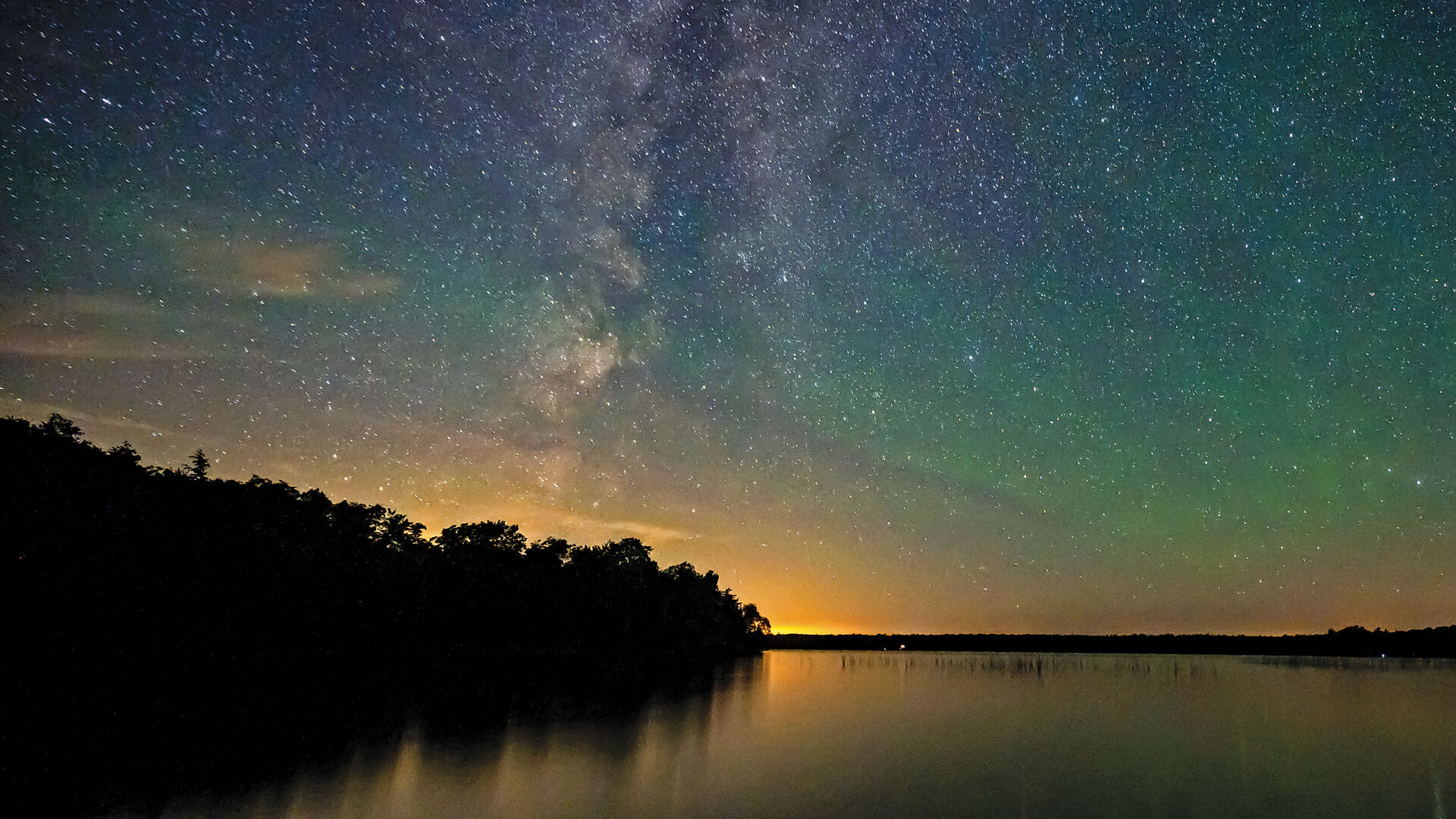

Door County’s Newport State Park is the state’s only DarkSky park designated by the International Dark-Sky Association.
Dan Eggert
Each year, Wisconsin state parks, trails, forests and recreation areas see upwards of 20 million visits — and that’s something to celebrate.
For the past 125 years, the state park system has not only protected and preserved some of Wisconsin’s most precious natural resources, it’s also been an economic driver that continues to attract more and more visitors each year.
This year, visitors to Wisconsin state parks will have an opportunity to attend some special events and activities planned for the system’s 125th anniversary, including a Free Fun Weekend June 7-8 and a dedicated celebration day in September, according to Travel Wisconsin.
Local parks are also finalizing some celebratory events, which will be free but require a state park vehicle admission pass.

“It’s kind of exciting to see that we’re having our 125th anniversary as the Wisconsin state park system,” says Eric Hyde, park superintendent – Peninsula, Newport and Rock Island state parks in Door County. “We have such a robust park system and our state forest throughout the state. It’s just important for a lot of folks that don’t necessarily have access to really good recreational options.”
These parks, along with Door County’s other state parks — Potawatomi and Whitefish Dunes — are a big reason why people visit the county, Hyde says.
“We have a population in the county like around 30,000, and still a lot of those amenities that you wouldn’t picture for a county that size — the restaurants, the wineries, the breweries, all the inns and B&Bs,” Hyde says. “That’s a lot of folks coming here to just see how beautiful the county is and the state parks are.”
———————-
125th anniversary celebrations
Stay updated on local and state events: dnr.wisconsin.gov/topic/parks/125years
———————-
The parks through history
In 1878, Wisconsin set aside about 50,000 acres of timber land in the northern part of the state as a “State Park.” The legislature dissolved the effort in 1897, but many state residents were still interested in having the state preserve significant areas. In 1900, the first Wisconsin state park — Interstate, located on the St. Croix National Scenic Riverway — was officially established.
Within the 18-county New North footprint, there are about two dozen state parks, trails and forests, each with its own special features — including the popular High Cliff State Park.

High Cliff, which is along Lake Winnebago in Calumet County, became a state park in 1956. It saw more than 700,000 visitors in 2024, making it the fourth-busiest park in the state, says Jay Vosters, natural resources property supervisor for High Cliff State Park.
“Looking at the past 25 years, it’s been a steady increase in visitation,” Vosters says. “I think some of it is just because it’s a state park that’s so close to so many municipalities.”
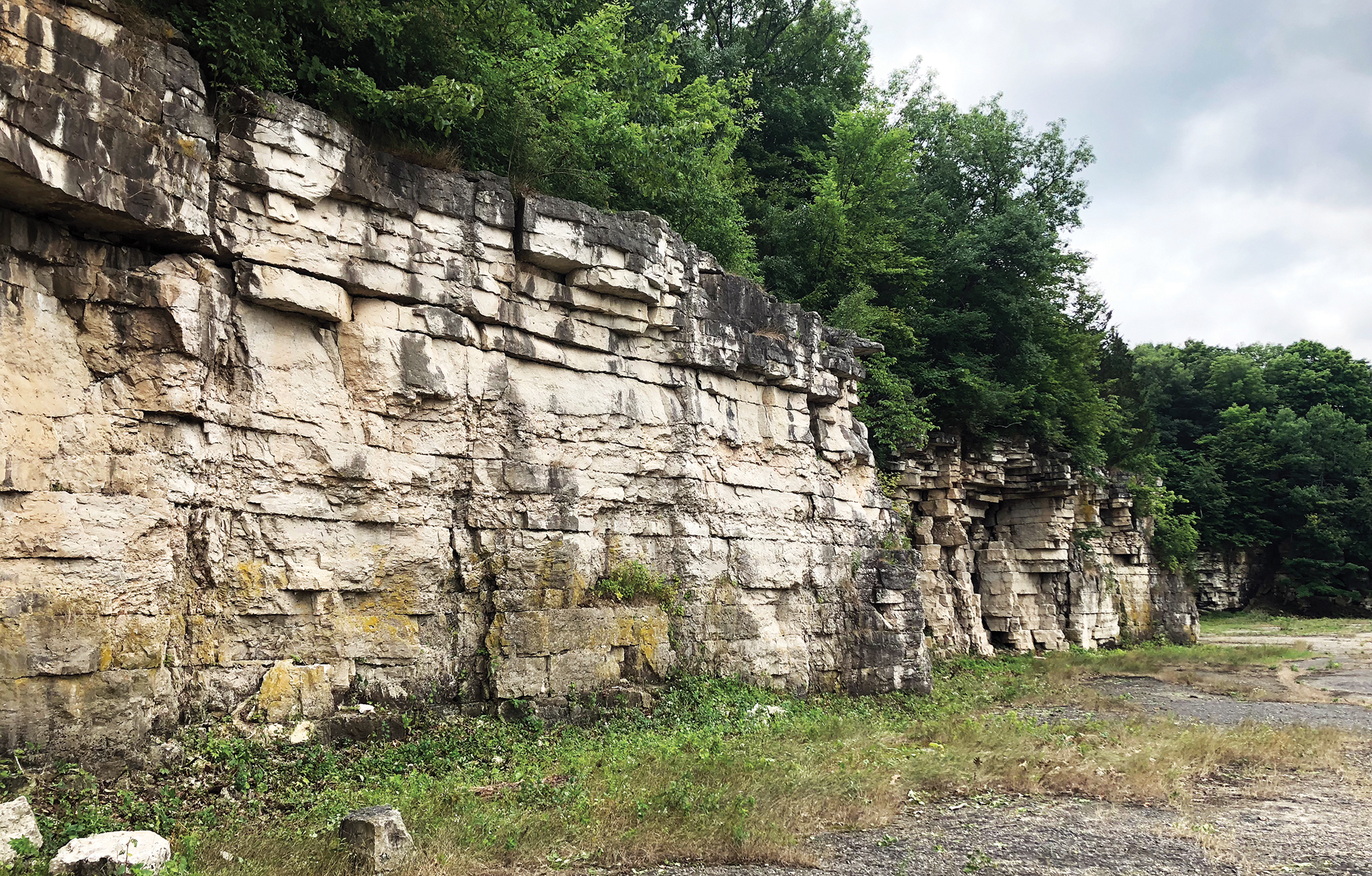
High Cliff is the only state park on Lake Winnebago and includes the Niagara Escarpment, a special geologic feature and UNESCO World Heritage Site that starts in South Central Wisconsin and curves into Canada to Niagara Falls.
The park frequently receives international visitors — including those interested in the pre-settlement Native American effigy mounds, few of which are still intact around the country.
High Cliff also is an attraction for history buffs as “some of the buildings are left from when they were doing coring and mining here,” Vosters says.
While part of the cliff was blasted out for stone, that blasting revealed 400-million-year-old stromatolite fossils from the days when Wisconsin was located south of the equator. “I think it’s pretty cool — stromatolites are the creature that transformed our atmosphere into oxygen, so existence owes it to this creature,” Vosters says. “It’s pretty humbling to be able to look at it with your own eyes.”
Value to ecology
High Cliff is also highly significant in area ecosystems, as home to endangered Rusty Patched bumble bees and threatened Henslow’s sparrows.
“This is one of the state hotspots for warbler migration in spring, and that’s on its way — pretty soon we’re going to be just inundated from people from all over coming to see the warblers,” Vosters says.
Winnebago shoreline is virtually all developed, except for the two-mile stretch within High Cliff, making it an important rest stop for migrating birds.
“A lot of people that live around the area, they just kind of think about High Cliff like, ‘Oh, it’s the local state park,’ but the significance of what this area is, is far greater than that,” Vosters says.
———————-
Tourism by the numbers
As a whole, Wisconsin tourism generates $25 billion in economic impact for the state, with outdoor recreation being a top driver for that impact, according to Travel Wisconsin.
The U.S. Bureau of Economic Analysis (BEA) found Wisconsin’s outdoor recreation industry (not exclusive to state parks or outdoor tourism) contributed $11.2 billion to Wisconsin’s GDP in 2023, reflecting all activity within the outdoor economy, including manufacturing, retailers, guides, outdoor-related travel, tourism and more.
———————-
Visitors help fund the parks
While recent spending cuts at the federal level have affected employment and budgets at the National Park Service, Wisconsin state parks remain largely unaffected. While a few state parks — including Hartman Creek State Park on the western side of the New North region — contain sections of the Ice Age National Scenic Trail, which falls under the purview of the National Park Service, most state parks don’t receive regular federal funding.
“We do see some federal dollars that come in for some of our larger capital development projects, but as far as I know we don’t seem to be affected as of right now,” Hyde says.
The state park system’s operating budget is fully funded by camp reservations, 12-month sticker sales and daily entrance passes, as well as some concession payments, Hyde says. The state eliminated general purpose revenue funding for park operations in 2015.
“It’s definitely a curse not being able to get any tax money to fund the state parks — we could use the money,” Vosters says. “But at the same time, when this is happening, that’s our insulation, because we’re not tied to that money. I know there are some grants that may affect some parks, but for the most part I think we’ll be okay.”
———————-
Wisconsin state parks at a glance
Number of parks: 50 parks, plus 15 state forests, and 44 state trails
Newest park: Lizard Mound State Park in West Bend, opened in 2022. Like High Cliff, the park contains Native American effigy mounds.
Most visited and largest: Devil’s Lake State Park at just over 9,200 acres in Sauk County, with more than 2.4 million visits in 2024
Smallest: Tower Hill State Park near Spring Green at 77 acres
———————-
Friends matter
Wisconsin state parks rely strongly on volunteer “Friends” groups that are passionate about their local parks to fundraise for projects and renovations to keep amenities updated for visitors. These groups also support naturalists and other programming, as well as coordinate volunteering on park projects such as trail restorations, tours and camp hosting.
“To get things done we need donations, and we need partners to make those things happen,” Vosters says. Currently, the Friends of High Cliff is helping the park update the popular Lime Kiln Trail, which Vosters says has needed work since the mid-1950s.
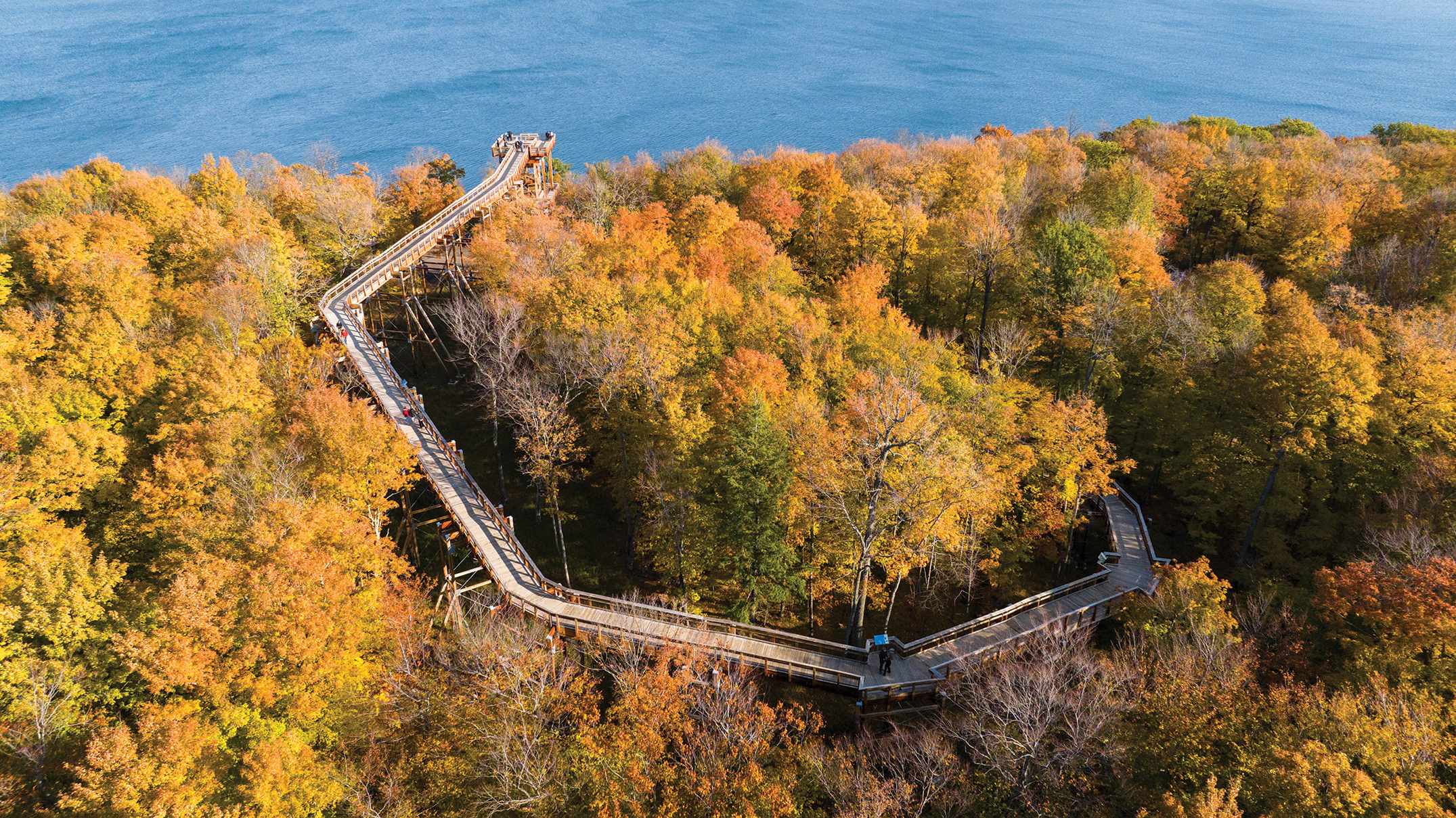
Hyde says the three Door County state parks each has its own Friends group, including the Newport Wilderness Society, Friends of Rock Island State Park and Friends of Peninsula State Park. The Peninsula group raised more than $750,000 to complete a significant recent update: the Eagle Tower replacement. It’s the third iteration of a tower first built in 1914, and the new version includes an 850-foot accessible ramp.
“It’s really a unique experience — you’re not just climbing up the stairs; you’re actually like walking through the forest canopy,” Hyde says. “That’s definitely been a big hit, and gives people a cool perspective.”
Peninsula, established in 1909, saw 1.35 million visitors in 2024. It has amenities including a full-time summer theater that has operated since the 1970s performing original plays, as well as hiking trails and eight miles of mountain bike trails that opened in fall 2024, with another 11 miles planned.
The Friends group has raised more than a million dollars for the new mountain bike trails and helped with fundraising to expand the park’s nature center, Hyde says.
“Peninsula [State Park] is known as the most complete state park,” Hyde says. “It offers almost all the recreational opportunities that people think about in Wisconsin, including being the only state park with a golf course.”
It includes scenic bluffs, a lighthouse and 468 camp sites, “so it’s definitely one of the busiest state parks in Wisconsin,” Hyde says. On the flip side, Door County also is home to Newport State Park, formed in 1964, which is a wilderness park and the only park in the state to be designated a DarkSky park by the International Dark-Sky Association. Newport attracted about 150,000 visitors in 2024.
The Newport Wilderness Society is working on providing a natural educational amphitheater with a formal seating area to accommodate dark sky programming as well as enhanced accessibility.
Rock Island State Park, established in 1965, is “kind of a mix between all the Door County state parks, where we have the bluffs on the east side, nice sand beaches, some sand dunes, really cool historical buildings, the oldest lighthouse in Wisconsin and just a kind of a unique walk-in campsite opportunity,” Hyde says.
Rock Island also requires two ferry rides to reach, and as one of the more remote state parks it attracts between 15,000 and 20,000 visitors annually, Hyde says. Rock Island will have a new dock in 2026 and last year completed lead abatement, painting and restoration to the Thorardson Boathouse.
“Visitors who haven’t seen that in a few years will definitely be impressed by that,” Hyde says. “That’s probably one of the coolest buildings in the state park system; it’s really cool to see funding going into that to keep it up to shape and open to visitors.”
Wisconsin state parks provide a place where people can find their connection to nature, and having that connection can foster an interest in protecting the environment, Vosters says.
“When people come out here, it’s their happy place, right? Nobody ever comes out to High Cliff to say, ‘Their roads are in great shape, and their buildings just got new windows,’” Vosters says. “Everybody comes out here for the nature, the stuff that we can’t improve on. I say the place sells itself — we’re just here to help people enjoy it.”
———————-
Get your vehicle admission pass
The Wisconsin state park system this year changed from an annual (January-December) sticker to one that is valid for a full 12 months from your purchase date. You can learn more and buy your sticker here: dnr.wisconsin.gov/topic/parks/admission