
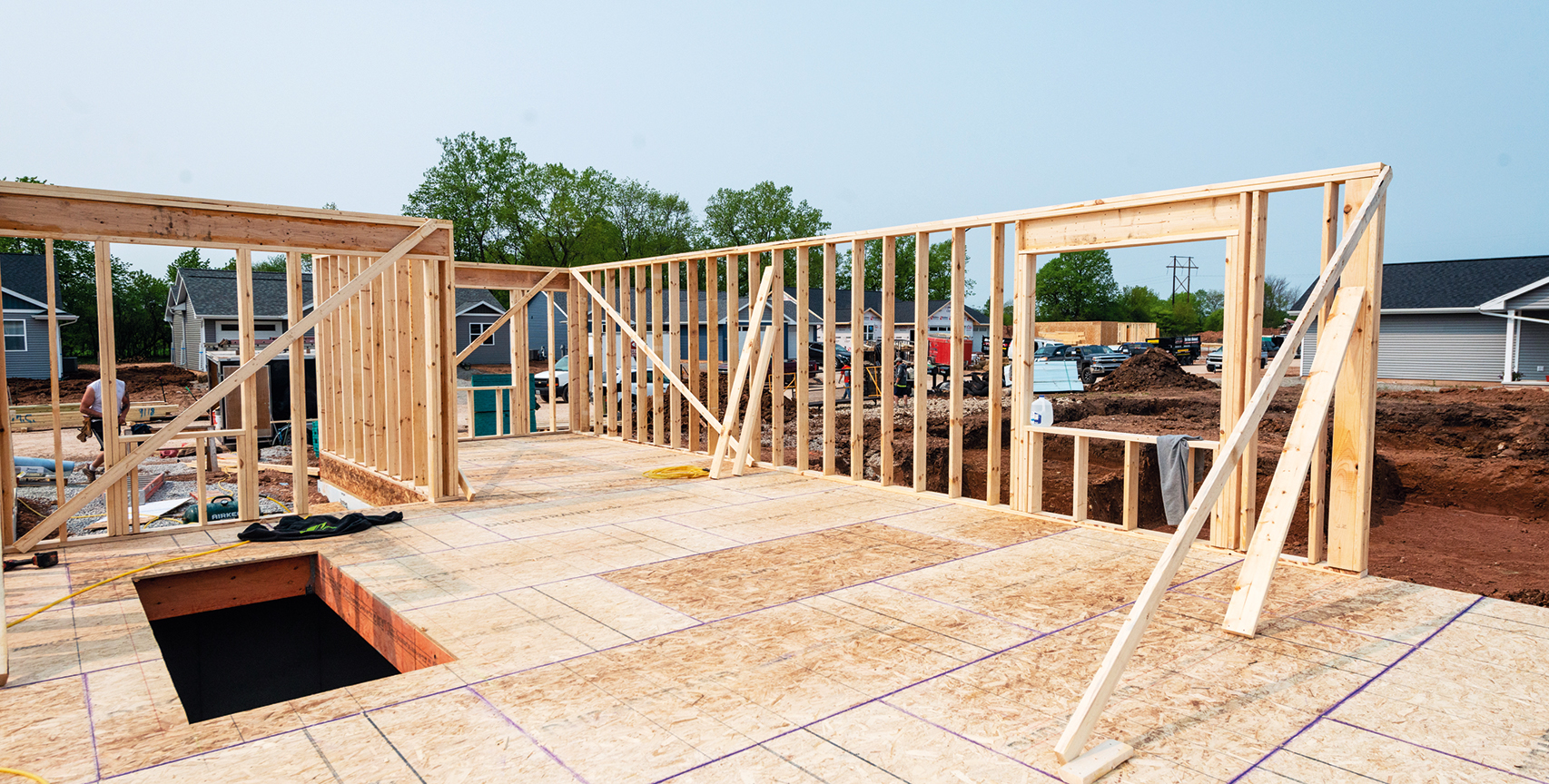

Several pieces of recent state legislation are clearing the way for communities and developers in Wisconsin to build more affordable housing options.
“We had a whole housing package of different bills that we were working on, all for the sake of workforce housing,” says Jennifer Sunstrom, the Realtors Association of Northeast Wisconsin’s director of public relations and government affairs.
One new law allows communities to create residential tax increment financing (TIF) districts specifically for workforce housing, Sunstrom says. TIF districts allow a community to pay for improvements with taxes on the increased property value within the district for a designated length of time.
In a workforce housing TID, homes must be either single family, with lot sizes that are 7,500 square feet or less, or two family homes with lot sizes not exceeding 12,500 square feet. Residences must not exceed 2,000 square feet. “So by that nature, what you’re trying to create is much higher density, smaller lots and smaller homes,” Sunstrom says.
This law is another way to help attract and encourage developers to create workforce housing. “Because it’s in a TIF district, the financing becomes more stable,” Sunstrom says. “Not only does it lower lot costs, but it creates predictability for the developer.”
Tom McHugh, owner of Tom McHugh Construction in Appleton, says while there are still questions, it could be a huge tool for development as taxes can be used to offset land development costs, particularly for rural communities.
“If you have a large lot, there’s no way to put a reasonable priced house on it … the home has to mesh with the lot, and this kind of gives a tool to be able to do that,” McHugh says.
Another piece of legislation — the Truth in Planning law, signed by Gov. Evers in early April — “goes to the heart of one of the most universal problems we’ve been having for a long time, and why we’re not getting housing units put up even regardless of the price,” Sunstrom says.
The problem was that zoning for particular parcels didn’t always match a community’s comprehensive plans, which means a developer often waited through a lengthy rezoning process that could get mired in not-in-my-backyard objections. That created uncertainty and financial risk for developers, Sunstrom says.
Now, comprehensive plans must identify residential growth location and density in 5-year increments over 20 years. At its core, the law essentially ensures that zoning is consistent with those plans, and when it’s not, it requires rezoning requests addressed in a timely fashion.
“What the Truth in Planning Bill is trying to do is just trying to provide more teeth, so to speak, to the original intention of the whole comprehensive planning law,” Sunstrom says.
The recently enacted Wisconsin Act 68 makes various changes to the plat review process, allowing a subdivider an opportunity to meet for a nonbinding pre-submission review, Sunstrom says.
Even preliminary engineering is expensive, and “no developer is going to want to spend another $40,000 to $80,000 for final engineering if they don’t even know if they’re going to get the plat approved in the first place,” Sunstrom says.
McHugh says the new legislation helps address risk and expense. “It’s not out of line that you could be into a subdivision for over $50,000 and still not knowing if the project is going to work or not. …You could spend $50,000 and then just walk away at the end,” he says.
Green Bay Mayor Eric Genrich says another new law aims to facilitate use of WHEDA loans for workforce housing development. The 2023-25 state budget earmarked $525 million for four different workforce housing loan programs, but they were “pretty difficult to use because the previous legislation had prohibited the utilization of those loans if they were in tandem with a TIF district,” Genrich says.
The new legislation, signed by Gov. Evers in April, “just makes those loan programs so much more accessible and practical for municipalities and for developers,” he says.
At the local level, the city also has worked to advance its own zoning reforms “in order to develop as much housing as we need, which is pretty daunting,” Genrich says. The city’s recent Green Bay Housing Market Study projects it will need between 2,100 and 4,575 rental units and 2,159 and 5,072 owner-occupied units by 2040.
The package approved by the common council included more than 90 reforms, says Genrich, including zoning to make it easier to build duplexes and triplexes in single family zoned areas. “So we’re looking forward to seeing that impact here,” he says, “hopefully in the near future.”