
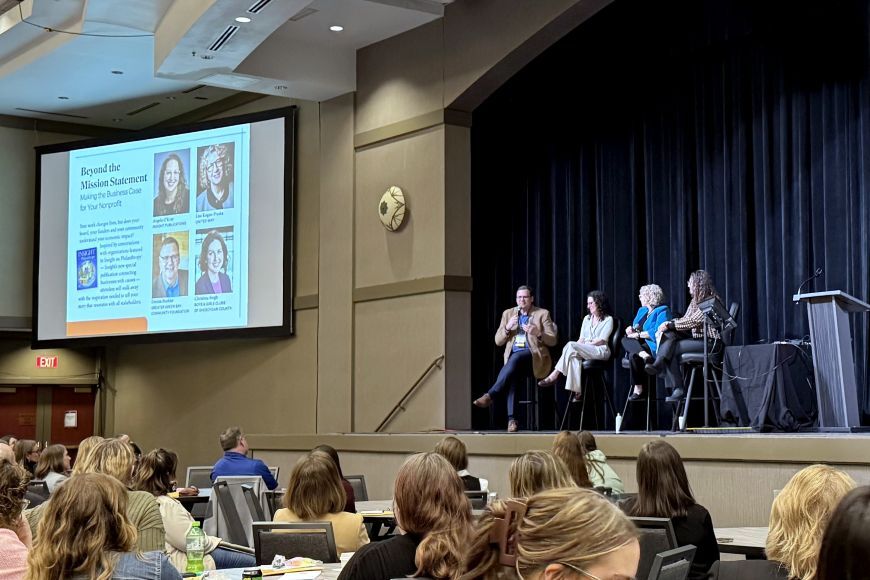

Dennis Buehler wants to talk about “the overhead myth.”
“A simple reduction in overhead does not mean you’re more impactful,” explained the Greater Green Bay Community Foundation CEO, speaking at the 2026 UW-Green Bay Nonprofit Leadership Conference April 16. “The conversation has to change with those who are investing: How are you staffing? Investing in technology? Using data? Everything you would in a for-profit business, if you will, to continue to improve your effectiveness?”
In a panel discussion moderated by Insight Publisher Angela O’Kray that concluded the day-long event at Oneida Hotel and Casino, Buehler, along with United Way Fox Cities CEO Lisa Kogan-Praska and Boys and Girls Clubs of Sheboygan County CEO Christina Singh, tackled the topic that was a focus of the inaugural issue of Insight on Philanthropy magazine: The need to start recognizing that nonprofits are businesses and that the third sector is a critical pillar of our economy — not just a “nice-to-have.”
This was the message conveyed in Insight’s November 2025 publication by Jody Levison-Johnson of the Social Current initiative “Five and Rising,” which aims to emphasize the U.S. social sector is responsible for 5.3% of GDP — ranking ahead of major industries including transportation, hospitality and construction. The need for respect for the sector’s economic impact was a topic O’Kray sought to further explore during the panel, and participants enthusiastically reinforced the message.
“We are solving the hardest problems, and yet, time and time and time again, we create a scarcity mindset in those that are tasked to do that work,” Kogan-Praska said, pointing out that her organization faces many or even most of the same challenges as for-profit companies: “Except I have to do it on a shoestring and I have to do it under scrutiny, and those are the two differences in our world.”
Panelists talked in particular about the need to be competitive and invested in the talent landscape. Singh says it was a revelation when she discovered that the local McDonald’s offered a better part-time starting wage than Boys and Girls Club offered part-time workers who were teaching and caring for children. Food service is hard work, she was quick to acknowledge, but the stakes of turnover by contrast are lower: “[Turnover] is bad for kids,” she said on the panel. “Kids need stable, consistent people in these roles, and every time I have turnover it’s not doing service to our mission.”
Singh says nonprofits can actually distinguish themselves as employers of choice without much sacrifice. Her organization has implemented overtime pay, unlimited sick leave and sabbaticals in addition to raising its wages.
“I honestly see nonprofits as pioneers in the space of, like, creating cultures and workplaces that people want to be in. I think we’re doing a better job of responding to the demands of Gen Z and Gen Alpha in terms of what they expect from their relationship with their employer and … what they want in a career,” she said.
“We’re never going to attract people solely based on pay to do this work,” Singh added, “but we need to take pay off the table as an issue.”
Kogan-Praska agreed.
“Compensation matters,” she said. “Being in the nonprofit sector, you still want to drive a nice car, you still want to retire, you still want to send your kids to college, and somehow, we feel like people should make a sacrifice to work in the sector. And I think we need to start to shift the mindset on that and understand that compensation does matter. I hate it when I think about if I have a talented team member that has to leave the sector to go work for a for-profit, doing similar work, to make $20,000 [more]. I mean, it doesn’t compute to me that I’d lose talent for that.”